
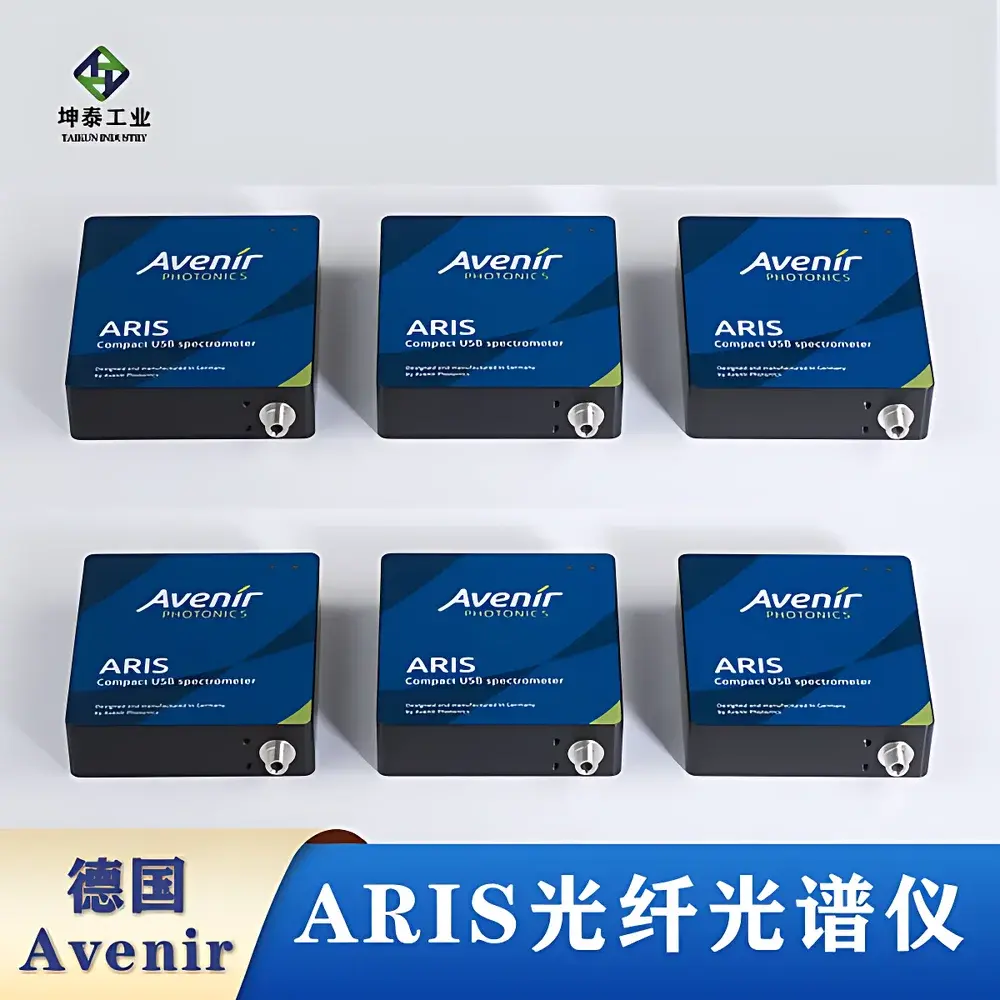
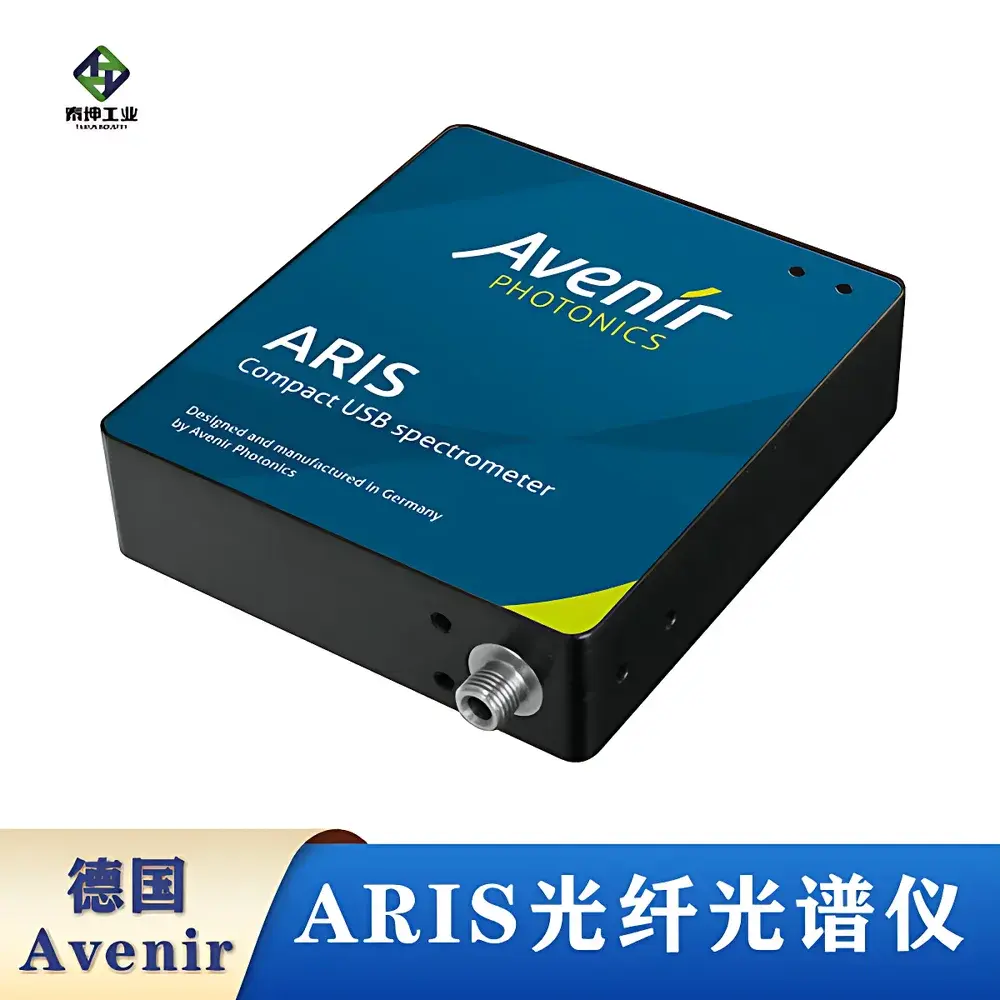
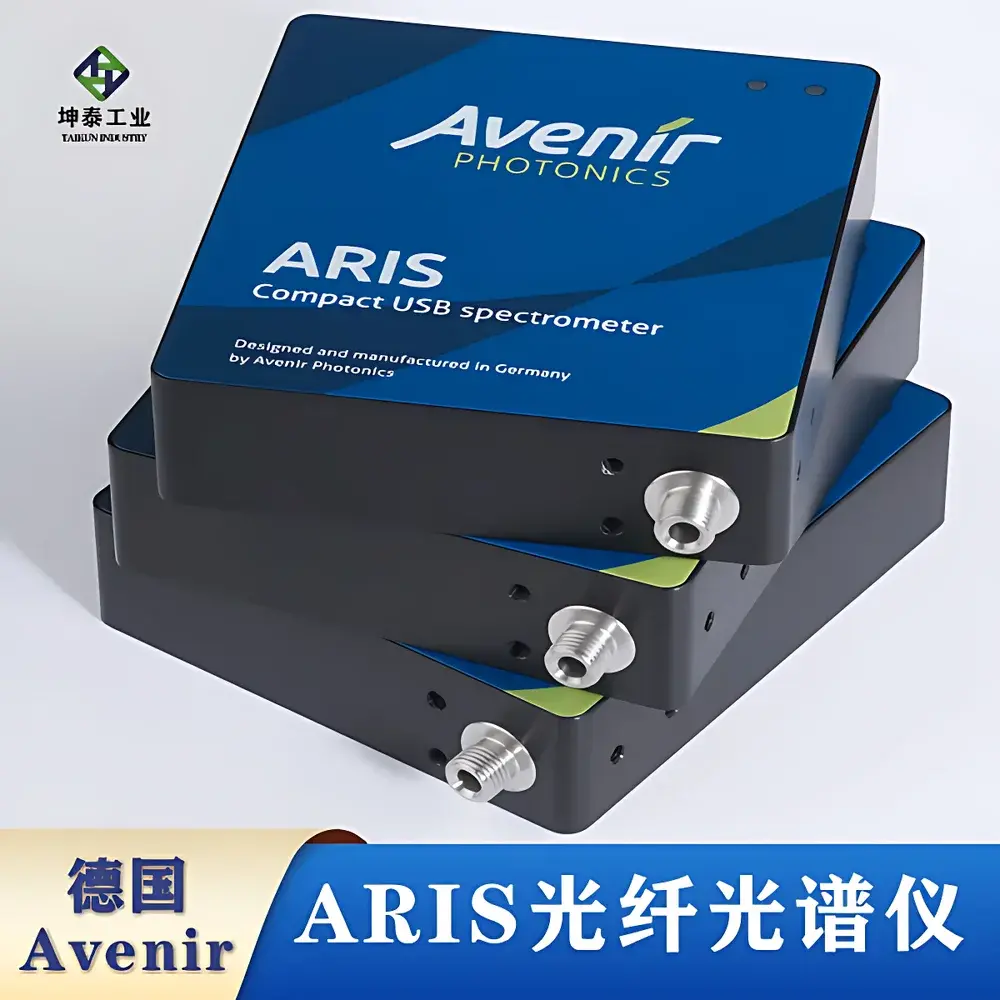
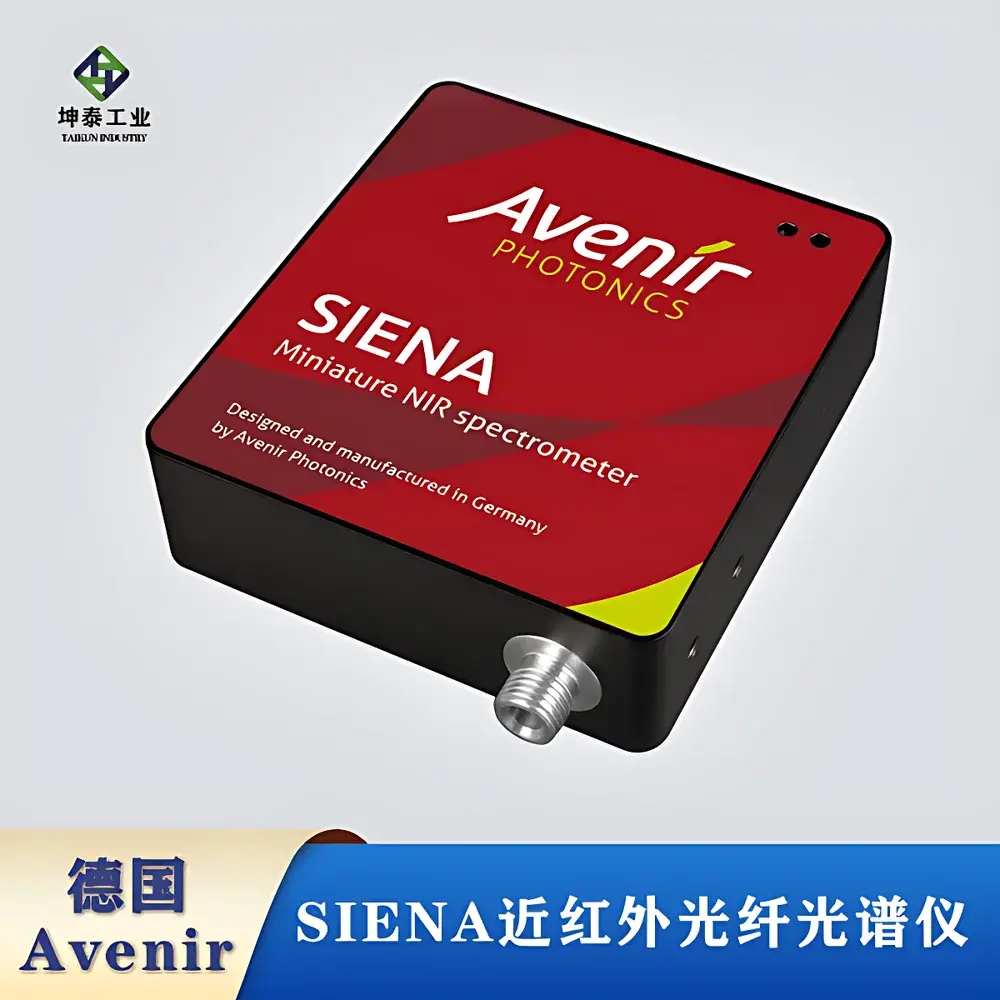
Avenir Photonics ARIS Portable Fiber Optic Spectrometer
| Brand | Avenir |
|---|---|
| Origin | Germany |
| Manufacturer Type | Authorized Distributor |
| Import Status | Imported |
| Model | ARIS |
| Spectral Range | 185–970 nm, 185–550 nm, 185–420 nm, 350–840 nm, 510–1020 nm |
| Detector Type | CCD |
| Optical Resolution (FWHM) | 0.33–1.40 nm |
| Signal-to-Noise Ratio | 350 or 600 (max, unaveraged) |
| Dynamic Range | 1900:1 or 5000:1 |
| Stray Light | < 0.08 % |
Overview
The Avenir Photonics ARIS Portable Fiber Optic Spectrometer is a compact, high-performance spectroscopic instrument engineered for precision optical measurement in demanding field, industrial, and embedded applications. Based on a symmetric high-throughput Czerny-Turner optical architecture with a 50 mm focal length and f/6.3 optics (NA = 0.16), the ARIS delivers laboratory-grade spectral fidelity in a ruggedized 67 × 74 × 19 mm package weighing only 122 g. Its core measurement principle relies on dispersion of incident light via interchangeable diffraction gratings onto a linear CCD array—either the Toshiba TCD1304DG (3648 pixels) or Hamamatsu S11639-01 (2048 pixels)—enabling accurate intensity-resolved wavelength analysis across five standardized spectral bands. The system operates without external cooling and maintains stable photometric response over its operational temperature range of −20 °C to +60 °C, making it suitable for continuous deployment in non-climate-controlled environments.
Key Features
- High optical throughput design delivering 2×–4× higher sensitivity than comparable spectrometers in its class
- Stray light suppression < 0.08 %, enabling reliable absorbance measurements up to OD 3.5+ in UV-VIS-NIR configurations
- Five factory-configurable spectral ranges: 185–970 nm (broadband), 185–550 nm (UV/VIS), 185–420 nm (deep UV), 350–840 nm (VIS), and 510–1020 nm (VIS/NIR)
- User-replaceable entrance slit (default 20 µm); optional wider slits available to trade resolution for increased signal throughput
- Onboard 16-bit ADC (2 MHz sampling), real-time auto-exposure control, spectral averaging, dark/reference subtraction, and nonlinearity correction
- Integrated order-sorting filters and SMA fiber-optic interface (custom connectors available upon request)
- USB 2.0 Full-Speed interface with Type-C connector; optional UART, SPI, and I²C digital interfaces for OEM integration
- Low power consumption (< 70 mW) and wide input voltage tolerance (4.4–5.5 V) support battery-powered and industrial bus-powered operation
Sample Compatibility & Compliance
The ARIS spectrometer is compatible with standard 200 µm–600 µm core silica optical fibers terminated with SMA-905 connectors. It supports direct coupling to halogen, deuterium, LED, and pulsed laser sources—provided appropriate attenuation and filtering are applied per application requirements. All configurations comply with EU directives 2014/30/EU (EMC), 2011/65/EU (RoHS), and REACH SVHC regulations. The device meets general-purpose electromagnetic immunity standards for industrial environments (IEC 61326-1 Class A) and contains no conflict minerals as defined under U.S. Dodd-Frank Section 1502. While not certified for GMP/GLP environments out-of-the-box, its onboard audit trail features—including timestamped exposure logs, firmware version tracking, and raw spectral buffer metadata—support traceability when integrated into validated workflows aligned with ISO/IEC 17025 or FDA 21 CFR Part 11 requirements.
Software & Data Management
The ARIS ships with Windows-compatible application software (Windows 7+) providing real-time spectrum acquisition, calibration management, peak identification, and basic chemometric tools. A comprehensive SDK includes C/C++, Python, and LabVIEW libraries with full API documentation, enabling custom algorithm development for inline process monitoring, material classification, or spectral fingerprinting. All spectral data is stored in vendor-neutral formats (CSV, HDF5) with embedded metadata including exposure time, grating ID, slit width, detector model, and temperature-compensated wavelength calibration coefficients. On-device spectral buffering supports up to 63 consecutive spectra (Hamamatsu variant) with sub-millisecond inter-scan intervals—critical for kinetic studies or feedback-controlled systems.
Applications
- Industrial process monitoring: Real-time colorimetry, LED binning, plasma emission analysis, and thin-film thickness verification
- Environmental sensing: UV index measurement, water quality assessment (COD, NO₃⁻, chlorophyll-a), and atmospheric gas detection via DOAS
- Academic and teaching labs: Low-cost platform for spectroscopy education, fluorescence lifetime estimation, and absorption kinetics
- OEM integration: Embedded spectral engine for handheld analyzers, agricultural sensors, and portable medical diagnostics devices
- Quality control: Incoming raw material verification, pharmaceutical excipient screening, and packaging film characterization
FAQ
What spectral resolution can be achieved with the ARIS?
Resolution depends on selected grating, entrance slit width, and detector pixel pitch. With the default 20 µm slit and Toshiba TCD1304DG sensor, FWHM values range from 0.33 nm (UV configuration) to 1.40 nm (broadband). Larger slits improve sensitivity but reduce resolution proportionally.
Is the ARIS suitable for UV-curable resin monitoring?
Yes—the 185–420 nm deep-UV configuration enables real-time tracking of photoinitiator absorption decay during curing, provided proper quartz fiber and UV-transmissive optics are used.
Can the ARIS operate independently without a host PC?
It requires a host for initial setup and data export, but all signal processing—including auto-exposure, dark correction, and spectral averaging—is performed onboard using its embedded microcontroller.
How is wavelength calibration maintained across temperature variations?
Each unit includes a factory-measured thermal drift coefficient and built-in thermistor. The SDK provides functions to apply real-time correction based on measured detector temperature.
Are NIST-traceable calibration certificates available?
Yes—certified wavelength and radiometric calibrations (traceable to PTB and NIST standards) are offered as optional accessories with documented uncertainty budgets per ISO/IEC 17025.




