
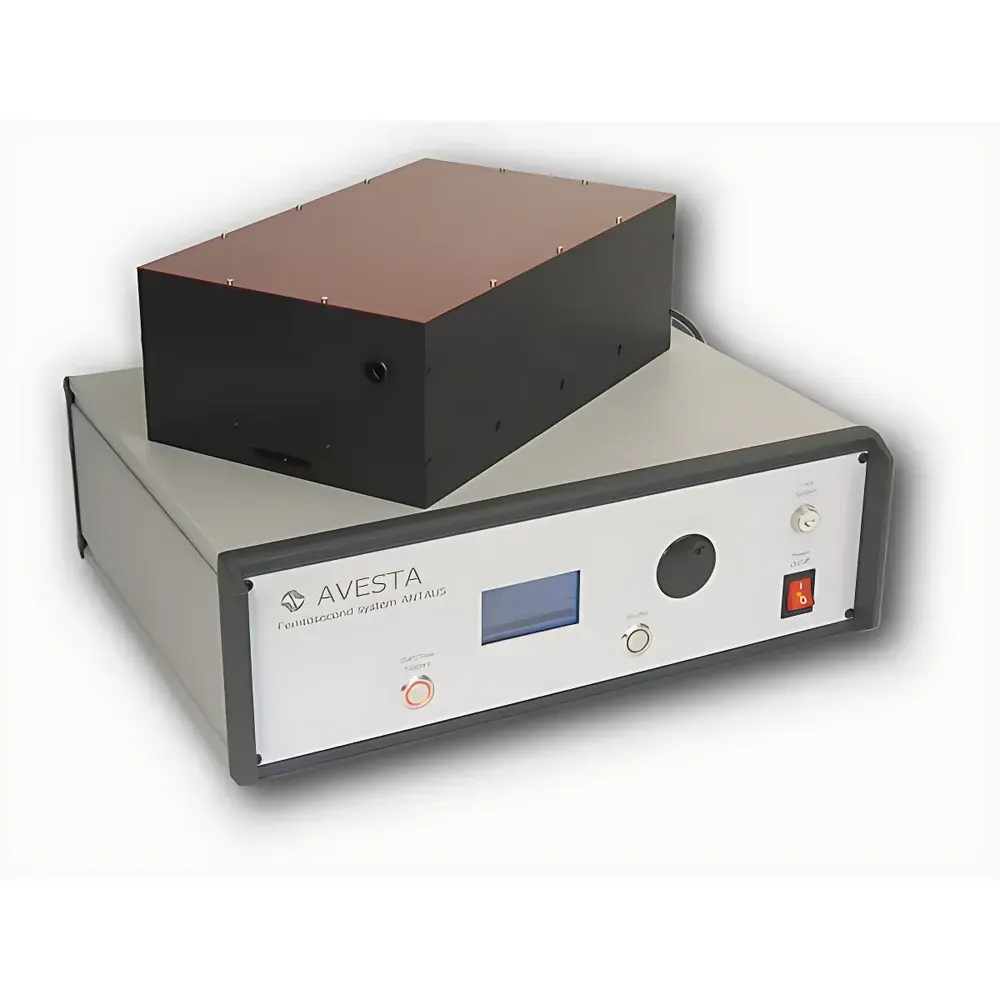
Avesta ANTAUS Series Femtosecond Fiber Laser System
| Brand | Avesta |
|---|---|
| Origin | Russia |
| Manufacturer Type | Authorized Distributor |
| Product Category | Imported |
| Model | ANTAUS |
| Core Architecture | All-Fiber Oscillator + Amplifier with Free-Space Pulse Compressor |
| Pulse Energy | > 2 µJ |
| Average Output Power | > 5 W |
| Pulse Duration (FWHM) | < 350 fs |
| Repetition Rate | 2.5 MHz (standard), adjustable down to single-shot via optional AO pulse picker |
| Wavelength Options | 1030 nm, 1040 nm, or 1050 nm (custom wavelengths available) |
| Spatial Mode | TEM₀₀ |
| Polarization | Linear, horizontal |
| Beam Quality (M²) | < 1.2 |
| Long-Term Power Stability (12 h) | < 1% RMS |
| Cooling | Air-cooled only (no water cooling required) |
| Footprint (Optics Unit) | 350 × 220 × 120 mm |
| Footprint (Power Supply Unit) | 470 × 385 × 155 mm |
Overview
The Avesta ANTAUS Series is a turnkey femtosecond fiber laser system engineered for high-repetition-rate, high-pulse-energy ultrafast applications in both industrial and academic environments. Based on an all-fiber oscillator-amplifier architecture followed by a free-space grating-based pulse compressor, the ANTAUS delivers transform-limited pulses with sub-350 fs duration at fundamental wavelengths of 1030–1050 nm. Its monolithic fiber front-end ensures exceptional environmental stability and long-term amplitude noise suppression—critical for pump-probe spectroscopy, nonlinear microscopy, and precision micromachining where timing jitter and intensity fluctuations must remain below 0.5% RMS over extended acquisition windows. Unlike bulk-solid-state Ti:sapphire systems, the ANTAUS eliminates alignment-sensitive optics and active water cooling, reducing operational overhead while maintaining diffraction-limited beam quality (M² < 1.2) and linear horizontal polarization.
Key Features
- Turnkey operation: Fully integrated control electronics, thermal management, and safety interlocks compliant with IEC 60825-1 Class 4 laser safety standards
- Air-cooled design: No external chiller or deionized water loop required—enabling deployment in cleanrooms, mobile labs, and OEM integration environments
- High pulse energy & average power: >2 µJ per pulse at >5 W average output enables efficient nonlinear frequency conversion and ablation threshold control
- Flexible repetition rate control: Standard 2.5 MHz operation; optional acousto-optic (AO) pulse picker allows deterministic selection from single-shot to full repetition rate without pulse distortion
- Robust all-fiber oscillator + pre-amplified fiber amplifier architecture minimizes sensitivity to vibration, temperature drift, and dust contamination
- Compact dual-unit layout: Optics module (350 × 220 × 120 mm) and dedicated power supply unit (470 × 385 × 155 mm) support modular integration into custom optical tables or medical device enclosures
Sample Compatibility & Compliance
The ANTAUS laser meets essential regulatory and metrological requirements for integration into ISO 13485-certified medical devices (e.g., LASIK platforms) and GLP-compliant research instrumentation. Its wavelength options (1030/1040/1050 nm) align with absorption minima in corneal tissue and silica-based photonic crystals—enabling optimized penetration depth and minimal collateral thermal damage in ophthalmic and microfabrication workflows. The system conforms to EN 61000-6-3 (EMC emission limits) and EN 61000-6-2 (immunity), and includes embedded firmware logging for audit-ready traceability of operating parameters (pulse energy, repetition rate, internal temperature). Optional FDA 21 CFR Part 11-compliant software packages support electronic signatures and secure data archiving for clinical trial documentation.
Software & Data Management
Control is executed via Avesta’s proprietary USB-connected GUI (Windows/Linux compatible), supporting real-time monitoring of diode current, pump power, cavity temperature, and output power with 0.1% resolution. Logged datasets include timestamped pulse energy histograms, RMS stability metrics over user-defined intervals (1 min to 12 h), and compressor alignment diagnostics. Export formats include CSV, HDF5, and MATLAB-compatible .mat files. For OEM integration, a documented ASCII command protocol over RS-232 or TCP/IP enables synchronization with motion controllers, galvo scanners, and gated detectors—facilitating automated calibration routines and closed-loop process monitoring in industrial laser processing lines.
Applications
- Ophthalmic surgery: Primary seed source in FDA-cleared LASIK platforms due to precise ablation thresholds and negligible thermal diffusion in stromal tissue
- Terahertz time-domain spectroscopy (THz-TDS): Pumping photoconductive antennas or optical rectification crystals (e.g., ZnTe, GaP) with high signal-to-noise ratio at 0.1–5 THz bandwidths
- Two-photon polymerization (TPP): Enabling sub-100 nm feature resolution in photosensitive resins via tightly focused, high-peak-power pulses
- Optical coherence tomography (OCT): Broadband spectral shaping compatibility supports swept-source OCT configurations with axial resolution < 5 µm
- Multi-photon fluorescence microscopy: High peak intensity (>10¹³ W/cm²) excites deep-tissue fluorophores (e.g., GFP, tdTomato) with reduced photobleaching compared to CW sources
- Surface nanostructuring: Controlled LIPSS (Laser-Induced Periodic Surface Structures) generation on metals, semiconductors, and dielectrics using polarization-resolved pulse trains
FAQ
Is the ANTAUS laser suitable for integration into Class II medical devices under FDA QSR?
Yes—the system’s mechanical, electrical, and optical design complies with IEC 60601-1 general safety requirements, and its firmware supports configurable safety interlocks and event logging required for Design History File (DHF) documentation.
Can the central wavelength be shifted beyond 1050 nm?
Custom configurations up to 1080 nm are available upon request, subject to gain fiber optimization and compressor recalibration; typical lead time is 12 weeks.
What is the maximum pulse energy achievable with the AO pulse picker enabled?
At 1 kHz repetition rate (selected via AO unit), pulse energy exceeds 5 mJ after external amplification; the standard ANTAUS output remains >2 µJ across all selectable rates.
Does the system include beam delivery optics for OEM integration?
Standard configuration includes a collimated free-space output (1/e² diameter: 2.5 mm); optional fiber-coupled variants (PM980 or HI1060) with FC/APC connectors are available.
How is long-term power stability validated during factory acceptance testing?
Each unit undergoes 72-hour continuous operation at rated power while recording output via NIST-traceable thermal power meter; stability reports include Allan deviation analysis and RMS deviation plots.



