
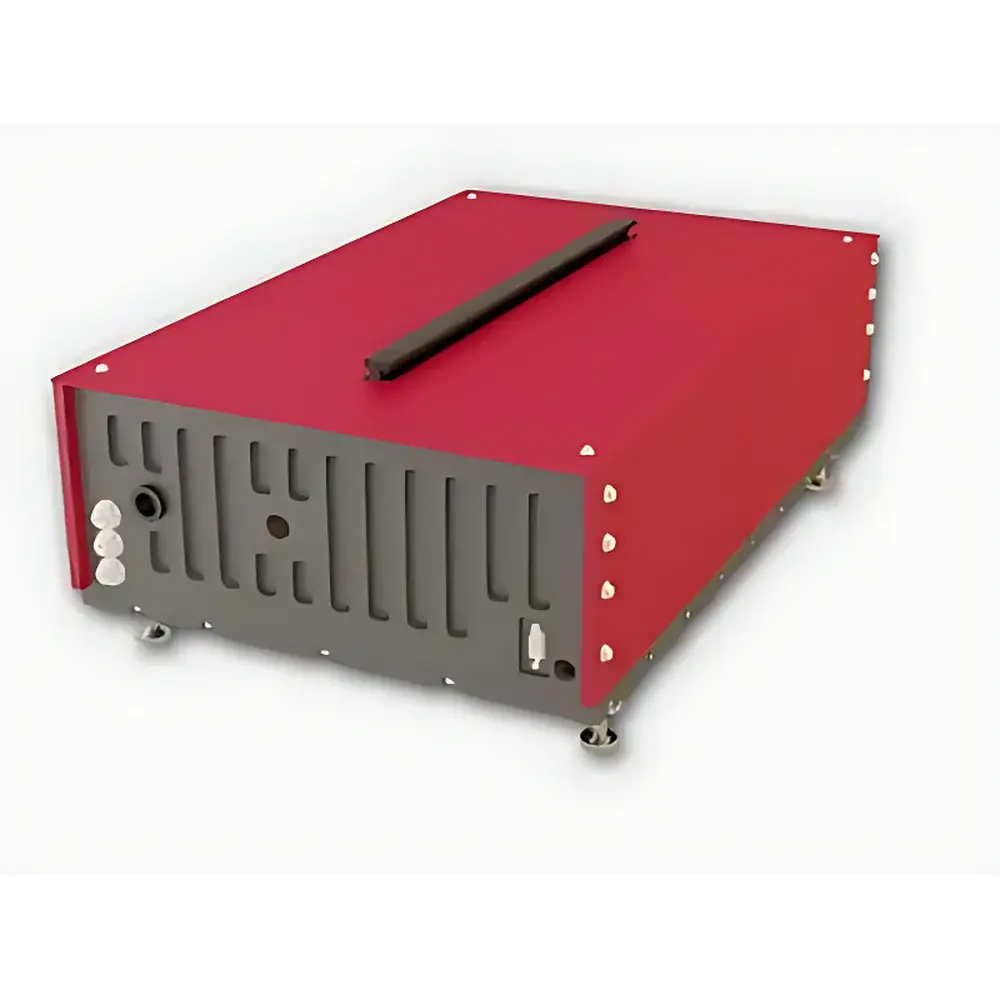
Avesta CrF Series Chromium-Doped Forsterite Femtosecond Laser
| Brand | Avesta |
|---|---|
| Origin | Russia |
| Model | CrF |
| Type | Solid-State Femtosecond Oscillator |
| Central Wavelength | 1250 nm (tunable 1230–1270 nm) |
| Pulse Width (FWHM) | <35 fs to <140 fs (model-dependent) |
| Average Output Power | 400–800 mW |
| Repetition Rate | 30 MHz or 95–96 MHz |
| Pulse Energy | >4 nJ to >20 nJ |
| Beam Mode | TEM₀₀ |
| Polarization | Linear, horizontal |
| Beam Divergence | <2 mrad |
| Cooling | Thermoelectric (Peltier) + Closed-Loop Water Chiller |
| Integrated Pump Source | 15 W Yb-doped Fiber Laser |
| Startup Mechanism | SESAM-based Self-Starting or Electro-Optic Triggering |
| Power Stability | <2% RMS (CrF-450TP), <5% RMS (CrF-700SP-L) |
Overview
The Avesta CrF Series is a family of solid-state femtosecond oscillators based on chromium-doped forsterite (Cr:Fo, Mg2SiO4) as the gain medium. Engineered for precision ultrafast science, these lasers deliver transform-limited pulses centered at 1250 nm—with tunability across 1230–1270 nm—enabling access to the biological transparency window and strong phonon-resonant interactions in semiconductors and dielectrics. Unlike Ti:sapphire systems operating near 800 nm, Cr:Fo’s intrinsic emission band supports direct generation of sub-1300 nm femtosecond pulses without nonlinear frequency conversion, minimizing complexity and preserving pulse fidelity. The oscillator architecture employs a compact folded cavity design with dispersion-compensated mirrors and low-loss intra-cavity optics, ensuring high long-term amplitude stability and minimal timing jitter. All CrF models integrate a thermally stabilized Cr:Fo crystal mounted on a Peltier-driven temperature control stage, coupled to a closed-loop water chiller for active thermal management—critical for maintaining consistent gain saturation, mode-locking reliability, and spectral purity under continuous operation.
Key Features
- Four distinct configurations: CrF-450TP (tunable, 96 MHz, <65 fs), CrF-400SP (fixed λ, 95 MHz, <75 fs), CrF-700SP (fixed λ, 30 MHz, <140 fs), and CrF-700SP-L (low-noise variant optimized for seeding amplifier systems)
- Integrated 15 W Yb-doped fiber pump laser with digital current and temperature regulation—eliminates external pump alignment and improves system robustness
- Two mode-locking initiation options: SESAM-based self-starting for hands-free operation, or electro-optic triggering for precise synchronization with external RF sources or pump-probe delay stages
- Thermoelectric + water-cooled crystal mount enabling sub-0.1 °C temperature stability—essential for wavelength reproducibility and long-term power consistency
- TEM00 spatial profile with linear horizontal polarization and beam divergence <2 mrad—optimized for coupling into single-mode fibers, nonlinear crystals, and scanning microscope objectives
- Factory-calibrated output power stability: <2% RMS (CrF-450TP) and <5% RMS (CrF-700SP-L) over 8 hours at constant ambient conditions
Sample Compatibility & Compliance
The CrF Series is designed for integration into regulated research and industrial environments. Its mechanical housing meets IP52 dust/moisture resistance standards; electrical safety complies with IEC 61010-1 for laboratory equipment. While not certified for clinical use, its optical output parameters align with ISO 60825-1:2014 Class 4 laser safety requirements—mandatory labeling, interlock-ready connectors, and key-controlled emission enable safe deployment in shared-core facilities. For GLP/GMP-aligned workflows, optional firmware logging (timestamped power, temperature, and status flags) supports audit trails compatible with 21 CFR Part 11-compliant data acquisition platforms. No hazardous substances are used in crystal growth or cavity assembly per RoHS Directive 2011/65/EU.
Software & Data Management
Each CrF system ships with Avesta’s LaserControl Suite—a Windows-based GUI supporting real-time monitoring of pump diode current, crystal temperature, output power, and cavity alignment diagnostics. Communication occurs via USB 2.0 or RS-232; SCPI command sets allow seamless integration into LabVIEW, Python (PyVISA), or MATLAB automation scripts. Optional Ethernet interface enables remote monitoring in multi-user laser labs. All operational logs are saved in CSV format with nanosecond-precision timestamps, facilitating correlation with external detectors or spectrometers. Firmware updates preserve user calibration tables and do not require factory recalibration.
Applications
- Multi-photon Excitation Microscopy: 1250 nm excitation minimizes scattering in thick tissue while enabling efficient two-photon absorption in red-shifted fluorophores (e.g., mCherry, tdTomato) and three-photon imaging of neuronal structures beyond 1 mm depth
- Terahertz Generation & Detection: Optical rectification in ZnTe or GaP crystals benefits from CrF’s high peak power and broad spectrum—supporting bandwidths >5 THz in time-domain spectroscopy setups
- Time-Resolved Spectroscopy: Sub-100 fs pulses serve as pump or probe sources for studying carrier dynamics in perovskites, 2D materials, and quantum dots with <50 fs temporal resolution
- Optical Coherence Tomography (OCT): Broad spectral bandwidth (<140 fs pulses yield ~10 nm FWHM) enables axial resolutions <10 µm in biological samples; compatibility with swept-source and full-field OCT architectures
- Seed Source for Amplifier Systems: CrF-700SP-L delivers high-energy (>20 nJ), low-jitter pulses ideal for injection seeding of Cr:Fo-based regenerative amplifiers (e.g., Avesta’s Pharos series), achieving millijoule-level output at 1 kHz repetition rates
FAQ
What is the typical warm-up time to achieve stable output?
Typically ≤15 minutes from cold start to <1% power drift, assuming ambient temperature variation <±1 °C.
Can the CrF be synchronized to an external clock signal?
Yes—the CrF-450TP and CrF-400SP support external RF triggering (SMA input, 1–10 Vpp, 50 Ω) for sub-10 ps jitter synchronization with pump lasers or delay generators.
Is wavelength tuning automated or manual?
Tuning is achieved via motorized cavity mirror mounts controlled through LaserControl Suite; step resolution is 0.1 nm with repeatability ±0.3 nm.
Does the system include beam delivery optics?
Standard configuration includes collimated free-space output (Ø1.5 mm, M² <1.1); optional fiber coupling (PM980 or HI1060) and kinematic mounts are available as accessories.
What maintenance is required during normal operation?
No routine optical alignment or consumable replacement is needed; annual verification of pump diode aging and chiller fluid integrity is recommended per Avesta’s Maintenance Protocol v3.2.




