
Avesta EFO Erbium-Doped Femtosecond Fiber Laser
| Brand | Avesta |
|---|---|
| Origin | Russia |
| Model | EFO |
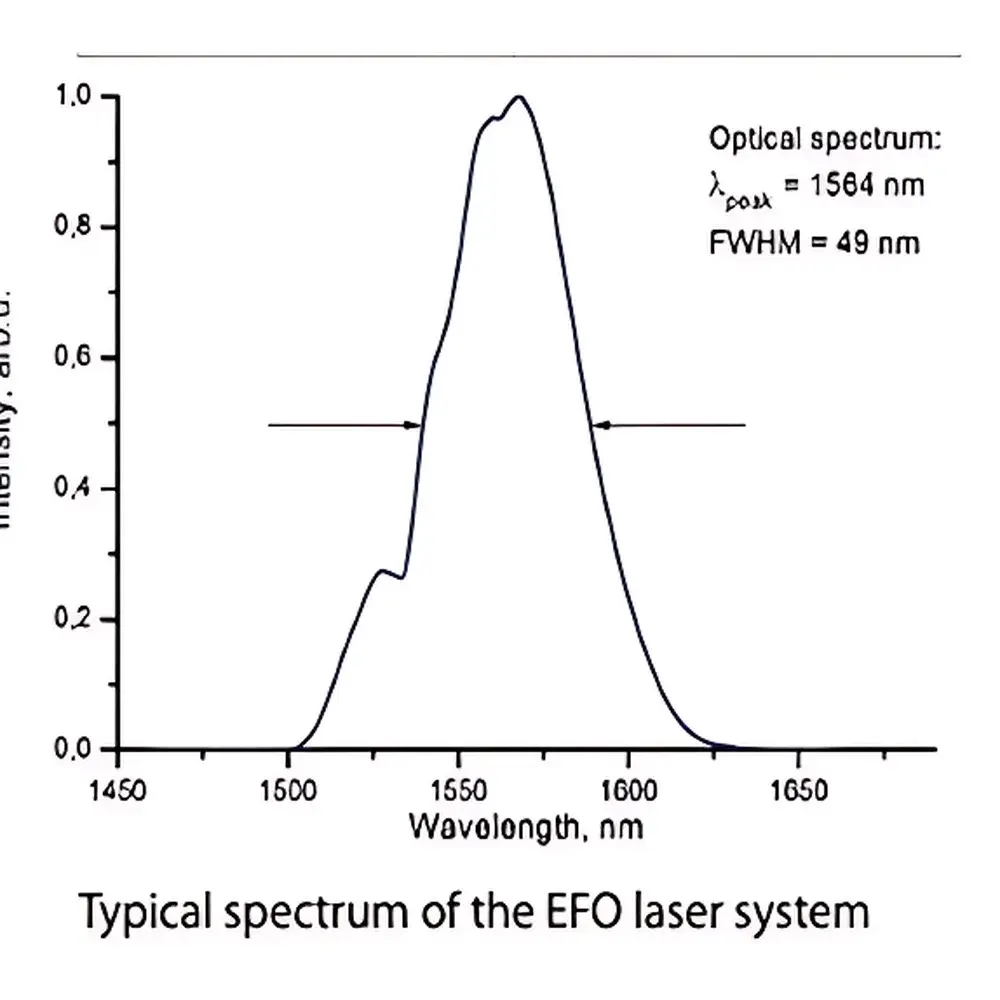
| Wavelength | 1560 ± 10 nm |
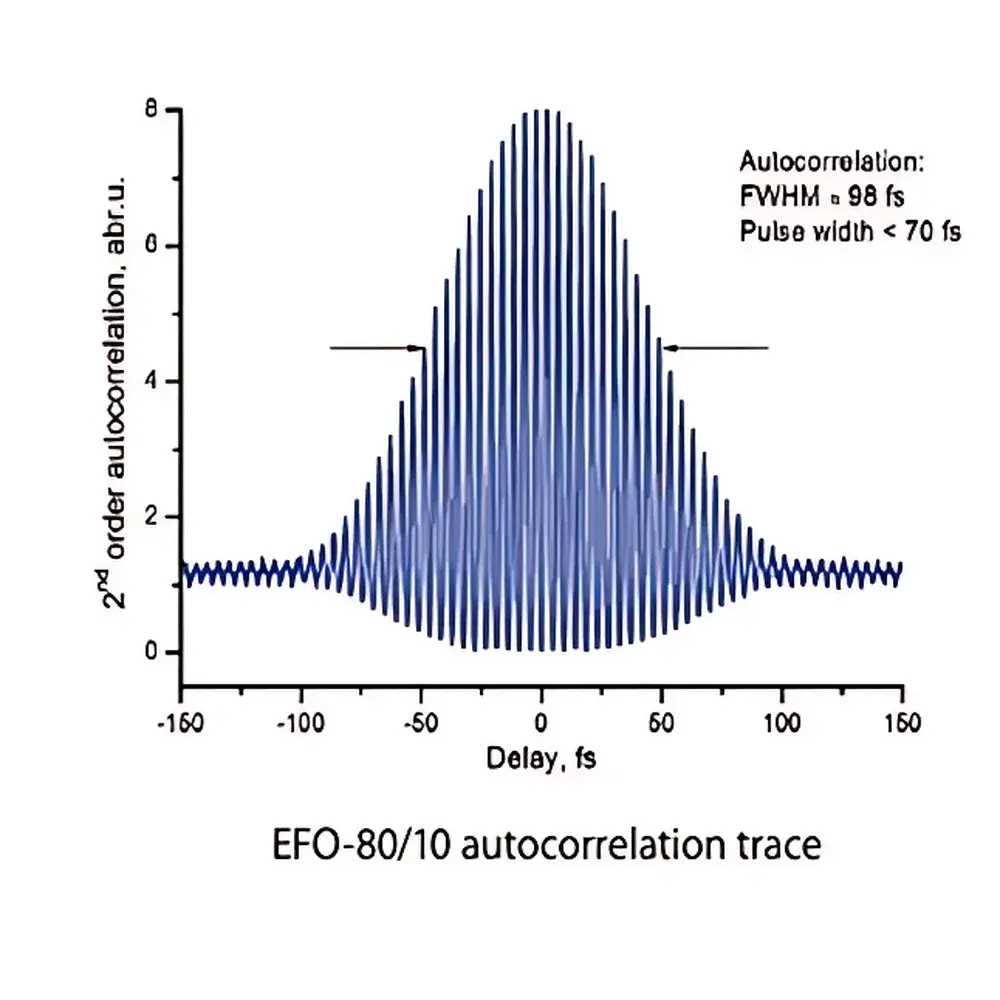
| Pulse Width | <80 fs (EFO-80/10), 250–5000 fs (EFO-T/50), 100–250 fs (EFOA-T/P) |
| Average Output Power | 10 mW (EFO-80/10), 50 mW (EFO-T/50), 100–250 mW (EFOA-T/P) |
| Repetition Rate | 70 MHz (EFO-80/10), 25–80 MHz (EFO-T/50), 70 MHz (40–80 MHz optional for EFOA) |
| Polarization | Linear, Vertical or Horizontal (EFO-80/10), Horizontal (EFO-T/50, EFOA) |
| Spatial Mode | TEM₀₀ |
| Output Coupling | FC/APC fiber port (~1 mW service tap), optional free-space or polarization-maintaining fiber |
| RF Sync Output | SMA connector (200–300 mV into 50 Ω) |
| Lock Status Monitor | SMA (3.5 V / 0 V) + LED indicator |
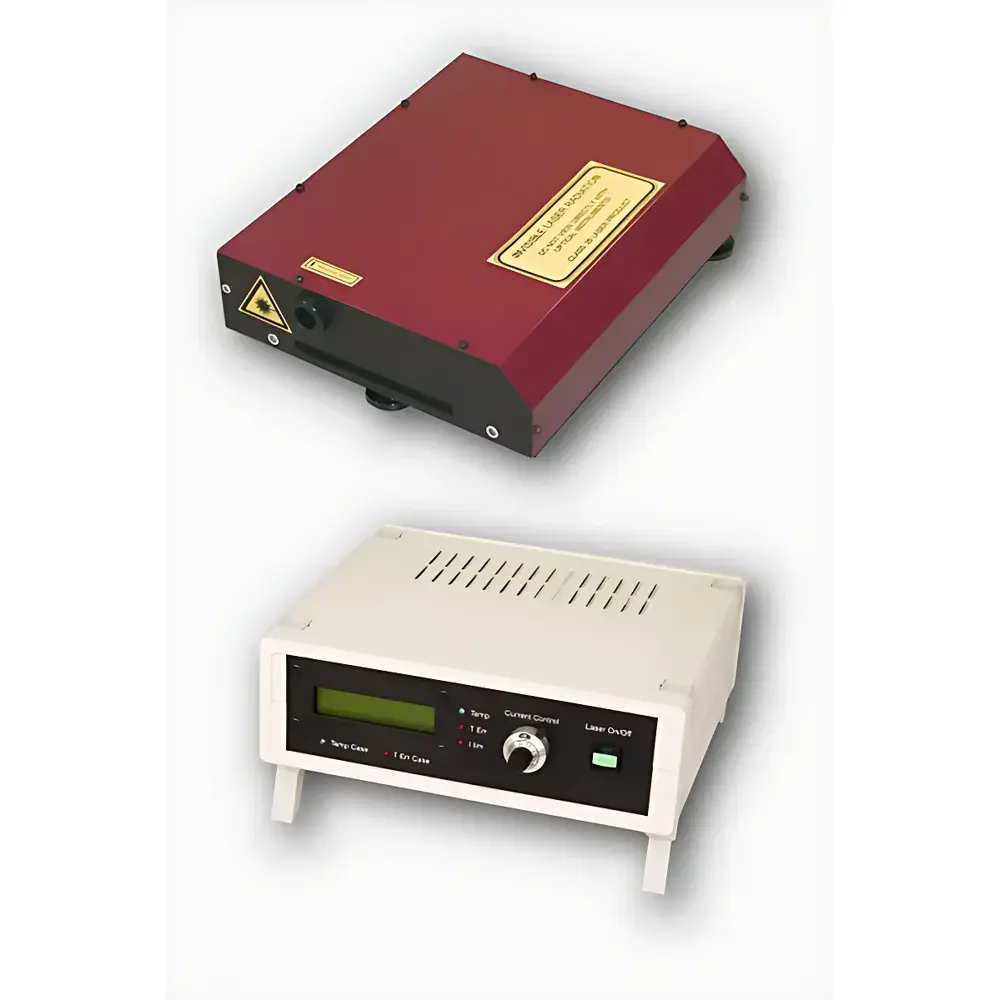
| Laser Head Dimensions (L×W×H) | 108×210×50 mm (70 mm height with baseplate) for EFO-80/10 |
| Power Supply Dimensions | 230×200×85 mm (EFO-80/10, EFO-T/50), 230×200×130 mm (EFOA) |
Overview
The Avesta EFO Erbium-Doped Femtosecond Fiber Laser is a turn-key, diode-pumped, mode-locked fiber oscillator engineered for robustness, long-term amplitude and timing stability, and operational simplicity in academic and industrial ultrafast laboratories. Operating at a center wavelength of 1560 ± 10 nm—within the low-loss, eye-safe telecommunications C-band—the EFO leverages erbium-doped photonic crystal fiber and nonlinear polarization evolution (NPE) or semiconductor saturable absorber mirror (SESAM)-based passive mode-locking to generate transform-limited femtosecond pulses. Its all-fiber architecture eliminates sensitive free-space alignment, enabling high reproducibility across thermal and mechanical perturbations. Designed explicitly as a seed source for chirped-pulse amplification (CPA) systems, it delivers precise temporal coherence and low timing jitter (< 100 fs RMS integrated from 10 kHz to 10 MHz), making it suitable for pump-probe spectroscopy, optical frequency comb stabilization, and synchronization with external RF references.
Key Features
- Turn-key operation with no routine realignment required—engineered for plug-and-play deployment in teaching labs and research environments.
- Multiple configuration options: fixed-pulse-width variants (EFO-80/10, <80 fs @ 10 mW) and tunable-pulse-width platforms (EFO-T/50, EFOA-T/P), where pulse duration and average power are co-optimized per user specification.
- TEM00 spatial beam profile with linear polarization (vertical/horizontal selectable on EFO-80/10; horizontal fixed on EFO-T/50/EFOA), ensuring compatibility with polarization-sensitive downstream optics including electro-optic modulators and nonlinear crystals.
- Integrated RF synchronization output (SMA, 200–300 mV into 50 Ω) and mode-lock status monitoring (TTL-level SMA + front-panel LED) for seamless integration into multi-laser timing systems and automated diagnostics.
- Compact laser head footprint (as small as 108 × 210 × 50 mm) with low-power-consumption electronics, supporting benchtop installation without active cooling or vibration isolation.
- Compliant with IEC 60825-1:2014 Class 3B laser safety requirements; includes interlock-ready connectors and key-switch enable for institutional safety protocols.
Sample Compatibility & Compliance
The EFO series is compatible with standard single-mode fiber (SMF-28 or PM1550) delivery and integrates directly with commercial ultrafast amplifiers (e.g., regenerative or multipass Ti:sapphire or Yb-fiber systems), THz generation setups (ZnTe, DAST, or photoconductive antennas), and scanning optical parametric amplifiers. Its 1560 nm output enables efficient difference-frequency generation (DFG) into mid-IR and optical rectification in GaP or GaSe. All units conform to CE marking directives (EMC 2014/30/EU, LVD 2014/35/EU) and meet RoHS 2011/65/EU material restrictions. Firmware and hardware design support audit-ready documentation for GLP-compliant environments, including timestamped internal diagnostics logs accessible via RS232 or USB interface.
Software & Data Management
While the EFO operates autonomously without host software, optional Avesta Control Suite (ACS) provides remote monitoring of laser status, temperature setpoints, and power regulation via USB or RS232. ACS generates CSV-formatted log files containing real-time output power, internal photodiode readings, and lock-state timestamps—enabling traceability for ISO/IEC 17025-accredited calibration workflows. The system supports IEEE 1588 Precision Time Protocol (PTP) synchronization when paired with compatible network time servers, facilitating distributed ultrafast experiments across multiple instruments. No proprietary drivers are required; communication uses ASCII command protocol compliant with SCPI-like syntax for integration into LabVIEW, Python (PySerial), or MATLAB automation frameworks.
Applications
- Seed source for femtosecond fiber and solid-state amplifiers requiring stable, low-noise pulse trains.
- Optical pumping in time-resolved terahertz spectroscopy (THz-TDS) and coherent control experiments.
- Excitation source for multiphoton fluorescence microscopy (MPM) using near-IR–optimized dyes and genetically encoded indicators.
- Frequency comb reference generation for optical atomic clocks and absolute distance metrology (in conjunction with f–2f interferometers).
- Ultrafast carrier dynamics probing in semiconductor nanostructures via transient absorption or photoluminescence upconversion.
- Supercontinuum generation in highly nonlinear fibers (HNLF) for broadband OCT light sources and spectroscopic applications.
- Synchronization trigger for electron diffraction, streak cameras, and RF-driven particle accelerators.
FAQ
Is the EFO compatible with third-party amplification systems?
Yes—its stable repetition rate, low amplitude noise (<0.5% RMS over 24 h), and clean RF spectrum ensure reliable injection seeding into commercial CPA platforms from vendors including Light Conversion, Amplitude, and Calmar.
Can pulse duration be adjusted post-purchase?
For EFO-T/50 and EFOA-T/P models, pulse width is factory-set per order specification; reconfiguration requires optical redesign and is not field-serviceable. However, dispersion compensation modules can be added externally to fine-tune compressibility.
What safety certifications does the EFO hold?
All variants carry CE marking and comply with IEC 60825-1:2014 Class 3B laser product requirements. Full safety documentation—including hazard analysis, interlock schematics, and labeling guidance—is provided with each unit.
Does the laser support external cavity length modulation?
No—pulse repetition rate is fixed per model (70 MHz standard). For variable repetition rates, Avesta offers the EFO-AUL series with acousto-optic modulation capability.
Is OEM integration supported?
Yes—custom mechanical housings, embedded controllers, and OEM-specific firmware builds are available under NDA with volume commitments.




