
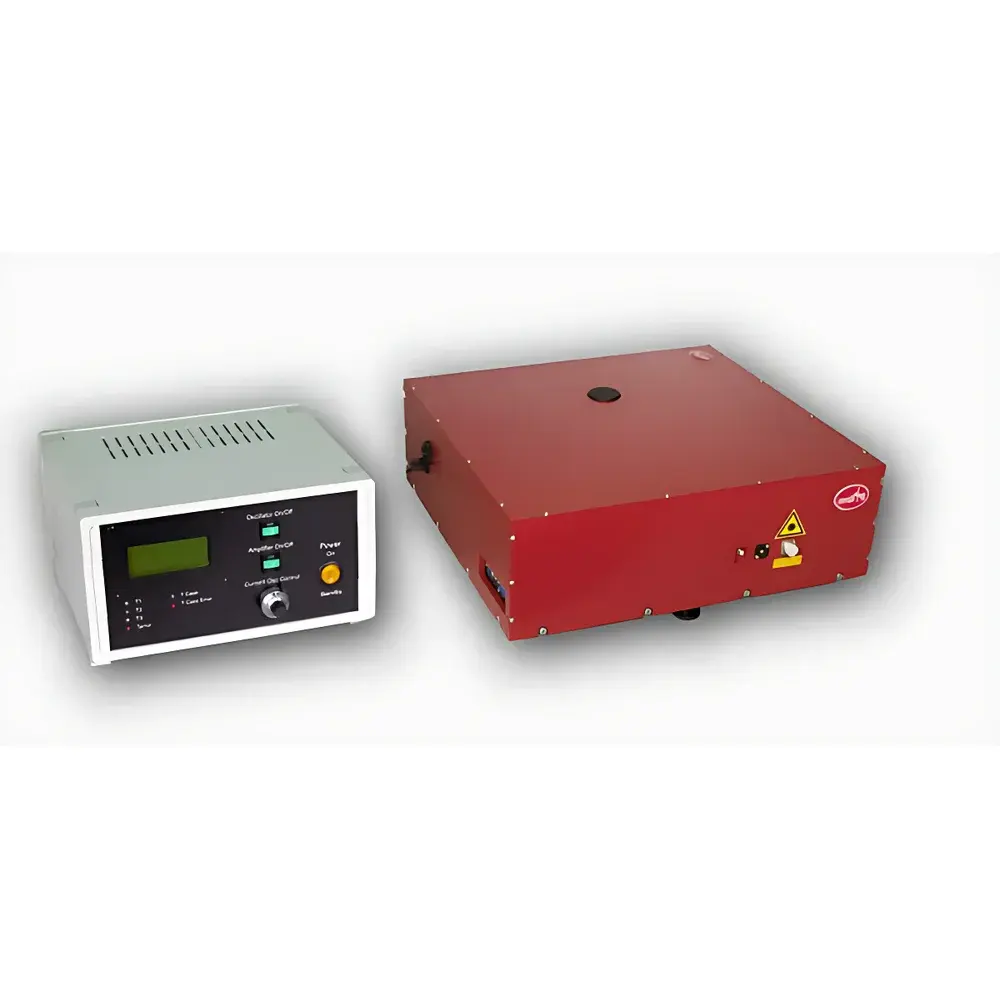
Avesta EFOA-SH Femtosecond Fiber Laser
| Brand | Avesta |
|---|---|
| Origin | Russia |
| Model | EFOA-SH |
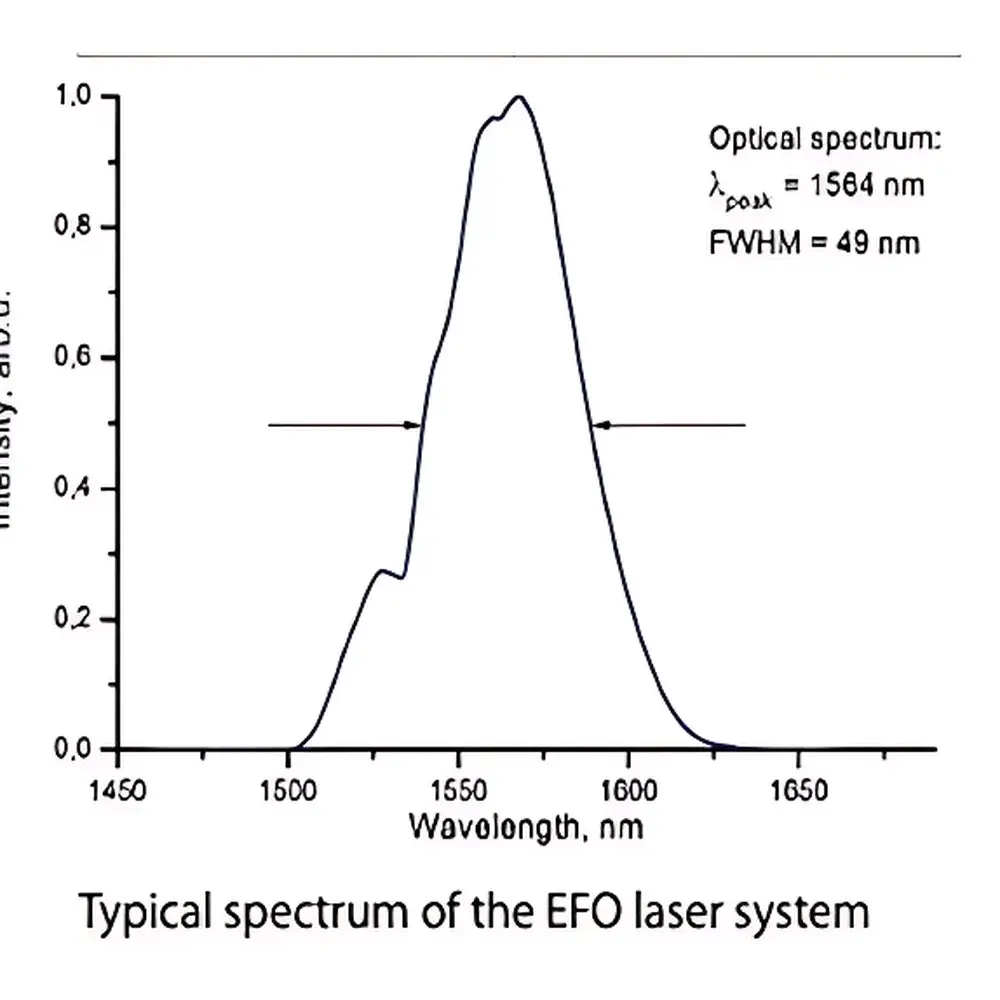
| Wavelength | 780 ± 5 nm (SH) / 1560 ± 10 nm (Fundamental) |
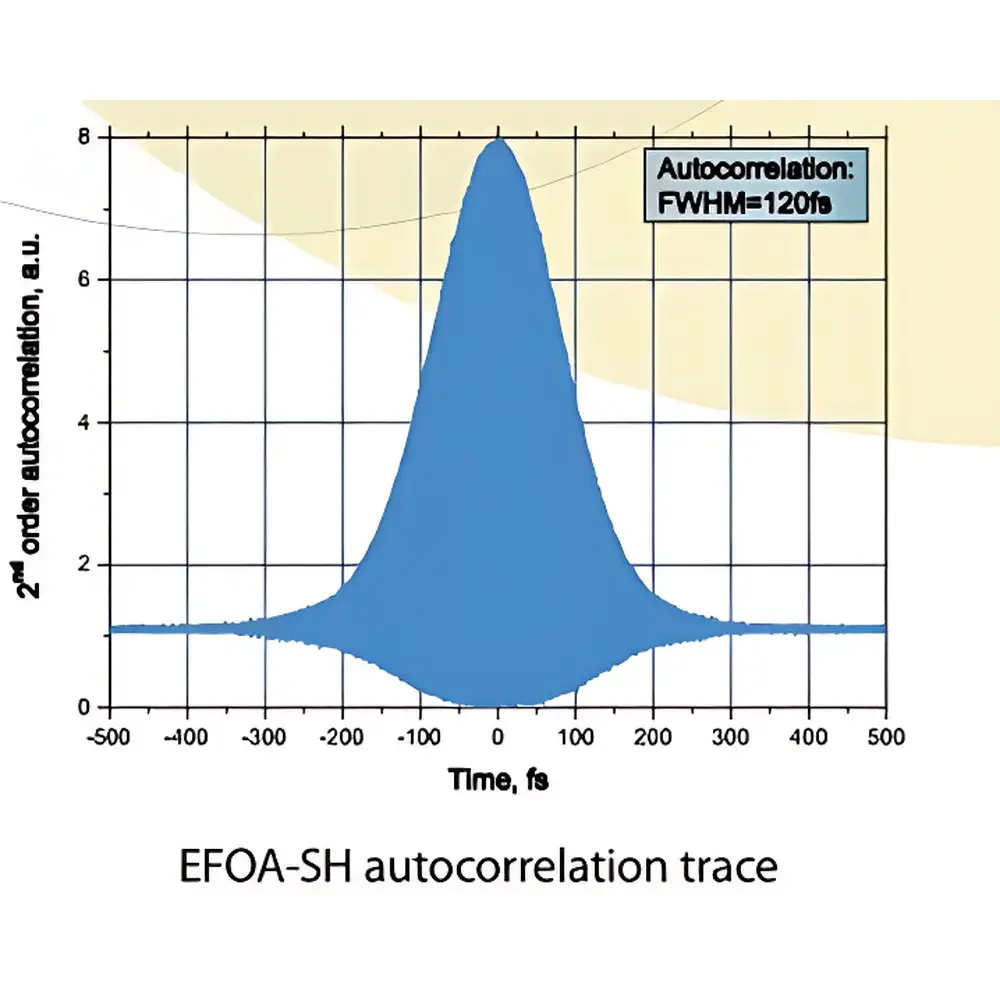
| Pulse Width (FWHM) | <100 fs |
| Average Power | >140 mW @ 780 nm |
| Repetition Rate | 65 ± 5 MHz or 80 ± 5 MHz |
| Spectral Bandwidth | ~7.5 nm |
| Pulse Energy | 1.1 nJ |
| Output Beam | TEM₀₀, Linearly Polarized |
| RF Sync Output | SMA |
| Mode-Lock Status Indicator | SMA + LED |
| Operating Temperature | 22 ± 5 °C |
| Warm-up Time | 20 min |
| Power Supply | 110/220 VAC, 50/60 Hz |
| Laser Head Dimensions | 278 × 242 × 111 mm |
| Control Unit Dimensions | 291 × 202 × 134 mm |
| Crystal Oven Controller Dimensions | 160 × 200 × 75 mm |
Overview
The Avesta EFOA-SH Femtosecond Fiber Laser is a compact, turnkey, all-fiber oscillator engineered for high-reproducibility ultrafast pulse generation at 780 nm via intracavity second-harmonic generation (SHG) of an erbium-doped fiber oscillator operating at 1560 nm. Based on robust nonlinear frequency conversion in a periodically poled lithium niobate (PPLN) crystal integrated within a monolithic cavity, the EFOA-SH delivers sub-100-fs pulses with excellent amplitude and timing stability—making it a reliable, low-maintenance alternative to bulk Ti:sapphire oscillators in demanding laboratory and industrial environments. Its single-box architecture eliminates alignment-sensitive free-space optics, reducing sensitivity to vibration and thermal drift while maintaining full compliance with laser safety Class 4 requirements (IEC 60825-1). Designed and manufactured in Troitsk, Russia by Avesta Ltd.—a spin-off of the P.N. Lebedev Physical Institute’s Quantum Radiophysics Department—the system inherits decades of expertise in ultrafast photonics developed under Nobel laureates N.G. Basov and A.M. Prokhorov.
Key Features
- Integrated intracavity SHG: Stable, alignment-free 780 nm output derived from fundamental 1560 nm emission
- Dual-wavelength operation: Simultaneous access to both 780 nm (SH) and 1560 nm (fundamental) outputs with independent power control
- High pulse energy: 1.1 nJ per pulse at 780 nm enables efficient seeding of regenerative amplifiers and optical parametric chirped-pulse amplification (OPCPA) systems
- Flexible repetition rate: Factory-configurable options at 65 ± 5 MHz or 80 ± 5 MHz; custom frequencies available upon request (25–80 MHz range)
- TEM₀₀ Gaussian beam profile with linear polarization ensures optimal coupling into downstream optics, waveguides, and nonlinear crystals
- Comprehensive synchronization interface: SMA-mounted RF trigger output referenced to the pulse train, plus TTL-compatible mode-lock status signal for integration with data acquisition and pump-probe timing systems
- Low maintenance design: All-fiber construction with no consumables, no water cooling, and minimal optical realignment over lifetime
Sample Compatibility & Compliance
The EFOA-SH is compatible with standard SMF-28 or PM1550 fiber pigtails (FC/APC connectorized), enabling seamless integration into fiber-based ultrafast setups including THz generation, OCT interferometers, and telecom-band characterization platforms. It meets IEC 60825-1:2014 for Class 4 laser product safety, and its electromagnetic emissions comply with CISPR 11 Group 1, Class B limits. The unit supports GLP/GMP-aligned operational documentation and includes built-in logging of internal temperature, pump diode current, and mode-lock status—facilitating audit-ready traceability in regulated R&D and quality control environments. While not certified to FDA 21 CFR Part 11 out-of-the-box, its digital control interface and timestamped event logging provide a foundation for validation in ISO 13485 or ISO/IEC 17025 workflows.
Software & Data Management
Operation is managed via front-panel controls and a dedicated USB-connected control application (Windows/Linux compatible), which provides real-time monitoring of output power, repetition rate, and thermal stabilization status. All settings—including RF sync polarity, output port selection, and crystal oven setpoint—are stored in non-volatile memory. The software exports timestamped measurement logs in CSV format, supporting automated post-processing in MATLAB, Python (NumPy/Pandas), or LabVIEW. Optional SDKs enable remote scripting for integration into custom automation frameworks used in high-throughput spectroscopy or semiconductor wafer inspection systems.
Applications
- Seed source for chirped-pulse amplification (CPA) and OPCPA systems requiring high-fidelity, low-noise 780 nm pulses
- THz time-domain spectroscopy (THz-TDS) via optical rectification in ZnTe or DAST crystals
- Multiphoton excitation in deep-tissue fluorescence microscopy, particularly with red-shifted genetically encoded indicators
- Ultrafast transient absorption and pump-probe spectroscopy across visible and NIR spectral ranges
- Carrier dynamics analysis in photovoltaic materials and quantum dot heterostructures
- Supercontinuum generation in highly nonlinear fibers (HNLF) for broadband OCT light sources
- Optical frequency comb stabilization and metrology applications leveraging the 780 nm line’s compatibility with Rb atomic transitions
- Characterization of high-speed photodetectors and electro-optic modulators in 10–100 Gb/s communication test beds
FAQ
Is the 780 nm output derived solely from second-harmonic generation, or does it include amplified spontaneous emission (ASE)?
The 780 nm beam is generated exclusively via intracavity SHG of the mode-locked 1560 nm pulse train; ASE contribution is suppressed to <−40 dB relative to peak intensity by optimized cavity dispersion management and spectral filtering.
Can the repetition rate be tuned continuously, or is it fixed per unit?
The repetition rate is factory-set to either 65 ± 5 MHz or 80 ± 5 MHz; fine-tuning within ±5 MHz is possible via cavity length adjustment using the integrated piezo actuator, but continuous wide-range tuning is not supported.
What is the long-term power stability specification over 8 hours?
Typical RMS power fluctuation is ≤0.8% over 8 hours at constant ambient temperature (22 ± 1 °C), verified per ISO 11551:2021 Annex B protocols.
Does the system support external cavity synchronization (e.g., to a master clock)?
Yes—the RF sync output provides a clean 65 MHz or 80 MHz sine wave (±0.5 dB amplitude stability) suitable for phase-locking to external references via standard PLL modules.
Are OEM integration options available, such as rack-mount chassis or analog modulation inputs?
Custom mechanical packaging, analog modulation ports (0–5 V, 10 kHz bandwidth), and TTL-gated output enablement are available under OEM agreement; contact engineering support for mechanical drawings and interface specifications.





