
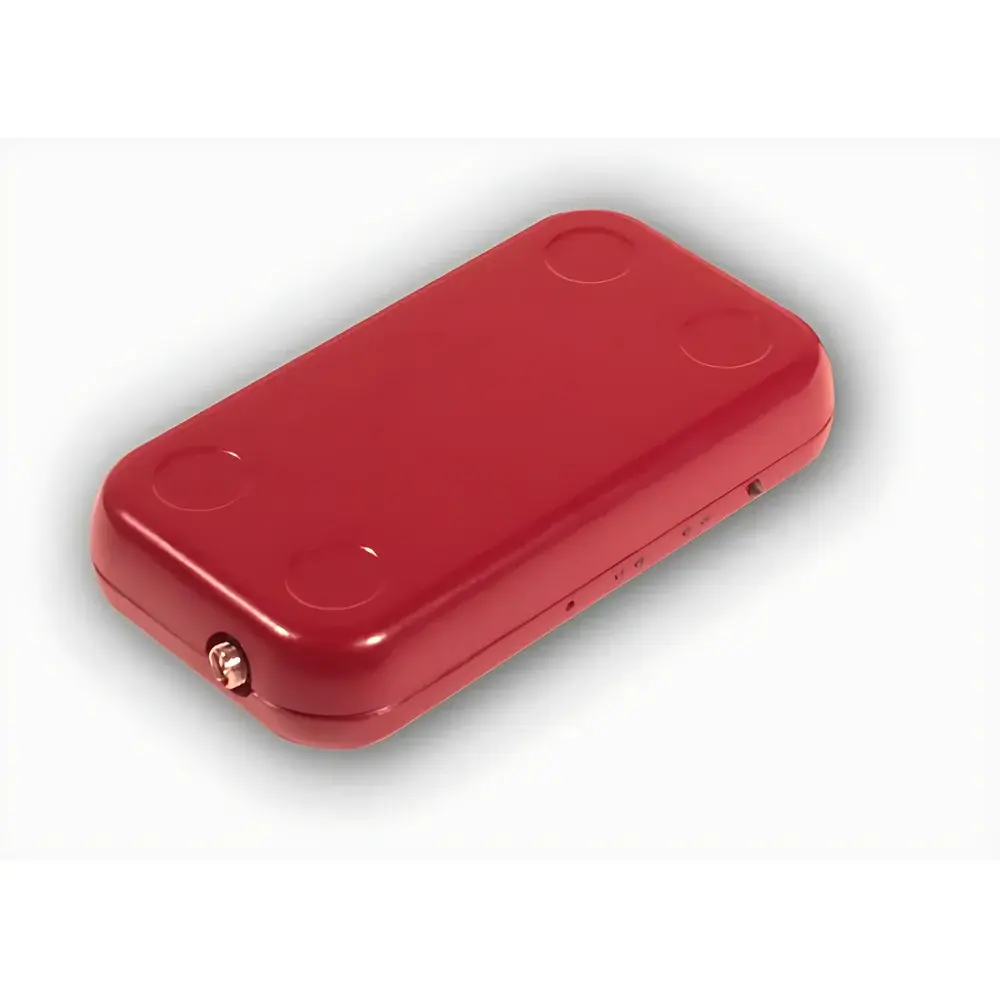
Avesta PErL Erbium-Doped Femtosecond Fiber Laser
| Brand | Avesta |
|---|---|
| Origin | Russia |
| Model | PErL |
| Wavelength Range | 1530–1565 nm (C-band) |
| Pulse Width | 250 fs – 5 ps (fixed options) |
| Average Output Power | up to 50 mW |
| Repetition Rate | RF-synchronized output |
| Power Supply | +5 V DC (with included 110/220 V AC adapter) |
| Package Type | OEM-integrated compact module |
| Compliance | CE-marked, RoHS-compliant |
| Pulse Shape | Near-transform-limited |
| Timing Jitter | < 50 fs RMS (integrated from 10 kHz to 10 MHz) |
| Phase Noise | Low time-variant optical phase noise |
| Pulse Baseline | Suppressed residual pedestal (< 1% of peak intensity) |
Overview
The Avesta PErL Erbium-Doped Femtosecond Fiber Laser is a compact, turnkey ultrafast oscillator engineered for precision in C-band (1530–1565 nm) applications. Based on mode-locked erbium-doped fiber technology, it delivers stable, self-starting femtosecond pulses without external cavity alignment or active stabilization. Its core architecture leverages nonlinear polarization evolution (NPE) or semiconductor saturable absorber mirror (SESAM)-based passive mode-locking—depending on configuration—to achieve high temporal fidelity and long-term amplitude stability. Designed explicitly for integration into demanding photonic systems, the PErL operates with minimal sensitivity to ambient vibration, temperature drift, or acoustic perturbation, making it suitable for deployment in industrial environments, telecom test benches, and laboratory-grade metrology setups. The laser’s near-transform-limited pulse profile ensures minimal chirp and optimal time-bandwidth product, critical for applications requiring high temporal resolution such as pump-probe spectroscopy or optical sampling.
Key Features
- Fixed-pulse-width variants spanning 250 fs to 5 ps—optimized for specific dispersion management and nonlinear interaction requirements
- OEM-optimized mechanical design: footprint under 120 × 90 × 30 mm, weight < 350 g, with integrated thermal management for continuous operation
- Ultra-low timing jitter (< 50 fs RMS, integrated 10 kHz–10 MHz), enabling precise synchronization with RF electronics, streak cameras, or delay stages
- Dedicated RF sync output (SMA, 50 Ω) at fundamental repetition rate (typically ~50–100 MHz), compatible with standard digital oscilloscopes and lock-in amplifiers
- Negligible pulse pedestal and high contrast ratio (>100:1), supporting clean nonlinear frequency conversion and low-noise photoconductive switching
- Single +5 V DC power input—no high-voltage drivers or water cooling required—reducing system complexity and footprint
- Factory-calibrated output power stability (< ±1.5% over 8 hours, 23 °C ambient), traceable to NIST-traceable photodiode standards
Sample Compatibility & Compliance
The PErL laser is designed for direct coupling into single-mode fiber (SMF-28 or PM1550) via FC/APC or FC/PC connectors, ensuring seamless integration with polarization-maintaining or dispersion-compensated modules. It complies with IEC 60825-1:2014 (Class 3B laser safety), CE Directive 2014/35/EU (Low Voltage Directive), and RoHS 2011/65/EU. For regulated environments—including ISO/IEC 17025-accredited calibration labs or GMP-aligned photonics manufacturing—the device supports optional firmware logging of operational parameters (uptime, output power history, temperature logs) for audit-ready documentation. While not intrinsically FDA 21 CFR Part 11 compliant, its deterministic behavior and deterministic trigger interface enable validation pathways for use in medical device characterization workflows.
Software & Data Management
The PErL operates as a fully autonomous source—no host PC or proprietary software is required for basic operation. However, optional USB-to-TTL interface kits (sold separately) allow remote monitoring of internal photodiode feedback, case temperature, and power supply voltage via ASCII command protocol (ASCII-based SCPI-like syntax). All communication adheres to IEEE 488.2 principles, facilitating integration with LabVIEW, Python (PyVISA), or MATLAB control environments. Firmware updates are performed via DFU mode using standard USB-C connection; version history and checksums are published in Avesta’s public technical repository for traceability. No cloud connectivity or telemetry is embedded—data sovereignty and network isolation are preserved by default.
Applications
- OEM integration into fiber-optic component testers (e.g., modulator Vπ characterization, interferometric sensor interrogation)
- Seed source for chirped-pulse amplification (CPA) systems targeting 1.5 µm mid-IR parametric generation
- Optical time-domain reflectometry (OTDR) with sub-100 fs resolution for fault localization in dense DWDM networks
- Terahertz time-domain spectroscopy (THz-TDS) using photoconductive antennas or optical rectification in ZnTe or GaP crystals
- Ultrafast optical sampling in analog-to-digital converter (ADC) testing and photonic analog signal processing
- Time-resolved photoluminescence (TRPL) and carrier lifetime mapping in semiconductor wafers and perovskite thin films
- Frequency comb offset detection in self-referenced Er:fiber combs (when combined with f–2f interferometers)
FAQ
Is the PErL laser compatible with polarization-maintaining (PM) fiber output?
Yes—PM-fiber-coupled versions are available with extinction ratio >20 dB and aligned slow-axis output upon request.
Can pulse duration be tuned in real time?
No—pulse width is factory-set per unit; discrete models cover 250 fs, 500 fs, 1 ps, 3 ps, and 5 ps. Tunability requires external compressors or stretchers.
What is the typical amplitude noise (RIN) performance?
Relative intensity noise is < 0.2% RMS (10 Hz–10 MHz), measured with a 12 GHz photodetector and RF spectrum analyzer.
Does the laser support external cavity synchronization (e.g., via optical injection locking)?
Not natively—but the low-jitter RF output enables reliable electronic synchronization with external modulators or cavity dumpers.
Is there a warranty or service program for international customers?
Avesta provides a 24-month limited warranty covering materials and workmanship; extended calibration and repair services are available through authorized regional partners in EU, USA, and APAC regions.





