
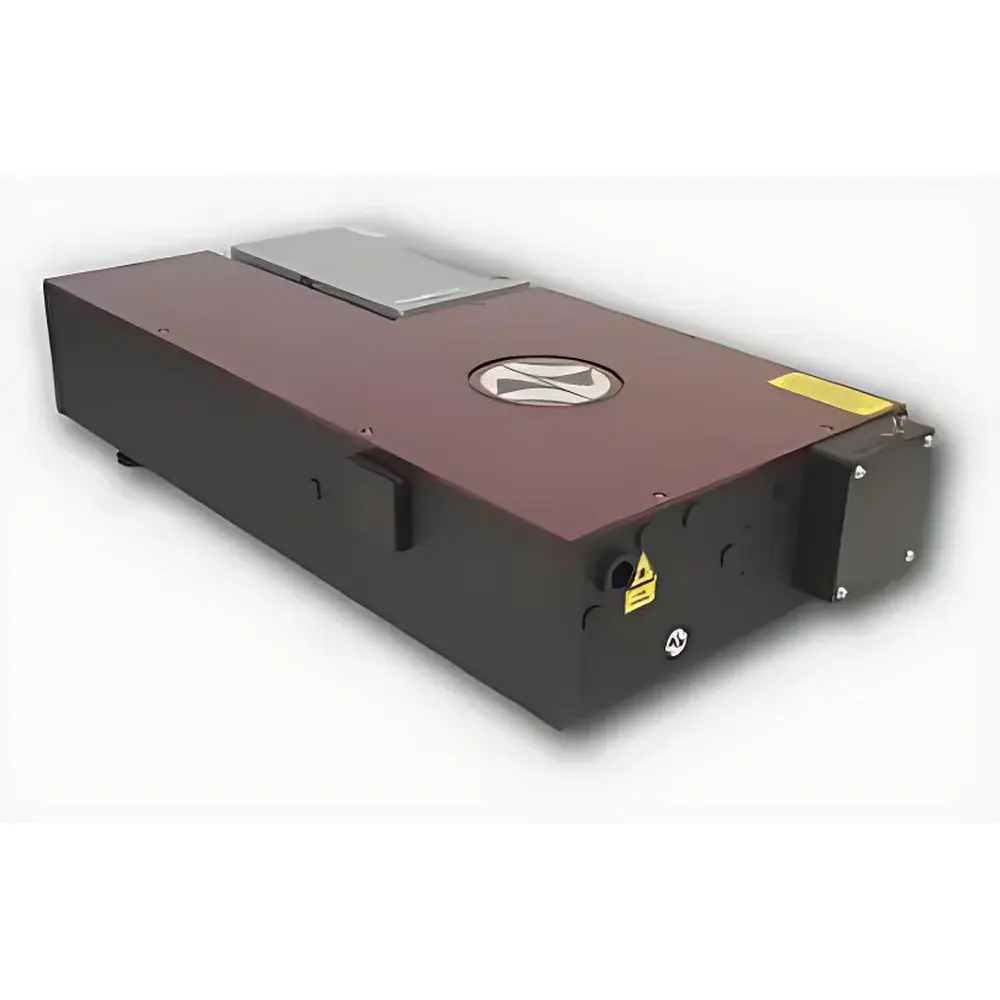
Avesta TiF-15 Titanium:Sapphire Femtosecond Laser
| Brand | Avesta |
|---|---|
| Origin | Russia |
| Model | TiF-15 |
| Type | Solid-State Femtosecond Oscillator |
| Tuning Range | 760–840 nm |
| Pulse Width (factory-configured) | <15 fs (TiF-15), <30 fs (TiF-15F) |
| Avg. Output Power | up to 500 mW @ 6 W pump |
| Repetition Rate | 90 MHz (TiF-15), 80 MHz (TiF-15F) |
| Pump Power Max | 6 W |
| Beam Quality | TEM₀₀ |
| Polarization | Linear, horizontal |
| Beam Divergence | <1 mrad |
| Power Stability | <1% RMS |
| Control Interface | USB |
| GDD Compensation Support | Yes (external prism pair or tunable compressor compatible) |
| Dimensions | 650 × 330 × 128 mm |
Overview
The Avesta TiF-15 is a high-stability, mode-locked titanium:sapphire (Ti:S) femtosecond oscillator engineered for ultrafast science applications requiring sub-15-fs pulse generation. Based on the Kerr-lens mode-locking (KLM) principle, the TiF-15 delivers transform-limited pulses directly from the oscillator cavity—enabling precise temporal characterization and minimal phase distortion. Its design prioritizes long-term amplitude and carrier-envelope phase (CEP) stability, making it especially suitable as a seed source for multi-stage chirped-pulse amplification (CPA) systems. Two configurations are available: the TiF-15 (standalone oscillator, externally pumped) and the TiF-15F (integrated with a 6 W industrial-grade diode-pumped solid-state (DPSS) pump laser). Both share identical Ti:S crystal head dimensions and mechanical footprint, ensuring seamless upgrade paths and system integration flexibility. The oscillator operates at a fixed repetition rate of 90 MHz (TiF-15) or 80 MHz (TiF-15F), with spectral bandwidth exceeding 70 nm (FWHM) at 800 nm in the TiF-15 configuration—supporting Fourier-transform-limited pulses below 15 fs without external compression.
Key Features
- Sub-15-fs pulse duration (factory-optimized, <15 fs for TiF-15; <30 fs for TiF-15F with optional GDD compensation)
- Wide electronic tuning range: 760–840 nm, controlled via USB interface with motorized grating drive
- High average output power: >230 mW at 3 W pump (TiF-15), >500 mW at 6 W pump (TiF-15F)
- TEM00 spatial mode with linear horizontal polarization and beam divergence <1 mrad
- Integrated thermal feedback loop and electromagnetic shutter for stable long-term operation
- Modular architecture supporting external dispersion management: prism pairs, chirped mirrors, or tunable pulse compressors
- Compact monolithic housing (650 × 330 × 128 mm) with vibration-damped optical baseplate
Sample Compatibility & Compliance
The TiF-15 is designed for laboratory environments operating under ISO/IEC 17025-aligned quality frameworks and complies with IEC 60825-1:2014 (laser safety class 4). Its robust mechanical design meets MIL-STD-810G shock and vibration requirements for transport and installation stability. While not certified to FDA 21 CFR Part 11 by default, the USB control interface supports audit-trail-capable software integration for GLP/GMP-regulated workflows (e.g., in optical coherence tomography development or metrology calibration labs). The system is compatible with standard vacuum-compatible optical tables, breadboards, and OEM integration platforms—including synchronization with RF triggers (TTL-compatible) for pump-probe experiments and time-resolved spectroscopy setups.
Software & Data Management
Avesta provides the proprietary TiF Control Suite (Windows-based, 64-bit), offering real-time wavelength tuning, power monitoring, shutter control, and pump laser diagnostics via USB 2.0. All parameter changes are logged with timestamps and user identifiers—enabling traceability for ISO 17025 or internal QA documentation. The software exports metadata-rich .csv and HDF5 files, including spectral traces, pulse energy history, and thermal sensor readings. API support (DLL and Python bindings) allows integration into LabVIEW, MATLAB, or custom Python-based automation pipelines—facilitating automated wavelength sweeps, closed-loop power stabilization, and remote operation in multi-user core facilities.
Applications
- Multi-photon excitation microscopy (MPM), particularly for deep-tissue imaging requiring high peak intensity and low photodamage
- Seed oscillator for regenerative amplifiers and optical parametric chirped-pulse amplifiers (OPCPA)
- Terahertz time-domain spectroscopy (THz-TDS) pump sources with sub-cycle electric field resolution
- Ultrafast pump-probe spectroscopy across condensed matter, molecular dynamics, and semiconductor physics
- Frequency comb stabilization and optical clock development (when coupled with f–2f interferometers)
- High-precision optical metrology, including attosecond streaking and dispersion measurement of broadband optics
- Micromachining and nonlinear lithography where minimal heat-affected zones depend on ultrashort pulse delivery
FAQ
What is the difference between TiF-15 and TiF-15F?
The TiF-15 requires an external 6 W DPSS pump laser, while the TiF-15F integrates the pump source within the same chassis. Both share identical Ti:S oscillator heads, enabling direct hardware interchangeability and consistent beam parameters.
Can pulse duration be adjusted on-site?
Yes—the factory-default <15 fs setting (TiF-15) can be fine-tuned by users or field engineers using built-in intracavity dispersion compensation elements or external prism compressors.
Is the system compatible with third-party pulse characterization tools?
Yes—it outputs a collimated, free-space TEM00 beam with M² < 1.1, fully compatible with FROG, SPIDER, and autocorrelator setups from companies such as Swamp Optics, APE, or Mesa Photonics.
Does the laser support CEP stabilization?
The TiF-15 does not include integrated f–2f interferometry or CEP feedback electronics, but its low-amplitude noise (<1% RMS) and high repetition-rate stability make it a proven platform for external CEP locking loops.
What maintenance is required during routine operation?
No consumables or alignment-sensitive optics require periodic replacement. Annual verification of pump laser pointing stability and Ti:S crystal temperature calibration is recommended per ISO/IEC 17025 preventive maintenance guidelines.





