
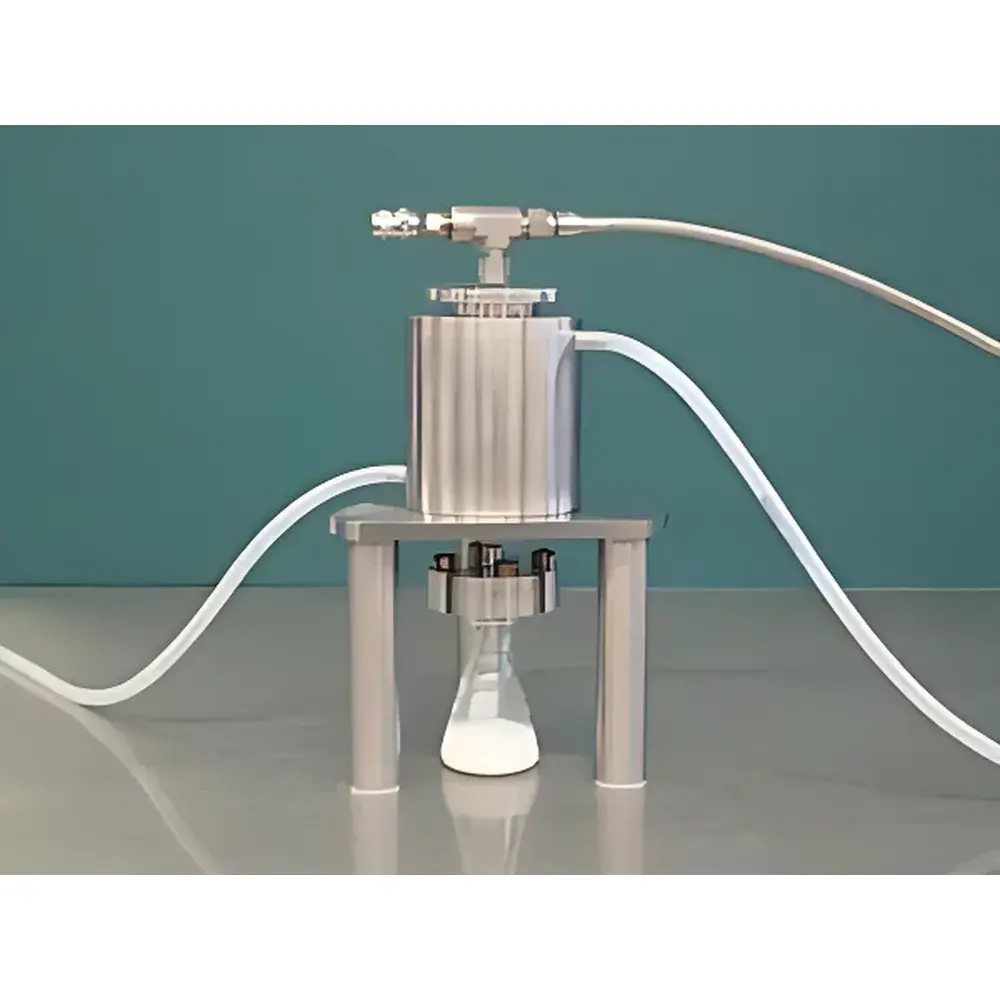
AVESTIN LF-50 Liposome Extruder
| Brand | AVESTIN |
|---|---|
| Origin | Canada |
| Model | LF-50 |
| Maximum Sample Volume | 50 mL per run |
| Operating Pressure | Up to 600 psi (41 bar) |
| Membrane Stack Configuration | Up to 3 polycarbonate membranes with support liners |
| Temperature Control | Jacketed stainless steel sample chamber compatible with external thermostatic circulators |
| Compliance | Designed for GMP-compliant processing and cleanability |
Overview
The AVESTIN LF-50 Liposome Extruder is an engineered benchtop extrusion system designed for precise, reproducible size reduction and homogenization of lipid-based nanocarriers—primarily liposomes, but also applicable to lipid nanoparticles (LNPs), polymersomes, and other soft colloidal vesicles. It operates on the principle of membrane extrusion: a pressurized sample suspension is forced sequentially through stacked polycarbonate track-etched membranes with defined pore sizes (e.g., 100 nm, 200 nm, 400 nm), resulting in narrow polydispersity index (PDI) and controlled hydrodynamic diameter. Unlike sonication or high-pressure homogenization, extrusion avoids thermal degradation and chemical oxidation, preserving labile encapsulated actives (e.g., mRNA, siRNA, peptides) and maintaining bilayer integrity. The LF-50 is widely adopted in academic labs, CMC development units, and early-phase GMP manufacturing environments where batch-to-batch consistency, scalability traceability, and process documentation are critical.
Key Features
- Robust pressure-driven architecture delivering up to 600 psi (41 bar) using regulated nitrogen or compressed air—ensuring stable flow rates across viscous lipid dispersions.
- Modular membrane holder accommodating up to three stacked polycarbonate membranes with optional stainless steel support liners and pressure-rated gaskets—enabling multi-step size fractionation without manual reassembly.
- Jacketed 316L stainless steel sample chamber with integrated thermal coupling ports—designed for seamless integration with external thermostatic circulators (e.g., Huber, Julabo) to maintain temperature between 4 °C and 60 °C during extrusion; essential for phospholipids with high phase transition temperatures (e.g., DPPC, Tm ≈ 41 °C).
- Single-chamber design minimizing dead volume and enabling full recovery of 0.5–50 mL batches—ideal for precious formulations and iterative formulation screening.
- GMP-oriented construction: all wetted surfaces are electropolished stainless steel or USP Class VI-certified polymers; no internal crevices or threaded joints in fluid path; fully autoclavable components (membrane holders, plungers, chambers) validated per ISO 17665.
Sample Compatibility & Compliance
The LF-50 processes aqueous lipid dispersions, ethanol-injection pre-formulations, and detergent-solubilized membrane protein reconstitution mixtures. Compatible with common phospholipids (e.g., POPC, HSPC, DSPC), cholesterol, PEGylated lipids, and cationic lipids used in nucleic acid delivery. All materials contacting product meet USP cytotoxicity requirements and FDA 21 CFR Part 11 readiness when paired with compliant data acquisition software. System design supports cleaning validation per ASTM E3106 and sterilization cycle mapping per ISO 13408-2. Documentation packages—including DQ/IQ/OQ protocols, material certifications, and surface finish reports (Ra ≤ 0.4 µm)—are available upon request for regulatory submissions.
Software & Data Management
While the LF-50 operates as a stand-alone mechanical extruder, its pressure input is compatible with digital pressure transducers (e.g., Omega PX409 series) and programmable nitrogen regulators (e.g., Parker IQ+ Series) for closed-loop control. When integrated into automated workflows, pressure profiles, extrusion cycles, temperature logs, and operator IDs can be captured via LIMS or ELN systems compliant with 21 CFR Part 11 audit trail requirements. AVESTIN provides standardized SOP templates aligned with ICH Q5A(R2) and USP for extrusion process qualification.
Applications
- Preclinical liposome formulation development (e.g., Doxil®-analogues, AmBisome®-like systems)
- mRNA-LNP process optimization for vaccine candidates
- Preparation of uniform-sized liposomes for drug loading studies (active/passive loading), stability assessment, and in vitro release testing (IVRT)
- Reconstitution of membrane proteins into defined-size proteoliposomes for structural biology and functional assays
- Generation of reference standards for DLS, NTA, and TEM calibration
FAQ
What is the minimum recommended sample volume for reliable extrusion?
0.5 mL is the validated lower limit; however, volumes below 2 mL may require careful plunger priming and reduced pressure ramping to avoid membrane channeling.
Can the LF-50 be used with organic solvents such as chloroform/methanol mixtures?
No—wetted components are not chemically resistant to halogenated or highly polar aprotic solvents; only aqueous buffers, ethanol/water blends (<20% v/v), and lipid suspensions in saline or HEPES are supported.
Is membrane reuse permitted under GMP conditions?
Polycarbonate membranes are single-use per ICH Q5B guidance; reuse risks pore deformation, cross-contamination, and inconsistent sizing—validated discard protocols are included in AVESTIN’s PQ documentation.
Does the system support inline particle size monitoring?
Not natively—but the outlet port is fitted with a standard 1/4″-28 UNF thread, allowing direct coupling to real-time DLS or microfluidic resistive pulse sensing (MRPS) modules for in-process characterization.
How is temperature uniformity verified across the chamber during operation?
Thermal mapping per ISO 14644-3 is performed using calibrated PT100 probes at radial/axial positions; typical ΔT across 50 mL load is ≤ ±0.8 °C at steady state when using a ±0.1 °C circulator.




