
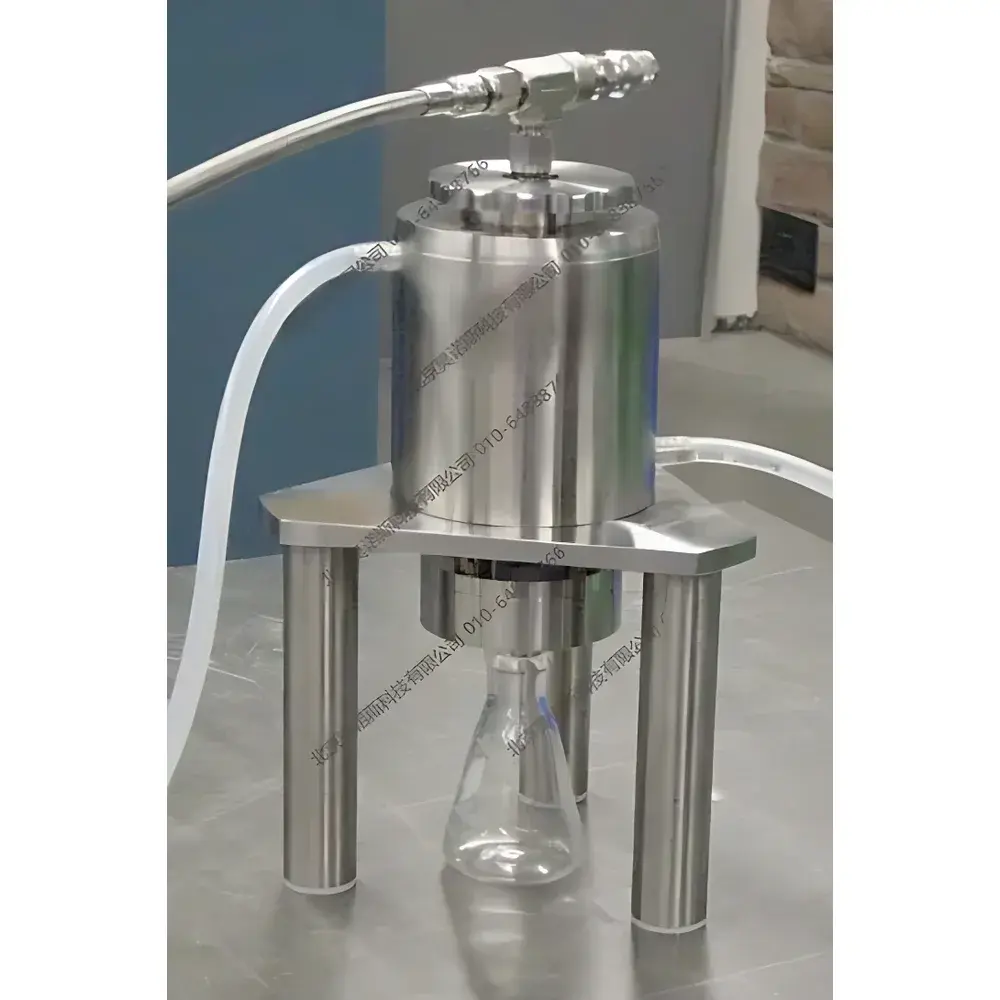
Avestin LF-50 Liposome Extruder
| Brand | Avestin |
|---|---|
| Origin | Canada |
| Model | LF-50 |
| Instrument Type | High-Pressure Extrusion System |
| Dimensions (W×D×H) | 280 × 460 × 260 mm |
| Sample Volume Range | 5–50 mL per run |
| Compatible Membrane Pore Sizes | 10 nm – 1.0 µm (polycarbonate track-etched membranes) |
| Maximum Operating Pressure | 10,000 psi (69 MPa) |
| Material Contact Path | 316 Stainless Steel, PTFE, and Anodized Aluminum |
| Compliance | Designed for GLP-compliant lab environments |
Overview
The Avestin LF-50 Liposome Extruder is a precision-engineered high-pressure extrusion system designed for the reproducible preparation of unilamellar or oligolamellar liposomes and other lipid-based nanocarriers. It operates on the principle of forced membrane extrusion—where a lipid suspension is pressurized and repeatedly passed through polycarbonate track-etched (PCTE) membranes with defined pore diameters. This mechanical size reduction process enables deterministic control over final particle diameter, yielding narrow polydispersity index (PDI) distributions typically <0.1 as measured by dynamic light scattering (DLS). Unlike sonication or detergent-based methods, extrusion preserves lipid integrity and bilayer structure while achieving consistent nano-scale dimensions (e.g., 50 nm, 100 nm, or 200 nm) essential for drug delivery formulation development, vaccine adjuvant production, and structural biophysics studies.
Key Features
- High-pressure hydraulic actuation system delivering up to 10,000 psi (69 MPa), enabling extrusion through sub-100 nm pore membranes with minimal shear-induced degradation.
- Jacketed extrusion chamber with integrated temperature control interface (±0.5 °C stability), compatible with external chillers or heating circulators for thermosensitive formulations (e.g., DPPC-based liposomes requiring phase transition management).
- Modular, tool-free membrane cassette design accommodating standard 25 mm or 47 mm PCTE membranes—validated for use with pore sizes from 10 nm to 1.0 µm per ISO 13322-2 guidelines.
- Stainless steel fluid path (316 SS) and chemically inert wetted components (PTFE seals, anodized aluminum housing) ensure compatibility with organic solvents, ethanol-containing lipid stocks, and aqueous buffers across pH 2–12.
- Ergonomic dual-hand lever operation with pressure relief valve and visual pressure gauge—designed to meet IEC 61010-1 safety standards for laboratory equipment.
Sample Compatibility & Compliance
The LF-50 supports extrusion of diverse lipid systems including phosphatidylcholine (PC), DSPC, DOPE, cholesterol blends, cationic lipids (e.g., DOTAP), and polymer-lipid hybrids. It is routinely employed in preclinical formulation labs adhering to FDA Q5A(R2) and ICH guidelines for nanomedicine characterization. The system’s repeatable extrusion cycles (typically 11–21 passes) facilitate compliance with USP for liposomal product size distribution testing. All contact materials comply with USP Class VI biological safety requirements. Documentation packages—including Factory Acceptance Test (FAT) reports, material traceability certificates, and calibration records—are available upon request to support 21 CFR Part 11–aligned quality systems.
Software & Data Management
While the LF-50 is a manually operated mechanical system without embedded firmware or digital controls, its operational parameters are fully documentable within electronic lab notebooks (ELN) and LIMS platforms. Users record extrusion cycle count, applied pressure (via analog gauge), membrane lot number, temperature setpoint, and post-extrusion DLS/NTA validation data—enabling full traceability required under GLP and GMP Annex 11 frameworks. Avestin provides standardized SOP templates aligned with ISO/IEC 17025 accreditation criteria for method validation, including repeatability assessment (RSD <3% for Z-average diameter across n=6 replicates).
Applications
- Preparation of uniform small unilamellar vesicles (SUVs) for structural studies (cryo-EM, SAXS) and membrane protein reconstitution.
- Scale-down process development for sterile liposomal drug products (e.g., doxorubicin, mRNA-LNPs) prior to pilot-scale homogenization.
- Routine quality control of liposome batch-to-batch consistency during analytical method transfer.
- Generation of calibrated nanoparticle standards for instrument qualification (e.g., DLS detector alignment, flow cytometry sizing reference).
- Extrusion of non-lipid nanosystems including polymersomes, exosome-mimetics, and peptide-lipid hybrids.
FAQ
What membrane pore sizes are supported?
Standard polycarbonate track-etched membranes from 10 nm to 1.0 µm are compatible; Avestin recommends validated membrane lots from Whatman™, Sterlitech™, or Nuclepore™ suppliers.
Can the LF-50 be used for sterile processing?
Yes—when paired with pre-sterilized membranes and autoclavable components, the system supports aseptic extrusion under laminar flow hoods or isolators.
Is temperature control mandatory for all applications?
Not mandatory, but strongly recommended for lipids with sharp gel-to-liquid crystalline phase transitions (e.g., DPPC at 41 °C) to prevent membrane clogging and ensure uniform extrusion kinetics.
How many extrusion cycles are typically required?
For SUV generation from multilamellar vesicles (MLVs), 11–21 cycles through two stacked membranes are standard; optimal cycles depend on initial size distribution and target diameter.
Does Avestin provide application support or method development services?
Yes—Avestin’s global technical team offers remote protocol optimization, troubleshooting guides, and collaborative feasibility studies for novel lipid formulations.



