
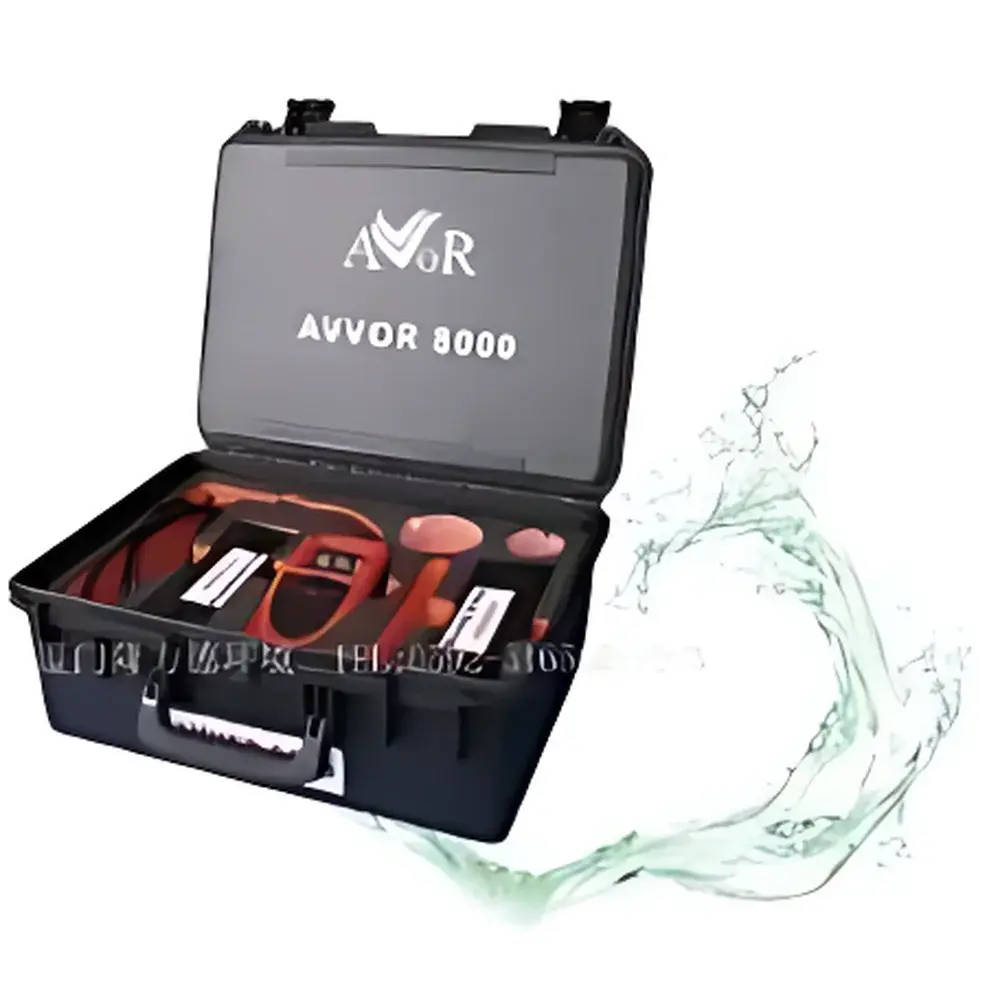
AVVOR 8000 Portable Heavy Metals Analyzer
| Brand | AVVOR |
|---|---|
| Origin | Canada |
| Model | AVVOR 8000 |
| Detection Principle | Anodic Stripping Voltammetry (ASV) and Spectrophotometry |
| Detection Range | Sub-ppb to ppm levels (e.g., As(III): 0.1–100 µg/L, Cd: 0.05–50 µg/L, Pb: 0.05–50 µg/L, Hg: 0.02–25 µg/L, Cu: 0.1–100 µg/L, Zn: 0.5–200 µg/L) |
| Supported Analytes | As(III), Total As, Cd, Cr(VI), Cu, Pb, Mn, Hg, Ni, Zn, Co, Se |
| Compliance | ASTM D3559, ISO 11969, US EPA Method 7000B (ASV), ISO 6603 (spectrophotometric metal chelation) |
| Data Management | Onboard tablet with GLP-compliant audit trail, CFR Part 11–ready export, Wi-Fi/Bluetooth connectivity |
| IP Rating | IP67 (instrument housing and integrated tablet) |
| Power | Rechargeable Li-ion battery (≥12 h continuous operation) |
Overview
The AVVOR 8000 Portable Heavy Metals Analyzer is a field-deployable electrochemical and optical instrumentation platform engineered for quantitative trace-metal analysis in aqueous environmental matrices. It employs dual detection modalities—Anodic Stripping Voltammetry (ASV) for ultra-trace electroactive metals (e.g., Pb, Cd, Cu, Hg, As(III)) and validated spectrophotometric methods (based on selective chelation and colorimetric development) for Cr(VI), Ni, Co, Mn, and Zn. Unlike laboratory-bound ICP-MS or AAS systems, the AVVOR 8000 delivers laboratory-grade accuracy under ambient field conditions through rigorously calibrated microelectrode sensors, temperature-compensated potentiostatic control, and matrix-matched standard addition protocols. Its design adheres to internationally recognized method frameworks—including US EPA Method 7000B for ASV-based metal quantification and ISO 11969 for spectrophotometric heavy metal determination—ensuring data defensibility in regulatory reporting and compliance monitoring.
Key Features
- Modular multi-analyte capability: Supports up to 12 regulated heavy metals across three hardware configurations (HM-1, HM-2, HM-3), with firmware-upgradable parameter expansion—no hardware replacement required.
- Field-optimized ASV architecture: Uses disposable or reusable screen-printed carbon electrodes with mercury-free bismuth or gold alloy working surfaces; eliminates hazardous mercury film deposition while maintaining sub-ppb sensitivity (LOD ≤ 0.05 µg/L for Cd, Pb).
- Dual-host configuration (HM-2): Two synchronized handheld meters enable cross-validated measurements, extended dynamic range (4–6 decades), and real-time outlier rejection via statistical concordance algorithms.
- Integrated ruggedized tablet (HM-3): IP67-rated Android-based interface with preloaded AVVOR Analytical Suite v4.x, supporting peak-height manual override, multi-point standard addition, regression curve fitting (linear/log-linear), correlation coefficient calculation (r²), and automatic sample dilution factor application.
- GLP/GMP-ready data integrity: Full electronic audit trail (user ID, timestamp, method version, electrode lot, calibration history), encrypted local storage, and 21 CFR Part 11–compliant PDF report generation with digital signature support.
- Environmental resilience: Operates continuously at –10 °C to +50 °C; ingress protection rated IP67 for both main unit and tablet enclosure; battery life ≥12 hours per charge under mixed-mode (ASV + photometry) operation.
Sample Compatibility & Compliance
The AVVOR 8000 is validated for use with raw surface water, groundwater, wastewater effluents, stormwater runoff, and treated drinking water sources. It accommodates turbidities up to 100 NTU and total dissolved solids (TDS) ≤ 2,000 mg/L without filtration when using ASV mode; spectrophotometric assays require optional inline membrane filtration (0.45 µm) for highly colored or particulate-laden samples. All onboard methods are aligned with ASTM D3559 (lead in water), ISO 6603 (chromium(VI) colorimetry), and ISO 11969 (voltammetric cadmium/lead/zinc). Instrument performance verification follows ISO/IEC 17025–recommended internal quality control: daily bracketing with NIST-traceable reference standards (SRM 1640a, 1643e), spike recovery testing (85–115% acceptance), and electrode response stability monitoring (RSD ≤ 5% over 20 injections).
Software & Data Management
The AVVOR Analytical Suite provides a unified interface for method selection, measurement execution, real-time voltammogram visualization, spectral overlay, and automated quantitation. Raw data—including current-time curves, absorbance spectra, and calibration logs—are stored in vendor-neutral CSV and SQLite formats. Cloud synchronization (via optional secure TLS 1.3 endpoint) enables remote QA/QC review, centralized database integration (e.g., LIMS via HL7 or REST API), and over-the-air firmware updates. All reports comply with ISO 17025 documentation requirements: each exported PDF embeds instrument ID, analyst ID, environmental metadata (GPS coordinates, ambient temperature/humidity), raw signal plots, and uncertainty estimates derived from calibration curve residuals and repeatability studies.
Applications
- Regulatory field screening under NPDES permits, Safe Drinking Water Act (SDWA) monitoring, and RCRA corrective action sites.
- Industrial pretreatment verification for electroplating, mining discharge, and semiconductor fab wastewater streams.
- Post-disaster rapid assessment (e.g., flood-affected wells, hurricane-damaged distribution systems).
- Agricultural runoff characterization near orchards using arsenical pesticides or livestock operations with copper/zinc supplementation.
- Research-grade speciation studies: As(III)/As(V) differentiation via pH-selective ASV, Cr(III)/Cr(VI) partitioning using redox-controlled extraction.
FAQ
What detection techniques does the AVVOR 8000 employ?
It integrates anodic stripping voltammetry (ASV) for electroactive metals and standardized spectrophotometry for chromophore-forming species—both methods fully documented in ASTM and ISO standards.
Can the instrument measure total arsenic and arsenite separately?
Yes: As(III) is measured directly by ASV; total As requires on-site pre-reduction (e.g., KI/ascorbic acid), enabling differential quantification with <5% interconversion error.
Is method validation data available for regulatory submission?
Each shipment includes a Certificate of Conformance with IQR (Instrument Qualification Report), method detection limit (MDL) study summary per analyte, and third-party verification against EPA Region 4 ELAP-accredited lab results.
How is electrode maintenance handled in remote locations?
Screen-printed electrodes are consumable (100–200 tests per strip); bulk packs include lot-specific calibration certificates. Gold- and bismuth-film electrodes are field-renewable using the integrated plating module without external power supplies.
Does the system support multi-point standard addition for complex matrices?
Yes: HM-2 and HM-3 models execute automated 3–5 point standard addition sequences with programmable volume increments, calculating final concentration via slope-ratio linear regression with forced zero-intercept where appropriate.
Related Products







