
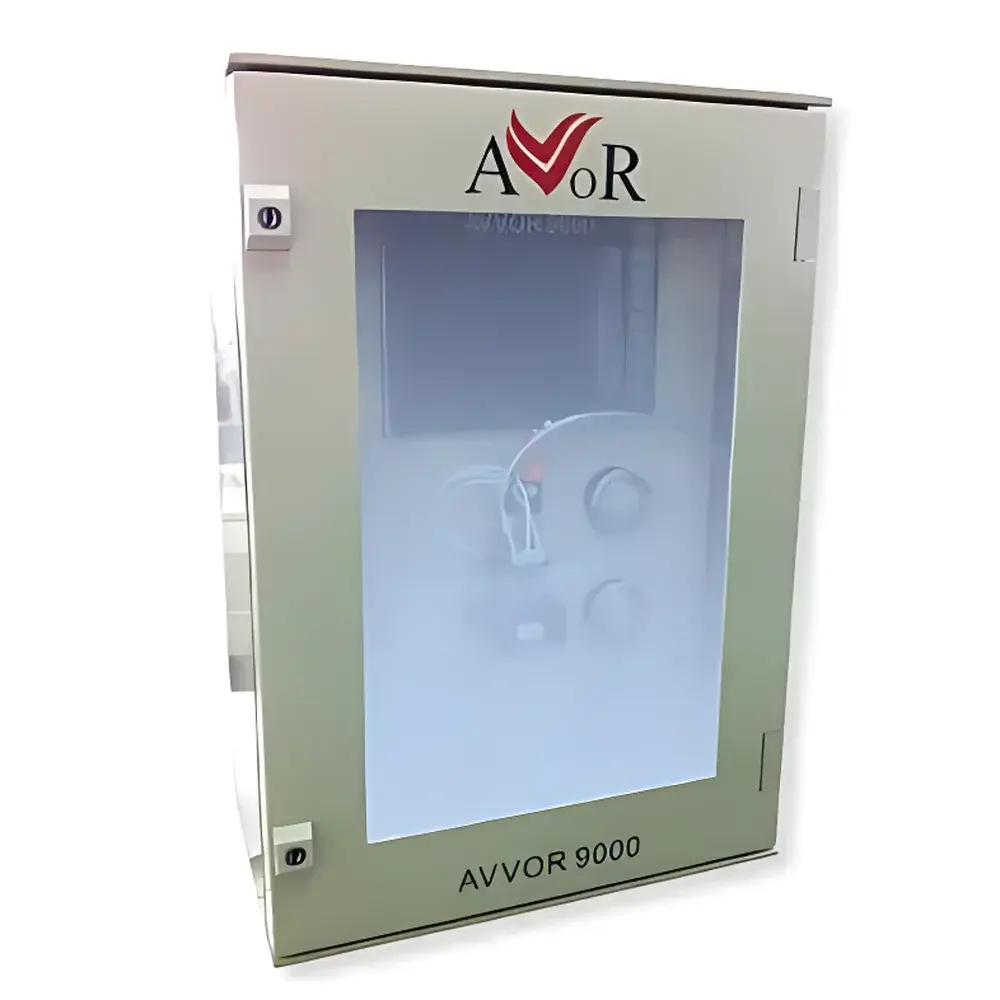
AVVOR 9000 Dual-Parameter Calcium and Fluoride Ion Analyzer
| Brand | AVVOR |
|---|---|
| Origin | Canada |
| Model | AVVOR 9000 |
| Detection Range (Ca²⁺) | 0.02–4010 ppm |
| Detection Range (F⁻) | 0.02–1900 ppm |
| Resolution | 0.01 ppm |
| Accuracy | ±5% of full scale |
| Output Signal | Isolated 4–20 mA (max load 1 kΩ) |
| Operating Temperature | 0–55 °C |
| Enclosure Rating | IP65 |
| Dimensions (H×W×D) | 400 × 300 × 150 mm |
| Display | 7-inch color touchscreen |
| Data Storage | Internal memory (8 GB microSD and USB flash drive optional) |
| Auto-cleaning module | Optional |
| Remote monitoring | Optional 3G/GPRS + web-based SCADA interface |
| SMS alert system | Optional multi-user configurable messaging |
Overview
The AVVOR 9000 Dual-Parameter Calcium and Fluoride Ion Analyzer is a laboratory-grade and field-deployable potentiometric analyzer engineered for continuous, real-time quantification of free Ca²⁺ and F⁻ ions in aqueous matrices. It operates on the principle of ion-selective electrode (ISE) potentiometry—measuring the thermodynamic activity of target ions via Nernstian potential response across selectively permeable membranes. For fluoride analysis, the instrument employs a lanthanum fluoride (LaF₃) crystal membrane electrode, which exhibits high selectivity against common anions (e.g., Cl⁻, NO₃⁻, SO₄²⁻) and minimal interference from hydroxide above pH 4. A proprietary TISAB (Total Ionic Strength Adjustment Buffer) formulation—containing strong chelating agents—is introduced to sample streams to dissociate metal-fluoride complexes (e.g., AlF₆³⁻, FeF₆³⁻), suppress hydrolysis, and buffer pH within the optimal operational window (pH 4.0–9.0). Calcium measurement utilizes a PVC-based calcium-selective membrane with ETH 1001 ionophore, calibrated against standard solutions traceable to NIST SRMs. The dual-channel architecture enables simultaneous, independent measurement without cross-talk, supporting regulatory compliance in drinking water, wastewater effluent, industrial process water, and groundwater remediation applications.
Key Features
- 7-inch high-resolution color touchscreen interface with intuitive icon-driven navigation and multilingual support (English, French, Spanish, German, Chinese)
- Onboard data logging with internal non-volatile memory; expandable via optional 8 GB microSD card or USB flash drive for long-term trend storage
- Configurable sampling interval (1 sec to 24 hrs) and automated data export via USB or RS-485/Modbus RTU to SCADA or LIMS systems
- Multi-point calibration capability (≥5 points) with linear, polynomial, or user-defined empirical curve fitting for enhanced accuracy across wide concentration ranges
- Programmable alarm thresholds with timestamped event logging, historical alarm review, and optional SMS notification via integrated GSM module
- Optional automatic electrode cleaning module (electro-mechanical wiper or ultrasonic actuation) with user-defined cleaning frequency and duration
- Rugged IP65-rated enclosure suitable for indoor control rooms or semi-outdoor mounting in pump stations and treatment plants
Sample Compatibility & Compliance
The AVVOR 9000 is validated for use with potable water, surface water, groundwater, treated wastewater, and low-TDS industrial process streams. It meets performance criteria referenced in ASTM D1129 (Standard Terminology Relating to Water), ISO 10304-1 (Water quality — Determination of dissolved anions by liquid chromatography), and EPA Method 300.0 (Ion Chromatography for Anions). While not a primary reference method, its ISE-based measurements are suitable for screening, process control, and trend monitoring under GLP conditions when operated per manufacturer’s SOPs—including daily calibration verification, electrode maintenance logs, and temperature compensation validation. The instrument supports audit-trail-enabled operation when paired with optional web-server firmware compliant with FDA 21 CFR Part 11 requirements (electronic signatures, secure user roles, immutable data history).
Software & Data Management
Data acquisition and visualization are managed through embedded firmware with real-time graphing (concentration vs. time), overlay of historical curves, and customizable dashboard widgets. Historical datasets export in CSV or Excel-compatible formats for post-processing in MATLAB, Python (Pandas), or commercial statistical packages. Optional 3G/GPRS connectivity enables secure HTTPS-based remote access via browser-based HMI—supporting role-based authentication, live parameter streaming, configurable report generation (daily/weekly/monthly PDF), and integration with cloud platforms (e.g., AWS IoT Core, Microsoft Azure IoT Hub) using MQTT or RESTful APIs. All communication channels support TLS 1.2 encryption and certificate-based device identity management.
Applications
- Drinking water fluoridation control at municipal treatment plants (compliance with WHO guideline values: 0.5–1.5 mg/L F⁻)
- Monitoring calcium hardness in cooling tower water to prevent scaling and optimize antiscalant dosing
- Effluent compliance tracking for fluoride discharge limits (e.g., EPA NPDES permit thresholds ≤2.0 mg/L)
- Groundwater plume characterization during fluoride-contaminated site remediation (e.g., volcanic aquifers, phosphate mining zones)
- Pharmaceutical manufacturing water-for-injection (WFI) loop surveillance per USP conductivity and ionic impurity guidance
- Research laboratories conducting speciation studies involving Ca²⁺–F⁻–PO₄³⁻ equilibria in biomineralization models
FAQ
What is the recommended calibration frequency for routine operation?
Daily calibration is advised for critical compliance applications; weekly calibration suffices for trend monitoring when supported by daily standard verification checks.
Can the AVVOR 9000 measure both ions simultaneously without reagent addition?
Yes—dual-channel ISE configuration enables concurrent, reagent-free measurement; however, TISAB addition remains mandatory for accurate fluoride quantification in complex matrices.
Is temperature compensation automatic or manual?
Automatic Pt100 RTD-based temperature compensation is built-in and applied in real time to all Nernst equation calculations.
Does the instrument support MODBUS TCP for integration into existing DCS systems?
Yes—RS-485 Modbus RTU is standard; MODBUS TCP is available via optional Ethernet gateway module with static IP configuration.
How is electrode drift monitored and corrected over time?
The firmware calculates slope deviation and asymmetry potential during each calibration cycle; alerts trigger when slope falls outside ±95–105 mV/decade (F⁻) or ±27–33 mV/decade (Ca²⁺), prompting maintenance or recalibration.
Related Products







