
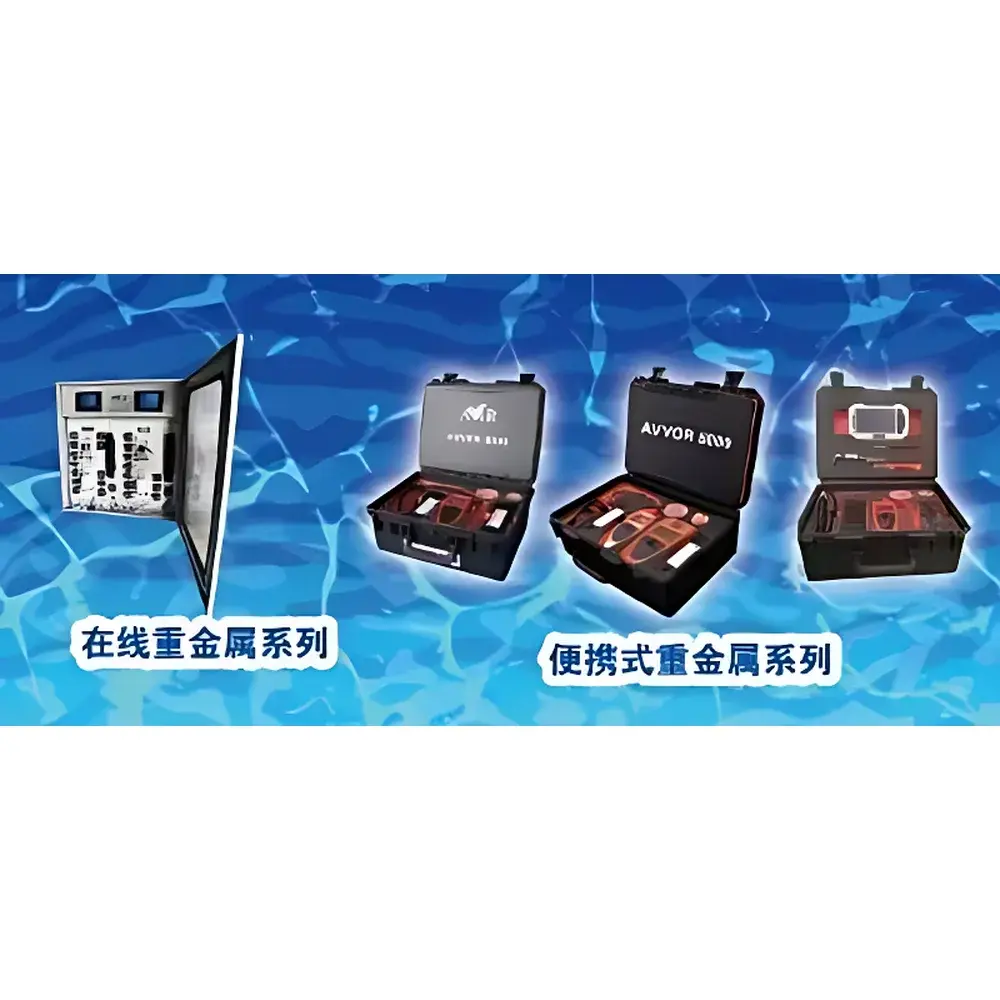
AVVOR 9000 Online Heavy Metals Analyzer
| Brand | AVVOR |
|---|---|
| Origin | Canada |
| Model | AVVOR 9000 |
| Detection Principle | Anodic Stripping Voltammetry (ASV) |
| Detectable Metals | As, Hg, Se, Zn, Cd, Pb, Cu, Mn, Sb, Tl, Fe, Ni, Sn, Cr, Cr(VI), Co, Mo, Au, Ag, Pd, U |
| Configuration | Dual-module support (up to 5 simultaneous metals per module) |
| Output Interfaces | 8 × 4–20 mA analog outputs, RS-485 & RS-232 digital interfaces |
| Compliance | Designed for continuous unattended operation in industrial effluent, municipal wastewater, surface water, groundwater, drinking water and seawater applications |
Overview
The AVVOR 9000 Online Heavy Metals Analyzer is an industrial-grade electrochemical instrument engineered for continuous, real-time quantification of trace heavy metal ions in aqueous matrices. It operates on the internationally standardized anodic stripping voltammetry (ASV) principle—a well-established, reference-method electroanalytical technique recognized by ASTM D3559, ISO 11969, and EPA Method 7000B for trace metal speciation and quantification. In ASV, target metal ions are first preconcentrated (electrodeposited) onto a working electrode under controlled potential and time, followed by a quiet period to allow diffusion stabilization, and finally oxidized (stripped) with a linear or staircase potential scan. The resulting current peaks—each uniquely associated with a specific metal’s redox potential—are measured and quantified via calibration curves. This method delivers sub-ppb (ng/L) detection sensitivity, high selectivity among co-existing metals, and minimal matrix interference when coupled with integrated sample conditioning (e.g., UV digestion, pH adjustment, and organic removal). The AVVOR 9000 is not a screening tool but a compliance-grade analyzer suitable for regulatory reporting, process control, and early-warning monitoring in critical water streams.
Key Features
- Modular dual-channel architecture: Supports up to two independent ASV measurement modules—enabling concurrent analysis of up to ten distinct heavy metals (e.g., Module 1: As, Hg, Se; Module 2: Zn, Cd, Pb, Cu, Mn, Sb, Tl, Fe, Ni, Sn).
- Electrode flexibility: Interchangeable working electrodes—including gold, mercury-film, bismuth-film, and bare carbon—optimized for specific metal groups and oxidation states (e.g., Cr(VI) vs. total Cr).
- Automated operational sequence: Fully integrated sample aspiration, filtration, pH conditioning, standard addition calibration, electrode cleaning, and multi-point validation—all executed without manual intervention.
- Robust environmental rating: IP65-rated enclosure with internal humidity control and temperature-stabilized cell housing for reliable deployment in outdoor cabinets, pump stations, or industrial control rooms.
- Regulatory-ready data integrity: Built-in audit trail, timestamped event logging, calibration history storage, and configurable alarm thresholds aligned with GLP/GMP and EPA-approved data handling practices.
- Flexible connectivity: Eight programmable 4–20 mA analog outputs (assignable to any measured parameter or diagnostic status), plus dual serial ports (RS-485 Modbus RTU and RS-232) for SCADA integration and remote diagnostics.
Sample Compatibility & Compliance
The AVVOR 9000 is validated for use with raw and pretreated water samples across a broad conductivity range (0–5 mS/cm) and pH 2–10. It accommodates influent and effluent streams from electroplating facilities, mining discharge points, municipal wastewater treatment plants, potable water distribution systems, and coastal monitoring buoys. Sample pretreatment—including inline UV oxidation (for organo-metallic complex breakdown), membrane filtration (≤0.45 µm), and automatic buffer dosing—is performed upstream to ensure electrochemical fidelity. The system complies with key international performance criteria: detection limits meet or exceed those specified in ISO 17294-2 (water quality — elemental composition by ICP-MS) for comparative validation, and its ASV methodology is referenced in EN ISO 11969 for cadmium, lead, and zinc determination. While not certified as a Class I medical device, it meets CE marking requirements for industrial instrumentation (EMC Directive 2014/30/EU and Low Voltage Directive 2014/35/EU).
Software & Data Management
The embedded firmware (v4.2+) provides a web-accessible interface for configuration, diagnostics, and historical trend review via HTTPS. All measurements, calibration events, maintenance logs, and fault codes are stored locally on non-volatile memory with 30-day rolling retention. Data export supports CSV and XML formats compatible with LIMS platforms. Optional cloud synchronization enables secure remote access through TLS 1.2–encrypted MQTT or RESTful API endpoints. Audit trails record user login/logout, parameter changes, calibration overrides, and sensor replacement—fully traceable per FDA 21 CFR Part 11 requirements when deployed in regulated environments. Firmware updates are delivered via signed OTA packages to ensure cryptographic integrity.
Applications
- Real-time compliance monitoring at NPDES or EU Urban Wastewater Treatment Directive (91/271/EEC) discharge points.
- Early leak detection in industrial cooling towers or rinse-water recirculation loops containing Cu, Ni, or Cr.
- Groundwater plume tracking at brownfield sites using autonomous buoy-mounted deployments.
- Drinking water safety assurance at intake points upstream of coagulation/filtration units.
- Process optimization in hydrometallurgical leach circuits where Zn, Co, or Mo concentrations directly impact recovery efficiency.
- Marine environmental surveillance for Hg, As, and Cd bioaccumulation risk assessment in estuarine zones.
FAQ
What metals can the AVVOR 9000 quantify simultaneously?
Up to five metals per module, with dual-module configuration supporting up to ten distinct analytes—including As(III), Hg(II), Cd(II), Pb(II), Cu(II), Zn(II), Mn(II), Ni(II), Cr(VI), and Sb(III)—depending on electrode selection and method programming.
Does the system require daily manual maintenance?
No. Scheduled electrode polishing, electrolyte replenishment, and calibration verification are automated; recommended preventive maintenance intervals are every 90 days under continuous operation.
Can it interface with existing PLC or DCS systems?
Yes. Native Modbus RTU over RS-485 allows seamless integration with Allen-Bradley, Siemens, Schneider Electric, and Yokogawa control systems without gateway hardware.
Is laboratory validation required before field deployment?
Field commissioning includes a three-point certified standard verification; however, site-specific matrix spike recovery testing (per EPA Method 7000B Section 9.2) is advised for regulatory acceptance.
How is interference from chloride or sulfide managed?
Integrated UV/persulfate digestion eliminates sulfide complexes, while proprietary pulse waveform optimization minimizes chloride-induced background noise during stripping scans.







