
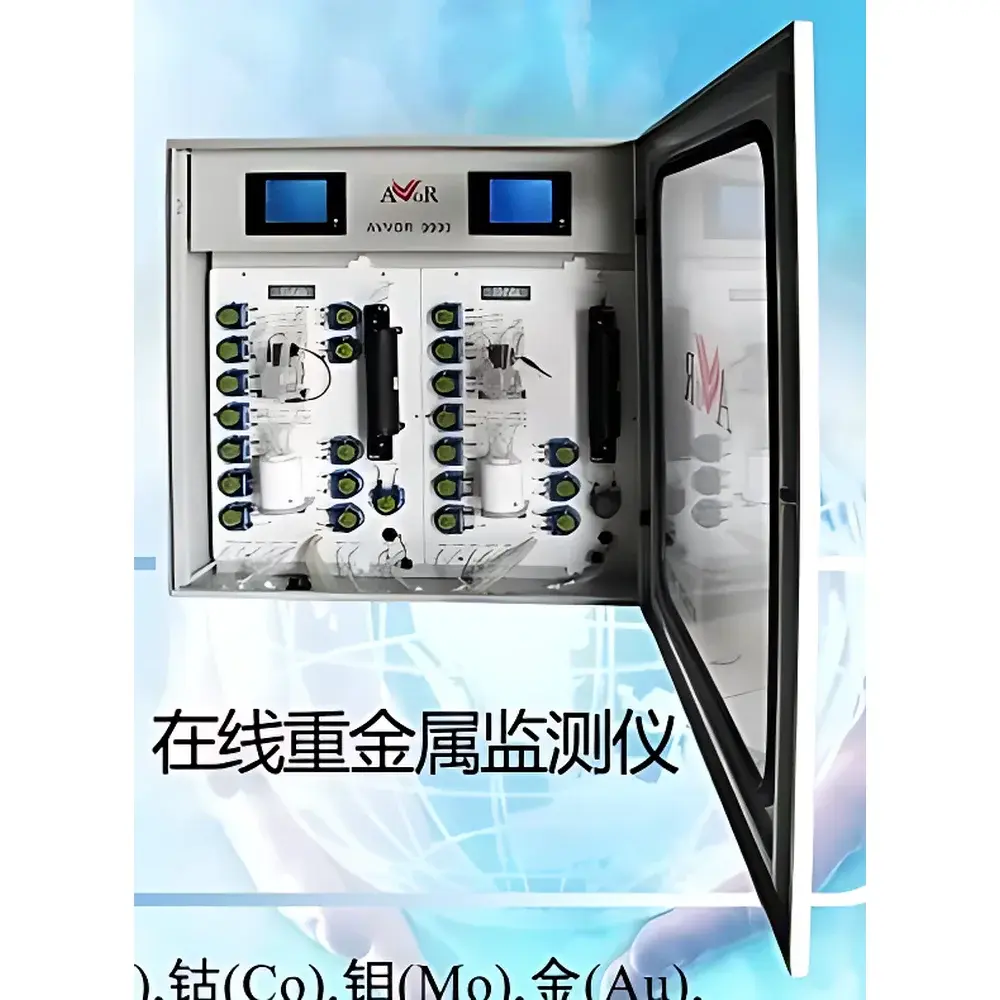
AVVOR 9000 Online Heavy Metals Analyzer Based on Anodic Stripping Voltammetry
| Brand | AVVOR |
|---|---|
| Origin | Canada |
| Model | AVVOR 9000 |
| Detection Principle | Anodic Stripping Voltammetry (ASV) |
| Measurable Elements | Cu, Pb, Zn, Cd, Mn, Sb, Tl, Fe, Ni, As, Hg, Se, Co, Mo, Au, Ag, Cr, Cr(VI), Sn, Pd, U |
| Electrode Options | Gold, Mercury-film, Bismuth-film, Bare Carbon |
| Max. Simultaneous Channels | 2 modules × 5 elements each |
| Output Interfaces | 8 × 4–20 mA analog outputs, RS-485, RS-232 |
| Compliance | Designed for ASTM D3559, ISO 11929, USP <232>/<233>, EPA Method 7000B & 7473 |
| Environmental Certification | IP65 enclosure, NEMA 4X-rated housing |
Overview
The AVVOR 9000 Online Heavy Metals Analyzer is an electrochemical instrumentation platform engineered for continuous, real-time quantification of trace-level heavy metal ions in aqueous matrices. It operates on the internationally standardized principle of Anodic Stripping Voltammetry (ASV), a two-stage potentiostatic technique comprising controlled pre-electrolytic enrichment followed by potential-sweep-induced oxidative dissolution. During the deposition phase, target metal cations are reduced and accumulated onto the surface of a working electrode under a fixed negative potential. After a defined equilibration period, a linear or staircase anodic potential scan is applied, causing oxidation and re-dissolution of the enriched metals. The resulting current peaks—each uniquely positioned at characteristic formal potentials—are measured amperometrically and correlated to analyte concentration via calibration curves. This method delivers sub-pptr (picogram-per-liter) detection limits for most transition and post-transition metals, with high selectivity enabled by differential peak separation and electrode material optimization.
Key Features
- Modular dual-channel architecture supporting up to two independent ASV test modules, each configurable for up to five simultaneous elements
- Interchangeable working electrodes: gold (for As, Hg, Se), mercury-film (for Zn, Cd, Pb, Cu, Mn, Sb, Tl, Fe, Ni, Sn), bismuth-film (for Cd, Pb, Zn, Co), and bare carbon (for Cr, Mo, Pd, Au, Ag)
- Integrated sample pretreatment system with UV digestion and chelation masking to minimize organic interference and matrix effects
- Automated calibration sequence with standard addition capability and drift compensation algorithms
- IP65/NEMA 4X-rated stainless-steel enclosure with humidity-controlled internal environment and self-diagnostic thermal management
- Eight programmable 4–20 mA analog outputs assignable to any measured parameter or diagnostic status; dual serial interfaces (RS-485 Modbus RTU and RS-232)
- Fail-safe operation: automatic power-loss recovery, flow interruption lockout, and electrolyte depletion alerting
Sample Compatibility & Compliance
The AVVOR 9000 is validated for direct analysis of raw and treated water streams without dilution across pH 4.0–9.5 and conductivity ≤ 2,000 µS/cm. It meets performance criteria outlined in EPA Method 7000B (for Pb, Cd, Cu, Zn) and Method 7473 (for Hg), and aligns with ISO 11929 for uncertainty evaluation of electrochemical measurements. Instrument firmware supports audit-trail logging compliant with FDA 21 CFR Part 11 requirements when deployed in GLP/GMP-regulated environments. All calibration and maintenance records—including electrode renewal timestamps, blank signal stability metrics, and spike recovery data—are timestamped, user-annotated, and exportable in CSV or PDF format.
Software & Data Management
The embedded Linux-based control system runs AVVOR Analytical Suite v4.2, featuring intuitive web-accessible GUI with role-based permissions (operator, supervisor, administrator). Real-time chromatogram-like voltammograms are rendered alongside peak integration overlays and baseline correction toggles. Data archiving includes raw current-potential sweeps, processed peak tables, QC flagging (e.g., low deposition current, unstable baseline, peak asymmetry >15%), and automated report generation per ISO/IEC 17025 templates. Remote monitoring is supported via MQTT over TLS or secure HTTP(S), enabling integration into SCADA, LIMS, or cloud-based environmental dashboards.
Applications
The AVVOR 9000 serves as a primary compliance tool in municipal wastewater effluent monitoring (especially for NPDES permit reporting), industrial discharge control (electroplating, mining leachate, semiconductor rinse water), drinking water safety verification (lead/copper rule implementation), and ecological risk assessment of surface and groundwater bodies. Its ability to resolve Cr(III) vs. Cr(VI) using selective electrode conditioning protocols makes it particularly valuable for regulatory distinction of hexavalent chromium—a known carcinogen subject to strict EU REACH and US OSHA exposure limits. Field deployments in coastal zones also leverage its seawater-tolerant electrode configurations and salinity-compensated algorithms.
FAQ
What electrode materials are recommended for mercury detection?
Gold working electrodes are specified for Hg(II) analysis due to their high affinity, reproducible stripping response, and resistance to amalgam overloading.
Can the AVVOR 9000 comply with EPA Method 7473 for total mercury?
Yes—when paired with the optional UV/persulfate oxidation module and gold electrode, it fulfills all procedural validation requirements including spike recovery (85–115%), MDL confirmation (<0.02 µg/L), and inter-laboratory precision benchmarks.
How frequently does the system require recalibration?
Factory-recommended interval is every 72 hours under continuous operation; however, adaptive calibration scheduling adjusts dynamically based on signal stability metrics and historical drift trends.
Is remote firmware update supported?
Yes—signed OTA (over-the-air) updates are delivered via HTTPS with SHA-256 integrity verification and rollback capability.
Does the instrument support multi-point standard addition?
Yes—the software includes automated standard addition workflows with customizable volume increments, mixing time, and deposition potential optimization per element.







