
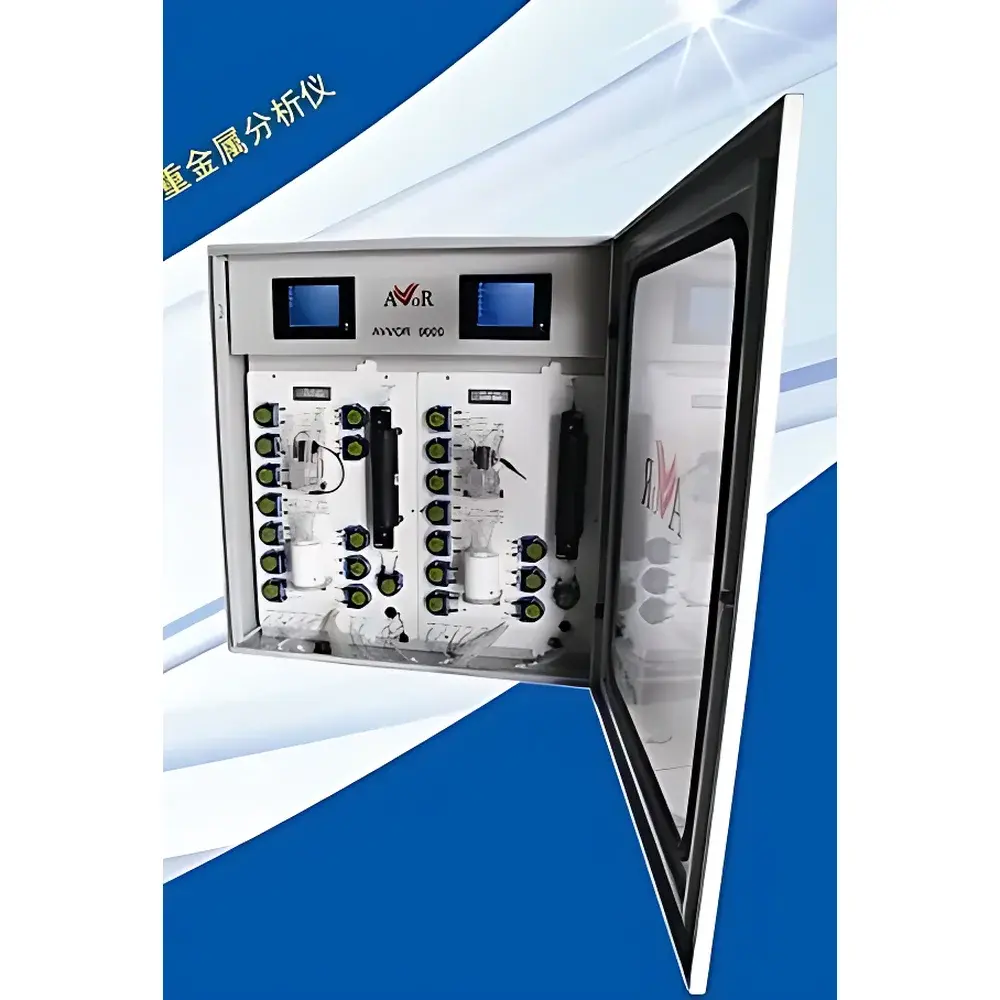
AVVOR 9000 Online Heavy Metals Analyzer for Water Quality Monitoring
| Brand | AVVOR |
|---|---|
| Origin | Canada |
| Model | AVVOR 9000 |
| Detection Principle | Anodic Stripping Voltammetry (ASV) |
| Measurable Elements | Cu, Pb, Zn, Cd, Mn, Sb, Tl, Fe, Ni, As, Hg, Se, Co, Mo, Au, Ag, Cr, Cr(VI), Sn, Pd, U |
| Electrode Options | Gold, Mercury-film, Bismuth-film, Bare Carbon |
| Max Modules | 2 |
| Max Simultaneous Parameters per Module | 5 |
| Analog Outputs | 8 × 4–20 mA |
| Digital Interfaces | RS-485, RS-232 |
| Compliance | Designed for ASTM D3559, ISO 11885, EPA Method 7063, and USP <232>/<233> guidance |
| Environmental Rating | IP65 Enclosure with Humidity Control |
| Power Supply | 100–240 VAC, 50/60 Hz |
Overview
The AVVOR 9000 Online Heavy Metals Analyzer is a fully automated, continuous-monitoring instrument engineered for real-time quantification of trace-level heavy metal ions in aqueous matrices. It operates on the internationally standardized electrochemical principle of Anodic Stripping Voltammetry (ASV), a technique recognized by regulatory frameworks including EPA Method 7063, ASTM D3559, and ISO 11885 for its high sensitivity, selectivity, and reproducibility in low-concentration (sub-ppb to low-ppb) metal analysis. Unlike optical or atomic absorption methods requiring sample digestion or laboratory infrastructure, the AVVOR 9000 performs in-situ electrochemical preconcentration and stripping directly within a flow-through cell—enabling rapid, reagent-free, and maintenance-optimized operation. Its primary deployment domains include industrial effluent streams, municipal wastewater discharge points, drinking water distribution networks, surface and groundwater monitoring stations, and marine environmental surveillance systems. The analyzer’s architecture supports unattended 24/7 operation with integrated auto-calibration, fault diagnostics, and environmental protection features—including IP65-rated enclosure with internal humidity control—to ensure long-term stability in field-deployed or harsh plant environments.
Key Features
- Modular dual-channel design: Supports up to two independent ASV measurement modules, each configurable for distinct elemental panels (e.g., As/Hg/Se in Module 1; Zn/Cd/Pb/Cu/Mn in Module 2).
- Electrode flexibility: Interchangeable working electrodes—including gold, mercury-film, bismuth-film, and bare carbon—allow optimization for specific analytes and matrix interferences.
- Multi-parameter capability: Each module delivers simultaneous quantification of up to five metals without hardware modification, leveraging differential pulse and square-wave voltammetric waveforms.
- Robust signal conditioning: Eight isolated 4–20 mA analog outputs, individually assignable to any measured parameter via embedded configuration software; all outputs support HART-compatible scaling and fail-safe modes.
- Dual communication protocol support: RS-485 (Modbus RTU) and RS-232 interfaces enable seamless integration into SCADA, DCS, or LIMS platforms with bidirectional data exchange and remote firmware updates.
- Autonomous operational integrity: Built-in automatic calibration scheduling, self-diagnostic routines for electrode health and flow path integrity, power-loss recovery with non-volatile memory retention, and dry-run protection for peristaltic sampling pumps.
Sample Compatibility & Compliance
The AVVOR 9000 is validated for direct analysis of clarified, filtered, or pre-treated water samples across pH 2–10 and conductivity ≤2 mS/cm. Integrated sample conditioning includes programmable acidification (HNO₃ or HCl), UV digestion (optional add-on), and membrane filtration to mitigate organic fouling and redox interference—critical for accurate detection of labile species such as Cr(VI), Hg(II), and As(III). All analytical protocols align with GLP-aligned data handling requirements: audit-trail-enabled calibration logs, timestamped raw voltammograms stored locally (≥30 days), and secure user-access levels (admin/operator/viewer). Instrument validation documentation supports compliance with ISO/IEC 17025 laboratory accreditation, FDA 21 CFR Part 11 electronic record controls (when paired with compliant SCADA), and EU WFD (Water Framework Directive) monitoring objectives.
Software & Data Management
The embedded firmware provides a web-based HTML5 interface accessible via Ethernet or optional Wi-Fi module—eliminating dependency on proprietary desktop applications. Real-time visualization includes dynamic voltammogram overlays, trend charts with configurable averaging windows (1 min to 24 h), and alarm thresholds with hysteresis logic. Data export formats include CSV, PDF reports (with digital signature support), and Modbus-mapped registers for third-party historian ingestion. Optional cloud synchronization enables centralized fleet monitoring across distributed sites, with TLS 1.2 encryption and role-based API access control. All calibration standards, method files, and QC checklists are version-controlled and exportable for regulatory submission.
Applications
- Industrial process water monitoring: Real-time tracking of Cu, Ni, Cr(VI), and Zn in plating rinse waters and semiconductor ultrapure water loops.
- Municipal wastewater compliance: Continuous reporting of Pb, Cd, Hg, and As at NPDES outfall points per EPA 40 CFR Part 136 requirements.
- Drinking water safety assurance: Early-warning detection of leached Pb from aging infrastructure or As contamination in groundwater-supplied utilities.
- Environmental remediation verification: Field-deployable assessment of Cr(VI) and U migration in soil leachate or aquifer monitoring wells.
- Marine and estuarine research: Quantification of bioavailable Cd, Co, and Mn in nutrient-rich coastal zones where speciation affects ecological risk modeling.
FAQ
What electrochemical method does the AVVOR 9000 use, and why is it suitable for regulatory compliance?
It employs Anodic Stripping Voltammetry (ASV), a reference-grade technique cited in EPA Method 7063 and ISO 11885 for trace metal analysis due to its sub-ppb detection limits, minimal reagent consumption, and robustness against complex matrices.
Can the instrument measure hexavalent chromium (Cr(VI)) separately from total chromium?
Yes—Cr(VI) is selectively detected using a pH-controlled, ligand-free ASV protocol with gold electrode; total Cr requires separate reduction pretreatment, supported via optional method scripting.
How often does the system require maintenance or electrode replacement?
Gold and bismuth-film electrodes typically operate >6 months under continuous duty; mercury-film electrodes require renewal every 2–4 weeks depending on sample load and sulfide content.
Is the AVVOR 9000 compatible with existing PLC or SCADA systems?
Fully compatible via RS-485 Modbus RTU or 4–20 mA analog signals; configuration templates are provided for Siemens, Rockwell, Schneider, and Honeywell platforms.
Does the analyzer support remote diagnostics and firmware updates?
Yes—secure HTTPS web interface and optional cellular gateway enable remote troubleshooting, parameter adjustment, and over-the-air firmware upgrades with rollback capability.
Related Products







