
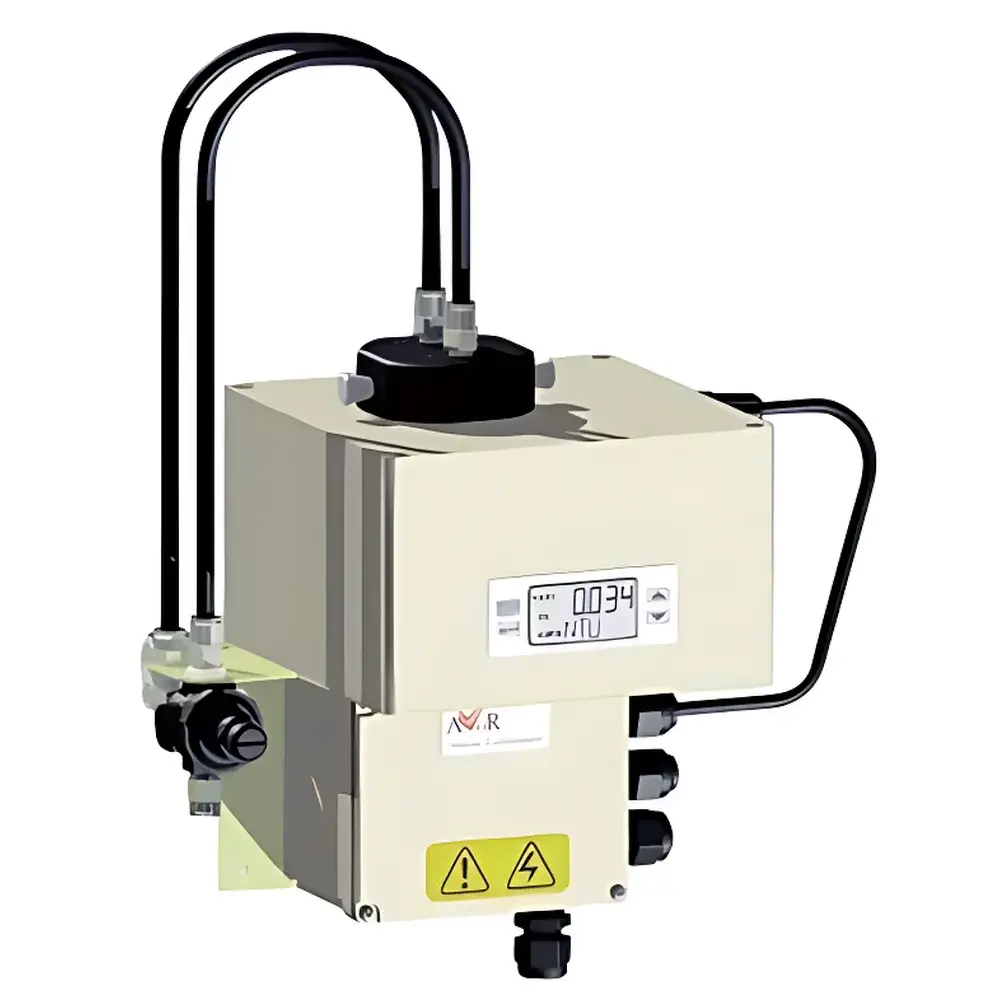
AVVOR 9000 Online Turbidimeter
| Brand | AVVOR |
|---|---|
| Origin | Canada |
| Model | AVVOR 9000 |
| Measurement Range | 0–100 NTU and 0–1000 NTU |
| Measurement Principle | 90° White Light (WL) and 90° Near-Infrared (NIR) Scattering per USEPA Method 180.1 and ISO 7027 |
| Accuracy | ±2% of reading or ±0.02 NTU (whichever is greater) for <40 NTU |
| Resolution | 0.0001 NTU (selectable, applicable below 10 NTU) |
| Response Time | 5–500 s (user-adjustable) |
| Light Source Lifetime | 7 years (white LED), 10 years (NIR LED) |
| Operating Temperature | +1 °C to +50 °C |
| Sample Flow Rate | 100 mL/min to 1 L/min |
| Max Inlet Pressure | 1380 kPa (integrated pressure regulator) |
| Display | Backlit multi-line LCD |
| Analog Output | Isolated 4–20 mA (600 Ω max load) |
| Digital Interface | Bidirectional RS-485 with Modbus RTU protocol |
| Alarm Outputs | Two programmable relays (120–240 VAC, 2 A) |
Overview
The AVVOR 9000 Online Turbidimeter is a high-reliability, process-integrated optical instrument engineered for continuous, real-time turbidity monitoring in potable water, wastewater, industrial effluent, and membrane filtration applications. It operates on the fundamental principle of nephelometry—quantifying suspended particulate matter by measuring light scattered at a precise 90° angle relative to the incident beam. The system supports dual-wavelength measurement modes: white light (WL) scattering compliant with U.S. EPA Method 180.1, and near-infrared (NIR) scattering aligned with ISO 7027 and EN ISO 7027. This dual-mode capability mitigates color interference and improves measurement robustness across diverse sample matrices—including yellow-hued surface waters, chlorinated distribution systems, and UV-treated streams—where spectral absorption can compromise single-wavelength performance. Designed for permanent installation in pressurized flow cells or bypass loops, the AVVOR 9000 integrates seamlessly into SCADA and DCS environments via standardized analog and digital interfaces, ensuring traceable, auditable data acquisition under regulated operational frameworks.
Key Features
- Dual optical path architecture: Independent white-light and NIR LED sources with matched 90° detection geometry, enabling method-switching without hardware modification
- Long-life solid-state illumination: 7-year rated lifetime for white LED; 10-year rated lifetime for NIR LED—minimizing scheduled maintenance and calibration drift over extended deployment cycles
- Integrated pressure regulation: Built-in pressure-reducing valve maintains stable flow conditions up to 1380 kPa inlet pressure, eliminating need for external regulators in high-pressure municipal or industrial service lines
- User-configurable response dynamics: Adjustable integration time (5–500 s) allows optimization for transient events (e.g., filter breakthrough) or steady-state compliance reporting
- High-resolution quantification: Selectable 0.0001 NTU resolution in low-range mode (<10 NTU), supporting ultra-low turbidity verification required by modern drinking water standards (e.g., WHO Guidelines, NSF/ANSI 61)
- Electrical isolation and industrial-grade I/O: Galvanically isolated 4–20 mA output, Modbus RTU over RS-485, and two SPDT relays rated for 240 VAC—designed for EMC-compliant operation in electrically noisy plant environments
Sample Compatibility & Compliance
The AVVOR 9000 accommodates aqueous samples with suspended solids concentrations from 0.001 NTU to 1000 NTU, covering raw intake, clarified effluent, and finished water applications. Its flow cell design supports sample temperatures between +1 °C and +50 °C and flow rates from 100 mL/min to 1 L/min—compatible with standard ¼″ or ⅜″ tubing configurations. Calibration is traceable to NIST-traceable formazin or AMCO AEPA standards, and all measurement protocols adhere strictly to regulatory validation requirements: USEPA Method 180.1 for WL mode and ISO 7027:2016 for NIR mode. Instrument firmware includes audit trail logging and user-access controls consistent with GLP and GMP data integrity expectations. While not pre-certified for FDA 21 CFR Part 11, its data export structure and relay event logging support validation pathways for pharmaceutical or beverage manufacturing QA/QC workflows.
Software & Data Management
Local configuration and diagnostics are performed via intuitive menu navigation on the backlit LCD interface, requiring no external PC. For centralized oversight, the embedded Modbus RTU server enables read/write access to all operational parameters—including range selection, alarm thresholds, damping settings, and calibration coefficients—through industry-standard HMI platforms or custom SCADA integrations. All analog outputs include live status flags (e.g., sensor fault, out-of-range, cleaning alert), and relay outputs may be assigned to discrete events such as high-turbidity alarms or maintenance reminders. Raw measurement timestamps, unit identifiers, and diagnostic codes are retained in non-volatile memory for post-event forensic analysis. Optional CSV export via serial interface supports offline trend review and regulatory submission preparation.
Applications
- Drinking water treatment: Continuous monitoring at rapid sand filter effluent, final disinfection contact basins, and clearwell outlets to verify compliance with turbidity limits (e.g., <0.3 NTU average, <1.0 NTU maximum per U.S. LT2ESWTR)
- Wastewater reuse: Real-time verification of tertiary filtration performance prior to membrane bioreactor (MBR) or reverse osmosis (RO) feed streams
- Industrial process water: Monitoring boiler feedwater clarity, cooling tower sidestream filtration, and semiconductor ultrapure water loop integrity
- Environmental compliance: Automated reporting for NPDES permit conditions requiring turbidity-based discharge limits
- Research & pilot-scale studies: High-temporal-resolution turbidity profiling during coagulation/flocculation optimization trials
FAQ
Does the AVVOR 9000 require periodic lamp replacement?
No—the white-light and NIR LEDs are rated for 7 and 10 years of continuous operation respectively, with built-in thermal management and current regulation to ensure stable spectral output over time.
Can the instrument automatically switch between WL and NIR measurement modes?
Yes, mode selection is fully configurable via front-panel menu or Modbus register write, allowing remote switching based on process conditions or regulatory reporting requirements.
Is the 4–20 mA output intrinsically safe for hazardous area installations?
The standard output is non-IS; however, an optional isolated barrier-compatible version is available upon request for Class I, Div 2 or ATEX Zone 2 deployments.
How is calibration verified in-situ without removing the sensor?
The unit supports zero and span verification using certified turbidity standards introduced through the dedicated calibration port, with full traceability logs stored internally.
What maintenance intervals are recommended for long-term accuracy?
Optical window cleaning is advised every 3–6 months depending on fouling potential; full verification against reference standards is recommended annually or after any physical impact or thermal shock event.





