
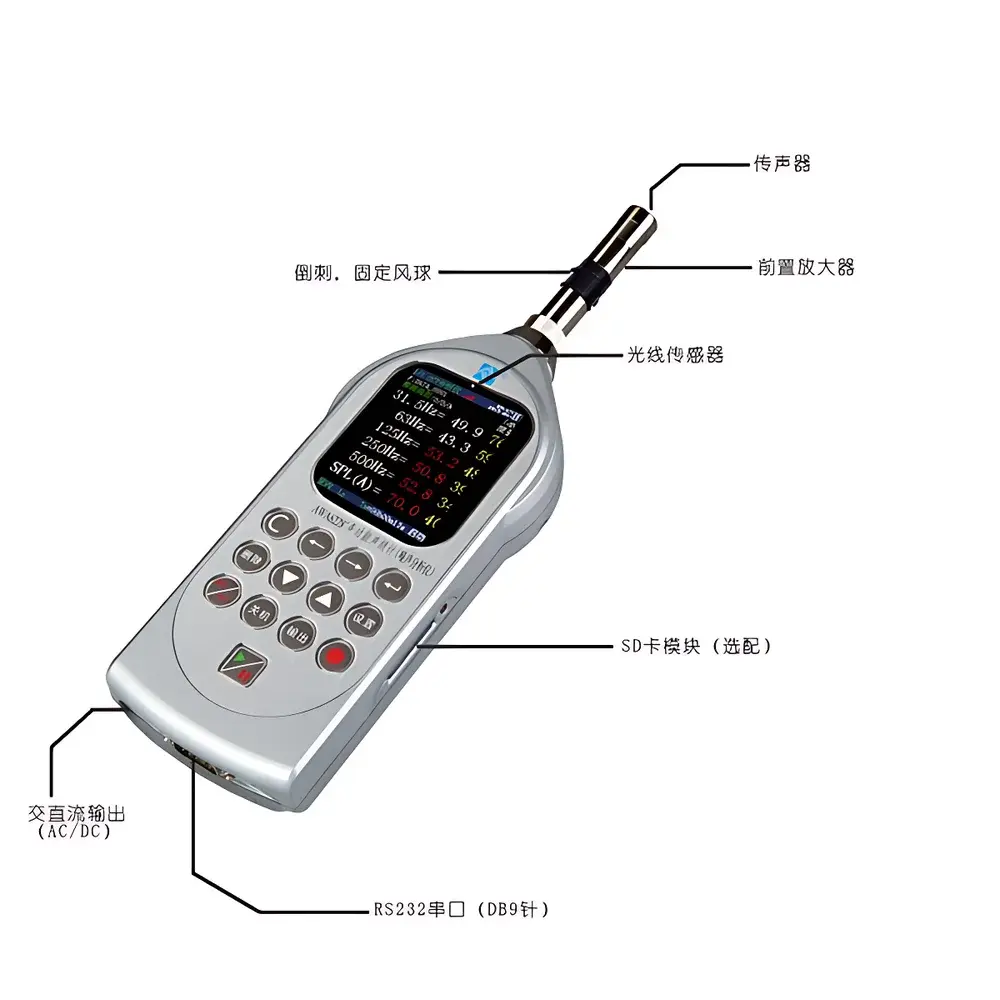
AWA AWA6228+ Class 1 Precision Sound Level Meter
| Brand | AWA |
|---|---|
| Origin | Zhejiang, China |
| Model | AWA6228+ |
| Frequency Range | 10 Hz – 20 kHz |
| Measurement Range | Low Range: 132 dB(A), High Range: 142 dB(A) |
| Self-Noise | <12 dB(A), <17 dB(C), <22 dB(Z) |
| Accuracy | ±1 dB |
| Battery Life | 10 h |
| Compliance | GB/T 3785.1–2010 / IEC 61672–1:2013 Class 1, GB/T 3241–2010 / IEC 61260–1:2014 Class 1 |
Overview
The AWA AWA6228+ Class 1 Precision Sound Level Meter is a digitally signal-processed (DSP) acoustic measurement instrument engineered for high-fidelity environmental and occupational noise assessment. It operates on the fundamental principle of pressure-to-voltage transduction via a precision electret condenser microphone, followed by real-time digital filtering, weighting, and statistical computation in accordance with internationally recognized metrological standards. Designed to meet the stringent performance requirements of IEC 61672–1:2013 Class 1 and its Chinese national equivalent GB/T 3785.1–2010, the AWA6228+ delivers traceable, repeatable sound pressure level (SPL) measurements across a wide dynamic and frequency range. Its architecture supports simultaneous parallel processing of multiple acoustic metrics—including time-weighted (Fast, Slow, Impulse), frequency-weighted (A-, C-, and Z-weighting), and spectral analyses—enabling comprehensive noise characterization without sequential mode switching.
Key Features
- Class 1 accuracy per IEC 61672–1:2013 and GB/T 3785.1–2010, verified through official type evaluation (Certificate No. 2016S593-33)
- Dual-range measurement capability: 132 dB(A) (low range) and 142 dB(A) (high range), with self-noise as low as <12 dB(A) in low-range configuration
- Full-spectrum real-time analysis: simultaneous 1/1-octave and 1/3-octave band filtering per IEC 61260–1:2014 Class 1, plus FFT-based spectral resolution up to 1024 lines
- Integrated time-domain functions: Leq, Lmax, Lmin, Lpeak, LN statistics (L10–L99), personal sound exposure level (LEX,8h), and reverberation time (RT60) calculation
- Modular expansion support: optional modules for audio recording (WAV format), GPS geotagging, Bluetooth data streaming, and external trigger synchronization
- Low-power color LCD display with intuitive graphical interface, configurable data logging intervals, and programmable auto-on/off scheduling
Sample Compatibility & Compliance
The AWA6228+ is compatible with standard 1/2″ electret condenser microphones (e.g., AWA14421 series) and calibrated pistonphones (e.g., AWA6161) for field and laboratory verification. It satisfies regulatory measurement requirements for environmental noise monitoring (e.g., ISO 1996–2:2017), industrial hygiene assessments (OSHA 1910.95, EU Directive 2003/10/EC), and building acoustics (ISO 140–4, ISO 717–1). Its firmware implements full audit-trail functionality for logged datasets, supporting GLP-aligned workflows. While not inherently 21 CFR Part 11 compliant out-of-the-box, raw binary data export (via USB or SD card) enables integration into validated laboratory information management systems (LIMS) where electronic signature and data integrity controls are externally enforced.
Software & Data Management
The instrument interfaces with AWA6228+ PC Analysis Software (Windows-compatible), which provides post-processing visualization of time-history plots, octave spectra, statistical histograms, and exposure dose reports. All measurements are timestamped and stored with metadata including microphone sensitivity, calibration history, and user-defined site tags. Data export formats include CSV (for spreadsheet analysis), TXT (ASCII), and proprietary .AWD files containing full-resolution waveform segments. Firmware updates are delivered via signed HEX packages, ensuring version control and cryptographic integrity. Internal memory retains ≥10,000 measurement records; expandable storage via microSDHC (up to 32 GB) supports continuous multi-day logging at 1-second intervals.
Applications
- Environmental noise mapping around transportation corridors, construction sites, and urban residential zones
- Ongoing compliance monitoring for ISO 14001-certified facilities and municipal noise ordinances
- Occupational noise surveys per ISO 9612:2009 methodology, including task-based exposure profiling
- Acoustic validation of noise control interventions (e.g., barrier efficacy, HVAC system optimization)
- Educational use in acoustics laboratories for teaching spectral analysis, weighting networks, and statistical acoustics principles
- Field validation of building envelope sound insulation per ISO 10140 series test protocols
FAQ
Does the AWA6228+ support real-time octave band analysis during data logging?
Yes — 1/1 and 1/3-octave band spectra are computed in parallel with broadband metrics and stored synchronously with time-stamped Leq and statistical values.
Is external calibration required before each measurement session?
While daily acoustic calibration using a traceable pistonphone (e.g., 114 dB @ 1 kHz) is recommended per ISO 9612 and IEC 61672, the instrument retains calibration coefficients internally and supports one-point electrical verification between acoustic calibrations.
Can measurement data be exported in formats compatible with MATLAB or Python?
Yes — CSV exports contain columnar time-series data (e.g., Leq, Lmax, L10, octave bands) with SI units and UTC timestamps, enabling direct ingestion into NumPy/Pandas or MATLAB’s readmatrix() function.
What is the temperature and humidity operating range?
The device is rated for operation from –10 °C to +50 °C and up to 90% relative humidity (non-condensing), consistent with IEC 61672 environmental class requirements.
Is the AWA6228+ suitable for impulsive noise measurement (e.g., firearm reports or pile driving)?
Yes — its Impulse time-weighting mode (I) and peak detection circuitry (Lpeak) comply with IEC 61672–1:2013 requirements for transient events, with rise time ≤20 µs and overload margin ≥10 dB above full scale.
Related Products







