
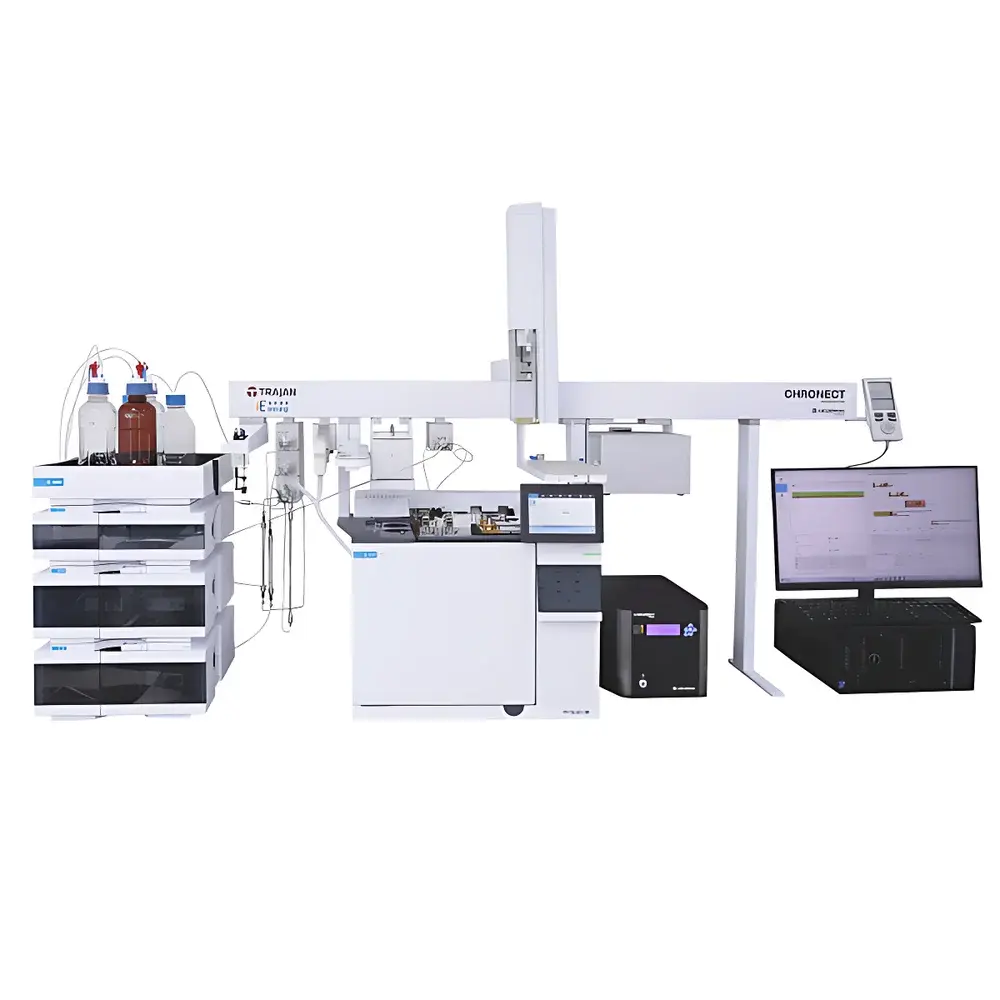
Axel Semrau CHRONECT LC-GC Automated Online Liquid Chromatography–Gas Chromatography System for Mineral Oil Hydrocarbon (MOH) Analysis
| Brand | Axel Semrau |
|---|---|
| Origin | Germany |
| Model | CHRONECT LC-GC |
| Temperature Control Range | 4–450 °C |
| Oven Ramp Rate | up to 120 °C/min |
| Oven Cool-down Rate | up to 100 °C/min |
| Carrier Gas Flow Range & Control | 0–1200 mL/min |
| Carrier Gas Pressure Range & Control | 0–970 kPa (7 pressure segments) |
| Injector Max Operating Temperature | 450 °C |
| Injector Pressure Setting Range | 0–970 kPa |
| Injector Total Flow Setting Range | 0–1200 mL/min |
Overview
The Axel Semrau CHRONECT LC-GC is a fully automated, online liquid chromatography–gas chromatography (LC-GC) hyphenated system engineered for trace-level quantification and speciation of mineral oil hydrocarbons (MOH) in complex food and packaging matrices. It implements the principle of two-dimensional orthogonal separation: first, size- and polarity-based fractionation via high-performance liquid chromatography (HPLC) using activated aluminum oxide (Al2O3) and silica columns; followed by thermal desorption and high-resolution gas chromatographic analysis with flame ionization detection (FID). This architecture enables selective isolation and sequential transfer of saturated mineral oil hydrocarbons (MOSH, C16–C35) and aromatic mineral oil hydrocarbons (MOAH, containing one or more benzene rings) — compounds classified by EFSA and the European Commission as potential genotoxic and bioaccumulative contaminants. The system operates without manual intervention across sample preparation, column conditioning, fraction collection, and GC injection — minimizing analyst exposure, reducing carryover risk, and ensuring inter-laboratory reproducibility required for regulatory compliance.
Key Features
- Fully integrated online LC-GC coupling with programmable interface valves and cryo-focusing traps for quantitative transfer of MOSH/MOAH fractions
- Automated alumina oxidation module for selective removal of interfering aliphatic co-extractives prior to MOSH analysis
- Automated epoxidation unit enabling selective derivatization and elimination of MOAH-interfering terpenes and sterols
- Robust temperature-controlled oven with ultra-fast heating (≤120 °C/min) and cooling (≤100 °C/min) profiles, supporting rapid method development and high-throughput screening
- Multi-segment carrier gas pressure control (7 independent setpoints) and precision mass flow regulation (0–1200 mL/min), ensuring retention time stability under gradient conditions
- High-temperature injector (up to 450 °C) with pressure- and flow-programmable operation compatible with large-volume injection (LVI) and cold-on-column techniques
Sample Compatibility & Compliance
The CHRONECT LC-GC system is validated for use with diverse sample types including edible oils, infant formula, chocolate, dried fruits, animal feed, cosmetic emulsions, and migration-tested food contact materials (e.g., recycled cardboard, printing inks). Its analytical workflow conforms rigorously to DIN EN 16995:2017-08 (“Vegetable oils and foods based thereon — Determination of mineral oil saturated hydrocarbons (MOSH) and mineral oil aromatic hydrocarbons (MOAH) by online HPLC-GC-FID”) and ISO 20122:2024 (“Food safety — Determination of mineral oil hydrocarbons in food and food contact materials — Method using online liquid chromatography–gas chromatography”). All hardware modules and software logic are designed to support audit-ready data integrity: full electronic records, user-access logging, method versioning, and instrument state tracking align with GLP and GMP principles. While not inherently 21 CFR Part 11-compliant out-of-the-box, the Chronect software platform supports optional validation packages for regulated environments requiring electronic signature and audit trail capabilities.
Software & Data Management
Chronect software serves as the unified control and evaluation environment for the entire LC-GC sequence. It provides vendor-agnostic driver support for major HPLC and GC platforms (including Agilent, Thermo Fisher, Shimadzu, and Waters), enabling seamless integration into existing laboratory infrastructures. Method templates for EN 16995 and ISO 20122 are preloaded with calibrated retention windows, peak integration rules, and reporting formats compliant with EU Commission Recommendation 2017/84/EU. Raw data files adhere to ASTM E1947-compliant formats; processed results include MOSH and MOAH concentration (mg/kg), carbon number distribution histograms, and signal-to-noise ratios for each resolved fraction. All chromatograms, calibration curves, and audit logs are stored in encrypted SQLite databases with configurable backup intervals and role-based access permissions.
Applications
- Quantitative MOSH/MOAH profiling in vegetable oils, margarines, and frying fats per EU monitoring programs
- Migration testing of mineral oil residues from recycled paperboard packaging into dry foods
- Screening of MOAH in cocoa butter substitutes and confectionery coatings where polycyclic aromatic hydrocarbon (PAH) interference must be distinguished from true MOAH
- Supporting EFSA’s ongoing risk assessment on MOH exposure via dietary intake pathways
- Method transfer and harmonization across contract laboratories participating in interlaboratory comparison studies (e.g., FAPAS, QUASIMODO)
FAQ
Does the CHRONECT LC-GC support offline GC×GC-TOF/MS confirmation?
Yes — its automated fraction collector delivers discrete MOSH and MOAH cuts in solvent-compatible vials, enabling subsequent off-line analysis by comprehensive two-dimensional gas chromatography coupled with time-of-flight mass spectrometry for structural identification.
Can the system analyze solid samples directly?
No — solid or semi-solid matrices (e.g., chocolate, feed pellets) require prior solvent extraction (e.g., hexane/iso-octane) and cleanup (e.g., silica gel column) before LC-GC injection; SOPs for these steps are documented in the system’s application library.
Is method validation documentation included?
Yes — the delivery package includes a complete validation report covering specificity, linearity (0.1–10 mg/kg), LOD/LOQ (0.05 mg/kg MOSH; 0.02 mg/kg MOAH), repeatability (RSD ≤6%), and robustness testing per ICH Q2(R2) guidelines.
What maintenance intervals are recommended for the LC-GC interface?
The cryo-trap and transfer line require quarterly inspection and cleaning; Al2O3 and silica columns are rated for ≥200 injections under standard operating conditions and are monitored via backpressure trends in Chronect.
Is remote diagnostics supported?
Yes — optional secure VPN-enabled remote access allows Axel Semrau service engineers to perform real-time troubleshooting, firmware updates, and preventive maintenance scheduling without on-site visits.






