
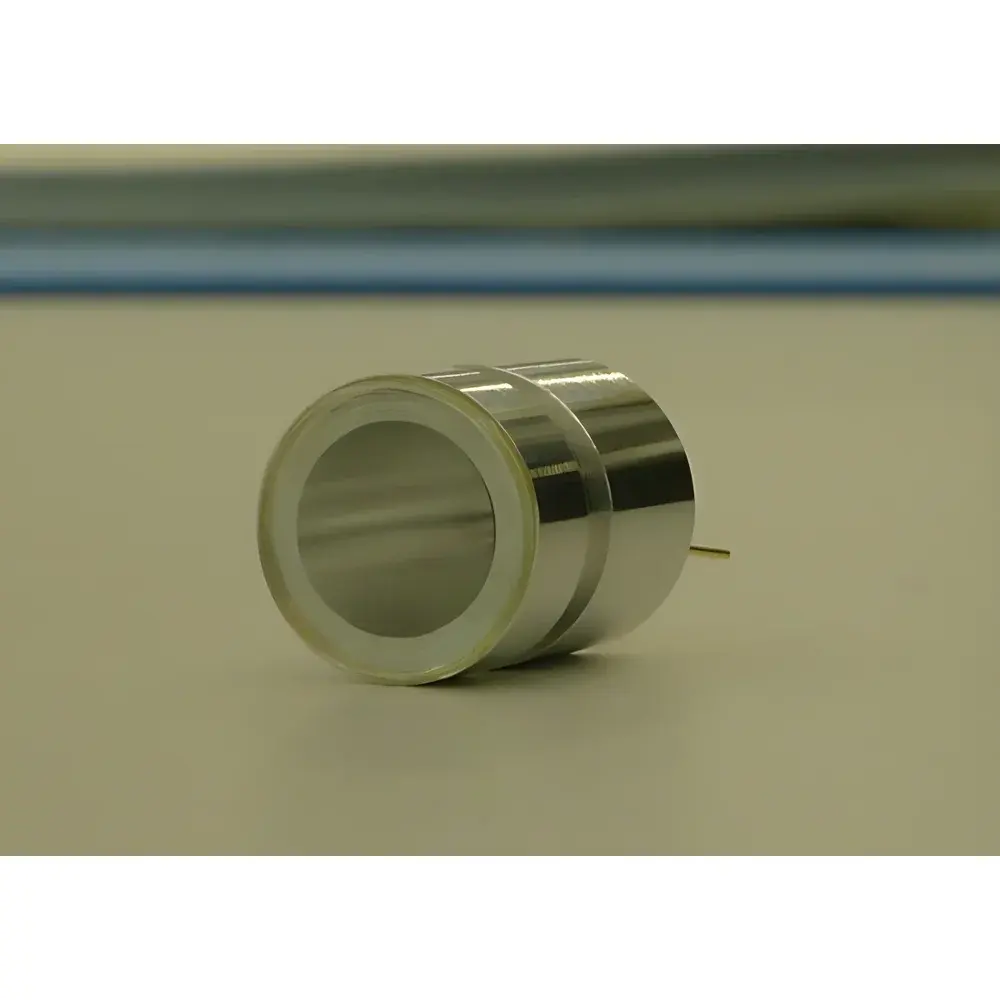
Axetris EMIRS Series Infrared Source with Optical Window
| Brand | Axetris |
|---|---|
| Origin | Switzerland |
| Housing | TO-39 metal can |
| Optical Window Options | Sapphire, CaF₂, BaF₂, Germanium |
| Spectral Range | 2–16 µm |
| Emission Profile | Near-ideal blackbody radiation |
| Modulation Capability | Electrical (chopper-free), kHz-range square-wave compatible |
| Power Consumption | Low (<150 mW typical operating power) |
| Lifetime | >50,000 hours (MTTF) |
| MEMS Architecture | Silicon-based microheater with dielectric thin-film coating on Si substrate |
| Compliance | IEC 61721-3-7 Class 7M3 qualified (excluding CaF₂/BaF₂ window variants) |
Overview
The Axetris EMIRS Series Infrared Source with Optical Window is a MEMS-based thermal emitter engineered for high-stability, low-power infrared spectroscopy in compact gas sensing systems. Operating on the principle of resistive heating of a microfabricated silicon-supported thin-film resistor, the EMIRS emitter produces near-blackbody radiation across a broad mid-infrared spectrum (2–16 µm), optimized for absorption bands of key target gases including CO, CO₂, CH₄, NH₃, NOₓ, SO₂, SF₆, VOCs, anesthetic agents, and ethanol. Unlike conventional filament or ceramic IR sources, the EMIRS design eliminates mechanical choppers by enabling direct electrical modulation—achieving clean, repeatable square-wave intensity switching at frequencies up to several kHz. This intrinsic modulability supports phase-sensitive detection schemes essential for NDIR (Non-Dispersive Infrared), PAS (Photoacoustic Spectroscopy), and ATR-FTIR (Attenuated Total Reflection Fourier Transform Infrared) configurations without optical moving parts.
Key Features
- MEMS-integrated silicon microheater with dielectric emissive coating, delivering stable, spectrally smooth blackbody-like emission
- Hermetically sealed TO-39 metal-can package with optional integrated reflector cup and protective cap for directional output control
- Standard and customizable optical windows: sapphire (transmission: 0.15–5.5 µm), calcium fluoride (CaF₂, 0.13–9 µm), barium fluoride (BaF₂, 0.15–12 µm), and germanium (Ge, 2–16 µm)
- Low steady-state power draw (<150 mW typical), enabling battery-operated and portable instrumentation
- High emissivity (>0.95 across 3–12 µm for standard configuration), ensuring minimal spectral distortion and high signal-to-noise ratio
- Proven long-term reliability: MTTF exceeding 50,000 hours under continuous operation at rated drive conditions
- IEC 61721-3-7 Class 7M3 qualified for mechanical shock and vibration robustness (valid for sapphire- and Ge-windowed variants)
Sample Compatibility & Compliance
The EMIRS source is compatible with gas cells employing single-pass, multipass (e.g., White or Herriott cells), photoacoustic cavities, and ATR waveguides. Its spectral output aligns with ISO 8573-5 (compressed air purity), ASTM D6245 (CO₂ in indoor air), EN 14687 (medical gas analyzers), and IEC 60601-2-56 (anesthesia gas monitoring). While the base device meets IEC 61721-3-7 Class 7M3 for mechanical durability, CaF₂ and BaF₂ window variants require separate qualification due to their lower fracture toughness under thermal cycling. All configurations comply with RoHS Directive 2011/65/EU and REACH Regulation (EC) No. 1907/2006. For regulated medical devices, the EMIRS supports traceable calibration protocols aligned with ISO/IEC 17025 and GLP documentation requirements.
Software & Data Management
As a hardware-level component, the EMIRS does not include embedded firmware or onboard software. It interfaces directly with external driver circuits (e.g., constant-current or PWM-controlled voltage sources) and is fully compatible with industry-standard analog/digital control platforms—including National Instruments DAQ systems, Texas Instruments MSP430-based sensor nodes, and ARM Cortex-M microcontrollers. Integration into FDA 21 CFR Part 11-compliant systems is enabled via external audit-trail logging of drive parameters (voltage, current, duty cycle, temperature feedback) and operational timestamps. Reference driver schematics, thermal modeling files (.STEP, .STL), and spectral radiance datasets (in CSV and MATLAB format) are provided under NDA upon request for system-level validation.
Applications
- Medical Diagnostics: Capnography modules, anesthetic gas monitors (ISO 80601-2-13), respiratory function analyzers, and breath alcohol testers (EN 15964)
- Automotive Safety: On-board OBD-II compliant exhaust gas sensors, ignition-interlock breathalyzers (SAE J2716), and cabin air quality controllers
- HVAC & Building Automation: Demand-controlled ventilation (DCV) CO₂ sensors (ASHRAE Standard 62.1), refrigerant leak detectors (ASHRAE Standard 15)
- Industrial Safety: Fixed and portable combustible gas detectors (IEC 60079-29-1), fumigation chamber monitors, and semiconductor process gas analyzers
- Environmental Monitoring: Ambient air quality stations (EPA Method TO-15, EN 14662), landfill methane tracking, and agricultural silo gas safety systems
FAQ
What is the maximum recommended drive current for continuous operation?
The absolute maximum DC drive current is 120 mA; however, optimal lifetime and stability are achieved at ≤95 mA with active thermal management.
Can the EMIRS be operated in pulsed mode with 50% duty cycle at 10 Hz?
Yes—electrical modulation is fully supported across 0.1–5 kHz. Pulsed operation at 10 Hz with 50% duty cycle is within specification and enhances signal discrimination in noisy environments.
Is spectral calibration data provided with each unit?
Spectral radiance curves (W·sr⁻¹·m⁻²·nm⁻¹ vs. wavelength) are supplied as batch-certified reference data per window material; unit-level NIST-traceable calibration is available as an optional service.
Does the TO-39 package support reflow soldering?
Yes—the package is compatible with lead-free reflow profiles per IPC/JEDEC J-STD-020D, peak temperature ≤260°C for ≤30 seconds.
Are there restrictions on using CaF₂ windows in humid environments?
CaF₂ exhibits slight hygroscopic sensitivity; prolonged exposure to RH >80% may cause surface clouding. For high-humidity applications, sapphire or Ge windows are recommended.



