
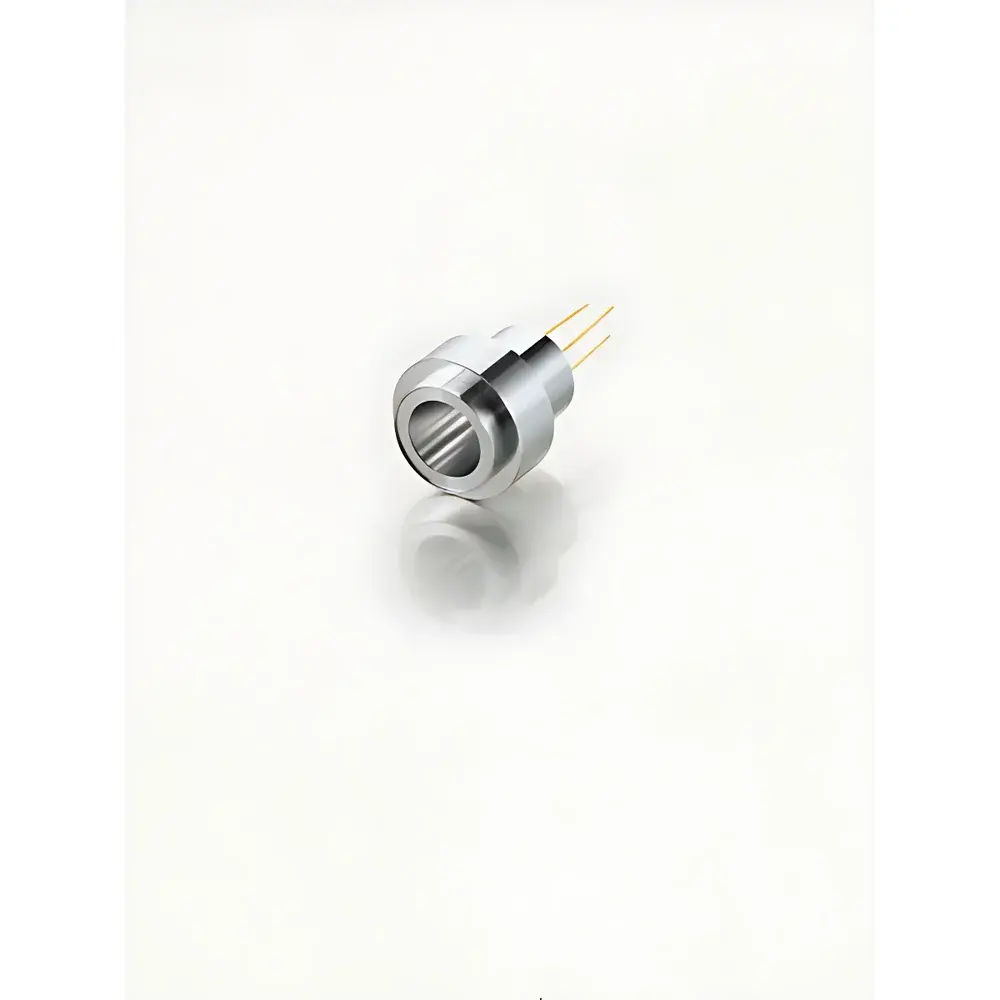
Axetris EMIRS200_AT01T_BR090 MEMS-Based Blackbody Infrared Source for NDIR, PAS & ATR-FTIR Gas Sensing
| Brand | Axetris |
|---|---|
| Origin | Switzerland |
| Model | EMIRS200_AT01T_BR090 |
| Housing | TO-39 metal can |
| Emission Range | 2–16 µm (blackbody spectral profile) |
| Modulation Speed | DC to >100 Hz (electrical chopping, no mechanical chopper required) |
| Emissivity | >0.95 (typical, calibrated per ISO 18434-1) |
| Power Consumption | <120 mW (steady-state operation) |
| Lifetime | >50,000 hours (L50 at 70°C case temperature, per IEC 62504 Annex B) |
| Window Options | Sapphire, CaF₂, BaF₂, Ge |
| Compliance | IEC 60747-17 (MEMS devices), IEC 62040-3 (EMC), RoHS 2011/65/EU, REACH SVHC-free |
| Qualification | IEC 60068-2-64 (vibration), IEC 60068-2-27 (shock), IEC 60747-17 Class 7M3 (mechanical robustness — excluding CaF₂/BaF₂ window variants) |
Overview
The Axetris EMIRS200_AT01T_BR090 is a MEMS-engineered thermal infrared source designed specifically for high-stability, low-power gas sensing systems operating on non-dispersive infrared (NDIR), photoacoustic spectroscopy (PAS), and attenuated total reflection Fourier-transform infrared (ATR-FTIR) principles. Unlike conventional filament-based or ceramic emitters, the EMIRS series integrates a micro-machined silicon substrate with a thin-film resistive heater and dielectric emissive coating—delivering a near-ideal blackbody radiation profile across the 2–16 µm mid- to long-wave infrared (MWIR–LWIR) band. This spectral fidelity enables precise calibration traceability to Planck’s law, supporting quantitative gas concentration measurements in compliance with ISO 4037-3 (radiometric reference standards) and ASTM E1421 (infrared spectroscopic methods). The device operates without mechanical choppers, relying instead on direct electrical modulation up to 100 Hz—eliminating moving parts, reducing system complexity, and enhancing long-term repeatability in mobile and field-deployable instrumentation.
Key Features
- MEMS architecture fabricated on single-crystal silicon, qualified to IEC 60747-17 Class 7M3 for mechanical shock and vibration resilience—validated for vehicle-mounted and portable monitoring platforms.
- High emissivity (>0.95) over 2–16 µm, certified via FTIR-based spectral radiance measurement per ISO 18434-1 Annex C.
- Low steady-state power draw (<120 mW), enabling battery-operated deployment in emergency response units and mobile monitoring vehicles without thermal management overhead.
- Integrated TO-39 hermetic metal-can package with customizable IR-transmissive windows: sapphire (2–5.5 µm), calcium fluoride (CaF₂, 0.15–9 µm), barium fluoride (BaF₂, 0.15–12 µm), or germanium (Ge, 2–16 µm).
- Electrical modulation interface compatible with standard 0–5 V analog control signals; supports square-wave, sinusoidal, or pulse-width-modulated drive schemes for optimized signal-to-noise ratio in lock-in detection architectures.
- Operational lifetime exceeding 50,000 hours (L50 metric at 70°C case temperature), validated under accelerated aging per IEC 62504 Annex B.
Sample Compatibility & Compliance
The EMIRS200_AT01T_BR090 is engineered for integration into analyzers targeting regulatory-grade gas quantification. It supports detection of CO, CO₂, NOₓ, SOₓ, NH₃, SF₆, VOCs, hydrocarbons, humidity, anesthetic agents (e.g., sevoflurane, isoflurane), refrigerants (R-134a, R-1234yf), and ethanol in breath. Its stable radiance output meets the radiometric stability requirements of EN 14625 (portable CO detectors), ISO 21844 (automotive cabin air quality sensors), and FDA 21 CFR Part 866.2100 (in vitro diagnostic breath analyzers). For medical device manufacturers, the component complies with essential requirements of MDR 2017/745 Annex I (General Safety and Performance Requirements), particularly clauses related to optical source stability and electromagnetic compatibility (IEC 60601-1-2:2020).
Software & Data Management
While the EMIRS200 is a hardware emitter with no embedded firmware, its electrical modulation interface is fully compatible with industry-standard data acquisition and control ecosystems—including National Instruments DAQmx, Keysight PathWave, and MATLAB/Simulink real-time targets. When integrated into OEM gas analyzers, it supports audit-trail-capable calibration workflows aligned with FDA 21 CFR Part 11 (electronic records/signatures) and ISO/IEC 17025:2017 (calibration traceability). Radiometric characterization reports—including spectral radiance curves, emissivity maps, and lifetime degradation models—are provided with each production lot and archived per GLP-compliant documentation protocols.
Applications
- Mobile Environmental Monitoring: Mounted in mobile monitoring vehicles for real-time urban air quality mapping (CO₂, NO₂, CH₄) and industrial fence-line monitoring per EPA Method 21 and EN 15267-3.
- Automotive Safety Systems: Core emitter in ignition interlock devices (IID) for breath alcohol testing, meeting ISO 23670:2020 and SAE J2716 performance thresholds.
- HVAC & Building Automation: Integrated into demand-controlled ventilation (DCV) modules compliant with ASHRAE Standard 62.1 and EN 16798-1 for CO₂-driven airflow regulation.
- Medical Diagnostics: Used in capnographs, anesthetic gas monitors, and pulmonary function test systems certified to IEC 60601-2-55 and ISO 80601-2-56.
- Industrial Safety: Embedded in fixed and portable combustible gas detectors (IEC 60079-29-1), refrigerant leak detectors (ASHRAE Standard 15), and incubator atmosphere controllers (ISO 13485).
FAQ
What spectral range does the EMIRS200 cover, and how is it characterized?
The EMIRS200 emits a continuous blackbody-like spectrum from 2 µm to 16 µm, verified by FTIR spectroradiometry per ISO 18434-1. Spectral radiance data is supplied with NIST-traceable uncertainty budgets for each production batch.
Can the EMIRS200 be used in explosion-hazardous areas?
Yes—when paired with intrinsically safe driver circuitry and housed in appropriate enclosures, it meets ATEX Directive 2014/34/EU Category 3G and IECEx Zone 2 requirements for surface temperature class T4 (≤135°C).
Is window material selection critical for specific gas bands?
Yes—CaF₂ and BaF₂ offer broad transmission below 10 µm but are hygroscopic; sapphire provides superior durability for humid environments but cuts off above 5.5 µm; Ge enables full LWIR coverage but requires anti-reflective coating for optimal throughput at 10–12 µm CO₂ absorption bands.
How is long-term radiometric stability ensured during field deployment?
Stability is maintained through wafer-level hermetic sealing, MEMS substrate stress compensation design, and pre-shipment burn-in per MIL-STD-883H Method 1015. Drift is typically <0.5% per 1,000 hours under constant-current drive at 70°C case temperature.
Does Axetris provide calibration certificates or radiometric test reports?
Yes—each unit ships with a factory calibration report including spectral radiance curves (±2% k=2 uncertainty), emissivity verification, and modulation response bandwidth (−3 dB point ≥100 Hz). Optional ISO/IEC 17025-accredited calibration is available upon request.
Related Products







