
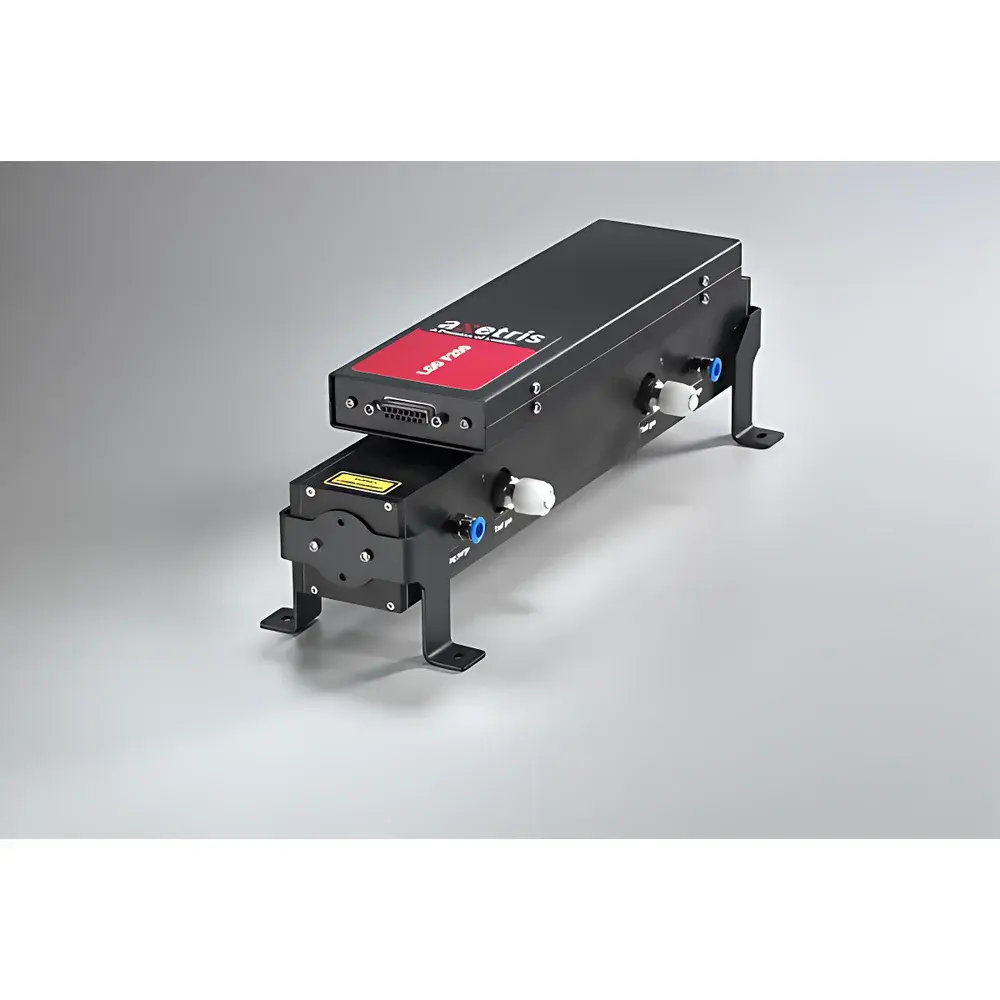
Axetris LGD Series Tunable Diode Laser Gas Detection Module
| Brand | Axetris |
|---|---|
| Origin | Switzerland |
| Model | LGD Series |
| Detection Gases | NH₃, CH₄, H₂O, CO₂, HCl, HF, O₂ |
| Technology | Tunable Diode Laser Spectroscopy (TDLS) |
| Design | OEM-ready modular platform |
| Operating Temperature (heated option) | up to 190 °C |
| Measurement Principle | Non-contact, optical absorption spectroscopy |
| Calibration | Factory-calibrated |
| Cross-Interference | Negligible due to narrow-linewidth laser targeting fundamental ro-vibrational absorption lines |
Overview
The Axetris LGD Series Tunable Diode Laser Gas Detection Module is an OEM-optimized optical sensing platform engineered for high-selectivity, real-time gas concentration measurement in demanding industrial and environmental applications. Based on Tunable Diode Laser Spectroscopy (TDLS), the module operates by directing a narrow-linewidth near-infrared or mid-infrared laser beam through a gas sample path—either in-situ (probe-based) or extractive (flow-through cell)—and quantifying target gas concentration via Beer–Lambert law analysis of wavelength-specific absorption features. Unlike electrochemical or metal-oxide semiconductor sensors, TDLS leverages fundamental ro-vibrational absorption lines unique to each molecule, delivering inherent immunity to cross-sensitivity from background gases (e.g., CO₂ interference in NH₃ measurement is eliminated). The absence of consumables, moving parts, or reference gas cells ensures long-term stability, minimal maintenance, and intrinsic suitability for unattended, continuous operation across harsh environments—from high-humidity biogas streams to hot, corrosive flue gases.
Key Features
- OEM-integrated modular architecture with standardized mechanical interfaces (e.g., M30×1.5, DIN 43650 connectors) and digital communication protocols (RS-485, UART, optional analog 4–20 mA output)
- Simultaneous multi-gas capability via multi-wavelength laser sources or time-multiplexed scanning; supports configurable detection of NH₃, CH₄, H₂O, CO₂, HCl, HF, and O₂ within a single compact footprint
- Heated optical path option enabling stable operation at process temperatures up to 190 °C—critical for hot-stack monitoring without external dilution or cooling systems
- Optical measurement principle ensures zero drift over time; factory calibration remains valid across operating life under GLP-compliant traceability (NIST-traceable reference standards used during calibration)
- No consumables, no catalytic poisoning, and no humidity-dependent signal attenuation—ideal for high-moisture applications such as landfill gas or livestock barn air
- Robust aluminum housing rated IP65; designed for CE, RoHS, and ATEX Zone 2/22 compliance (model-dependent)
Sample Compatibility & Compliance
The LGD module accommodates both extractive sampling (via heated sample lines and flow-controlled cells) and in-situ probe configurations. It maintains accuracy across dynamic gas matrices containing particulates, condensables, and variable pressure (70–110 kPa) and temperature (−20 °C to +190 °C, heated version). All variants comply with IEC 61000-6-2 (immunity) and IEC 61000-6-4 (emissions), and support audit-ready data logging aligned with ISO 14001 environmental management systems. For regulated emissions reporting (e.g., EU IED, US EPA Method 320), the module’s linearity (R² > 0.9999), repeatability (< ±1% FS), and documented uncertainty budgets meet requirements for Tier 2 CEMS integration.
Software & Data Management
Axetris provides the LGD Control Suite—a Windows-based configuration and diagnostics application supporting firmware updates, spectral validation, alarm threshold setup, and real-time signal visualization. Raw absorbance spectra and concentration time-series data are exportable in CSV and HDF5 formats. For enterprise integration, the module supports Modbus RTU/TCP and MQTT over Ethernet/Wi-Fi (optional add-on), enabling direct ingestion into SCADA, DCS, or cloud-based IIoT platforms (e.g., Azure IoT Hub, AWS IoT Core). Audit trails—including parameter changes, calibration events, and system errors—are timestamped and cryptographically signed to satisfy FDA 21 CFR Part 11 and EU Annex 11 data integrity requirements.
Applications
- Process Control: Ammonia slip monitoring in SCR systems; methane optimization in anaerobic digesters; combustion efficiency tuning via O₂/CO₂ ratio feedback in boilers and incinerators
- Emissions Monitoring: Continuous stack emission monitoring (CEMS) for HCl/HF in waste-to-energy plants; CH₄ and CO₂ flux quantification at landfill sites per IPCC Tier 2 methodology
- Environmental Surveillance: Real-time NH₃ and H₂S (via optional spectral extension) tracking in intensive livestock facilities to comply with EU Nitrates Directive reporting thresholds
- Safety & Leak Detection: HF and HCl leak detection in semiconductor fab tool exhausts; refrigerant (CH₄-derived hydrofluorocarbons) monitoring in HVAC chillers
- Indoor Air Quality (IAQ): Demand-controlled ventilation using CO₂ and NH₃ as occupancy and bioeffluent proxies in agricultural buildings and greenhouses
FAQ
Does the LGD module require periodic recalibration?
No—factory calibration is stable over the operational lifetime. Drift is typically < 0.5% FS/year. Verification checks using certified gas standards are recommended annually for regulatory compliance.
Can the module operate in explosive atmospheres?
Yes—ATEX-certified variants (II 3G Ex nA IIC T4 Gc / II 3D Ex tc IIIC T130°C Dc) are available for Zone 2/22 installations.
Is water vapor cross-interference corrected in real time?
Yes—the integrated H₂O channel enables dynamic spectral compensation, eliminating need for external drying or compensation algorithms.
What is the minimum detectable concentration (MDL) for NH₃?
Typically 0.5 ppm·m for standard 1-m pathlength configurations; sub-ppb sensitivity achievable with multipass cells (custom order).
How is temperature and pressure compensation handled?
Onboard Pt100 sensor and absolute pressure transducer feed real-time corrections directly into the spectral fitting algorithm, ensuring compliance with ISO 14687 and ASTM D6420 traceability frameworks.







