
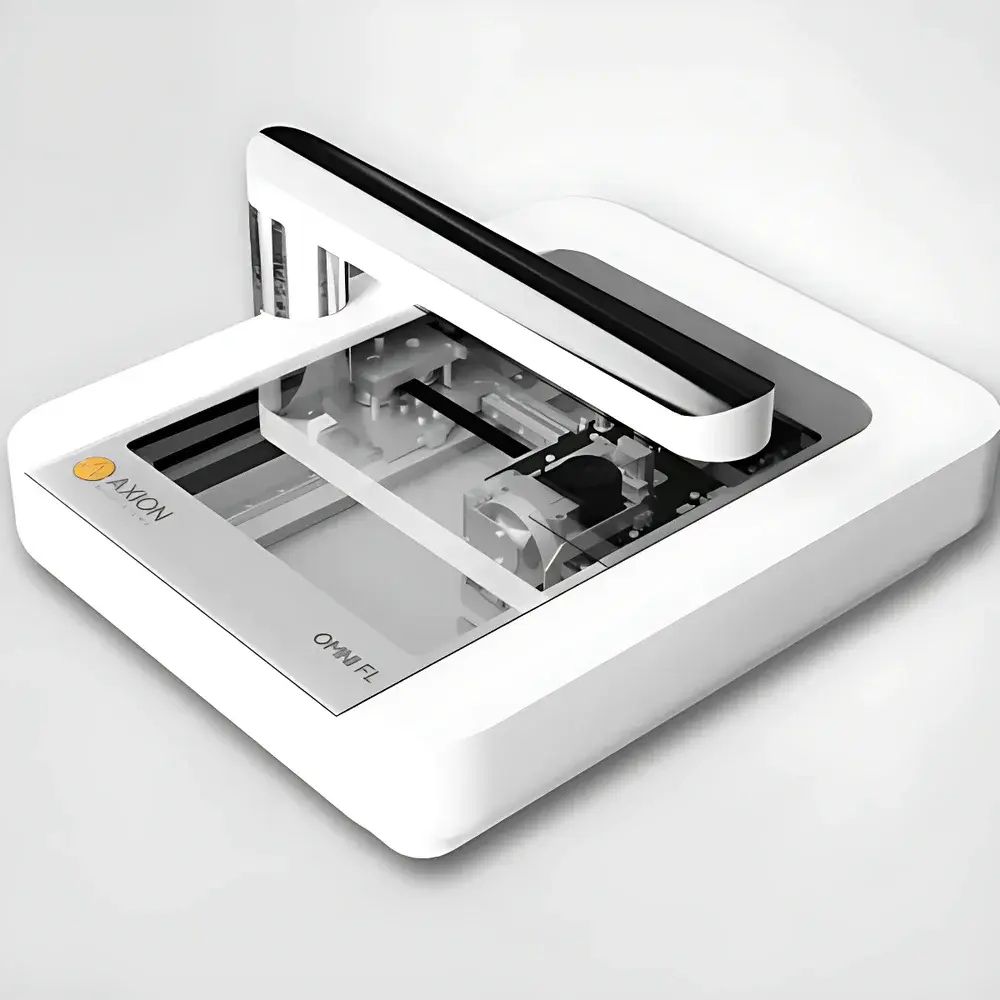
Axion BioSystems Omni BR/FL Live-Cell Real-Time Imaging Analysis System for Cytotoxicity Assessment
| Brand | Axion BioSystems |
|---|---|
| Origin | Netherlands |
| Manufacturer Type | Original Equipment Manufacturer (OEM) |
| Origin Category | Imported |
| Model | Omni/Lux3 |
| Pricing | Available Upon Request |
Overview
The Axion BioSystems Omni BR/FL is a fully integrated, label-free live-cell imaging platform engineered for long-term, non-invasive monitoring of cellular responses within standard CO₂ incubators. It employs high-resolution brightfield and fluorescence microscopy—without requiring dyes, transfection reagents, or genetic modification—to quantitatively assess cytotoxicity, proliferation, confluence, migration, and morphological dynamics in real time. The system operates on a fixed-stage, motorized lens architecture: an LED-based illumination module is positioned above the sample, while a precision-stepped imaging sensor beneath the stage captures sequential sub-images across defined fields of view. These are computationally stitched into high-fidelity panoramic mosaics (86 mm × 124 mm), enabling whole-well or whole-dish analysis at micron-level spatial fidelity. Unlike endpoint assays or plate readers, the Omni BR/FL delivers kinetic, context-rich datasets rooted in native cell behavior—critical for mechanistic toxicology, drug safety profiling, and translational assay development under physiologically relevant conditions.
Key Features
- Incubator-compatible design: Certified for continuous operation at 5–40°C and 20–95% relative humidity, with EMI-shielded electronics and thermal-stable optical path calibration.
- Dual-channel imaging: Simultaneous or alternating brightfield (BR) and fluorescence (FL) acquisition using user-selectable excitation/emission filters (e.g., GFP, RFP, Hoechst).
- Automated multi-position scanning: Programmable XY-stage navigation supports full-plate imaging (6–384-well formats), single-well ROI targeting, or custom grid-based acquisition.
- Real-time confluence analytics: Proprietary algorithm computes pixel-intensity-based cell coverage metrics with <2% inter-assay CV across repeated measurements.
- Cloud-native workflow: All images and metadata are encrypted and uploaded to the CytoSMART Cloud platform, supporting audit-trail-enabled data storage compliant with GLP/GMP documentation requirements.
- Modular software licensing: Optional image analysis modules include Confluence Quantification (BR/FL), Scratch Assay Migration Tracking, Colony Formation Analysis, and Fluorescent Object Counting—each validated per ISO/IEC 17025 traceability standards.
Sample Compatibility & Compliance
The Omni BR/FL accommodates any optically transparent culture vessel with a maximum height of 55 mm—encompassing standard tissue-culture-treated plates (6–384-well), Petri dishes (35–150 mm), T-flasks (T25–T225), and specialized formats such as organoid microplates and spheroid-restricted wells. Its open hardware interface supports integration with environmental sensors (O₂, pH, temperature) and third-party liquid handlers via TTL/RS-232 protocols. Regulatory alignment includes adherence to ASTM E3212-21 (Standard Guide for Live-Cell Imaging Assay Development), ISO 20947:2022 (Biotechnology – Cell-based assays – General requirements), and compatibility with FDA 21 CFR Part 11-compliant electronic signatures when deployed with enterprise CytoSMART Cloud configurations.
Software & Data Management
Data acquisition, stitching, and primary analysis occur through the CytoSMART Software Suite v5.x—deployed locally or accessed remotely via browser-based client. Raw TIFF stacks and JSON-formatted metadata (including timestamp, focus position, exposure settings, and environmental logs) are preserved in immutable format. Advanced users may export unprocessed frames for secondary analysis in ImageJ/Fiji, MATLAB, or Python-based pipelines (e.g., scikit-image, CellProfiler). The cloud infrastructure provides role-based access control, automated backup rotation, and versioned analysis protocol templates—ensuring reproducibility across labs and audit readiness for regulatory submissions.
Applications
- Chemotherapeutic cytotoxicity profiling: Time-resolved IC₅₀ determination and mechanism-of-action inference via longitudinal confluence decay kinetics (e.g., paclitaxel dose-response in PACO7/PACO43 co-cultures).
- Tumor spheroid viability assessment: Monitoring necrotic core expansion, peripheral mitotic activity, and structural disintegration in 3D models under therapeutic pressure.
- Immuno-oncology functional assays: Quantifying CAR-T–mediated target cell lysis kinetics, synapse formation duration, and bystander killing efficiency.
- Transfection/transduction efficiency tracking: Correlating fluorescent reporter expression onset with morphological differentiation or stress marker induction.
- Wound healing & collective migration: Automated scratch gap closure rate calculation with edge-detection robustness across heterogeneous monolayers.
- Toxicology screening (OECD TG 499): Supporting in vitro alternatives to animal testing by generating OECD-accepted kinetic endpoints for hazard identification.
FAQ
How does the Omni BR/FL achieve label-free cytotoxicity quantification?
It leverages dynamic changes in cellular confluence, morphology, and phase contrast texture—measured via brightfield imaging—as quantitative proxies for membrane integrity, metabolic activity, and proliferative capacity. No exogenous dyes or reporters are required.
Can I perform kinetic fluorescence assays without phototoxicity?
Yes. The system uses low-intensity, pulsed LED illumination synchronized with sensor readout to minimize cumulative photon dose—validated for >72 h continuous GFP+ cell tracking without observable photobleaching or stress induction.
Is raw image data accessible for custom algorithm development?
Absolutely. Full-resolution TIFF stacks, metadata logs, and calibration files are downloadable in batch mode—enabling integration with machine learning frameworks for bespoke feature extraction.
What validation documentation is provided for regulated environments?
Each unit ships with Factory Acceptance Test (FAT) reports, IQ/OQ documentation templates, and software validation packages aligned with GAMP5 principles—supporting internal qualification under ISO 13485 or 21 CFR Part 11.
Does the platform support multi-user collaboration across geographically dispersed sites?
Yes. Cloud-hosted projects allow concurrent access, annotation sharing, and version-controlled analysis protocol deployment—facilitating multi-center studies and CRO partnerships.





