
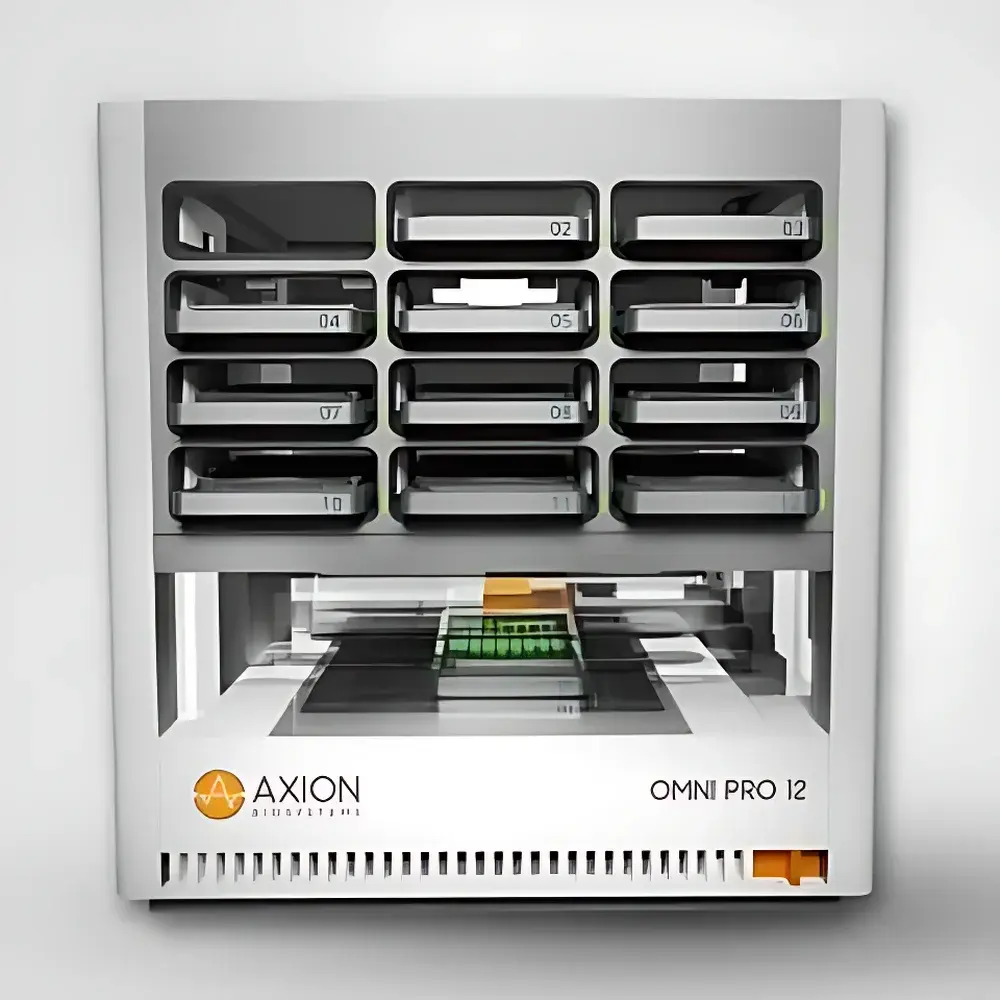
Axion BioSystems Omni Pro 12 High-Throughput Incubator-Integrated Live-Cell Imaging and Analysis System
| Brand | Axion BioSystems |
|---|---|
| Origin | USA |
| Manufacturer | Axion BioSystems, Inc. |
| Type | Imported Instrument |
| Model | Omni Pro 12 |
| Temperature Control Range | 5–40 °C |
| Humidity Control Range | 20–95% RH |
| Full-Plate Scan Time | ≤10 min per 384-well plate |
Overview
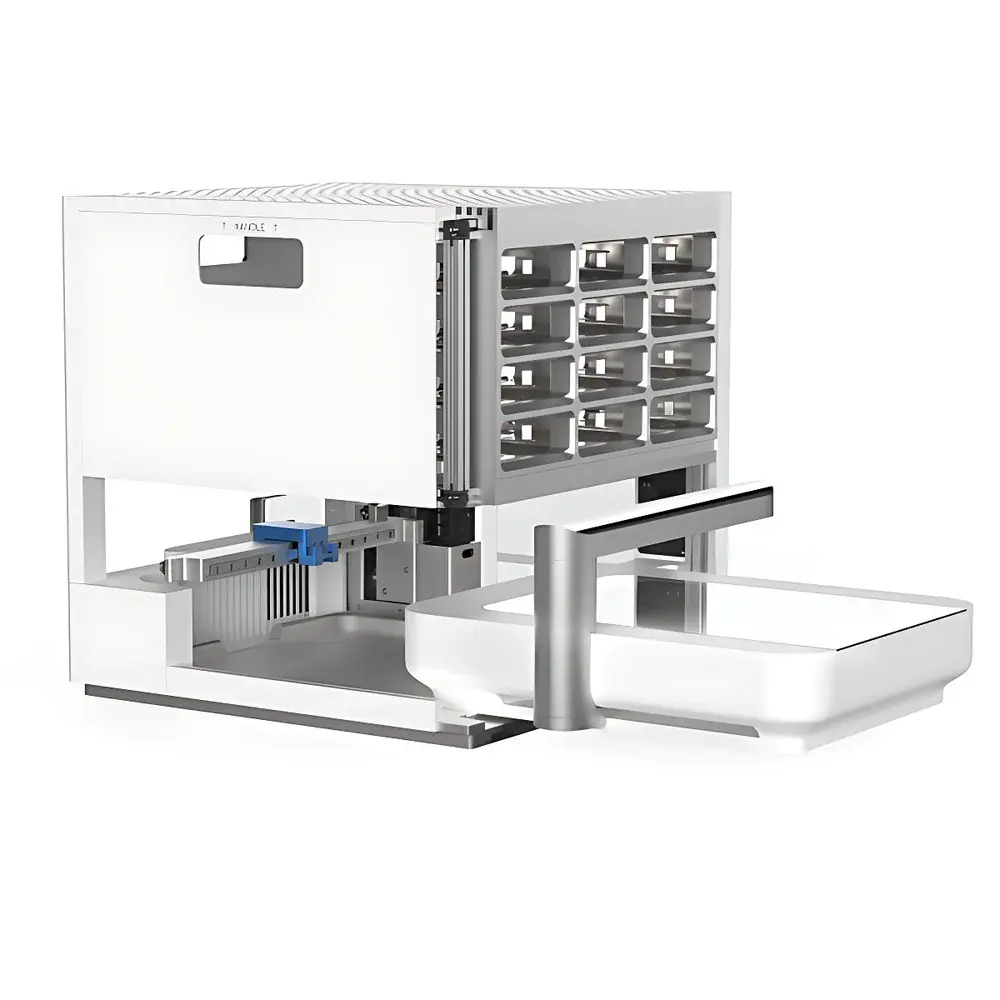
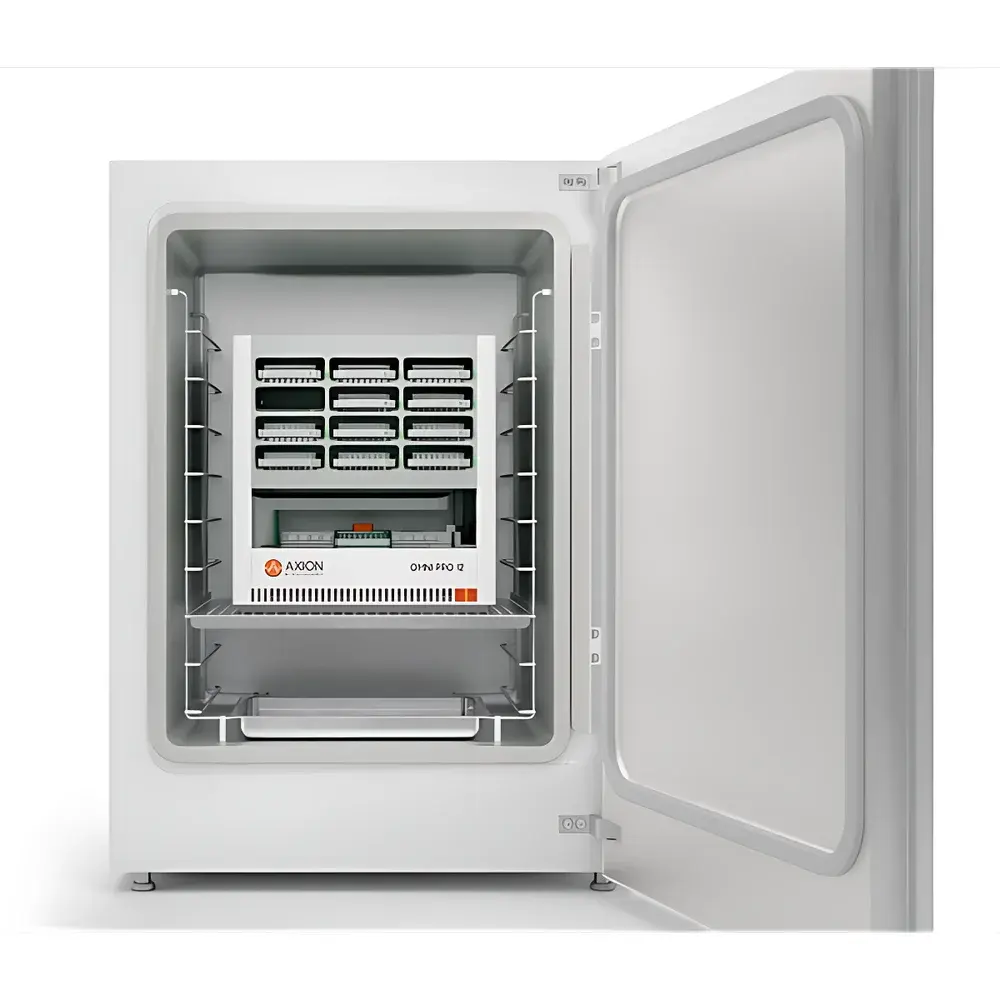
The Axion BioSystems Omni Pro 12 is an incubator-integrated, high-throughput live-cell imaging and analysis platform engineered for longitudinal, label-free, and fluorescence-based phenotypic monitoring under physiologically relevant culture conditions. Unlike conventional benchtop microscopes requiring sample removal from controlled environments, the Omni Pro 12 operates entirely inside standard CO₂ incubators—eliminating thermal, pH, and humidity perturbations during acquisition. Its core architecture combines a motorized, precision Z-stage with a high-resolution CMOS sensor and programmable LED excitation optics, enabling automated wide-field brightfield and dual-channel (488 nm/561 nm) fluorescence imaging across up to twelve 384-well plates simultaneously. Data acquisition follows a non-invasive, tile-scan methodology: for brightfield, the system captures ~7,850 overlapping sub-images across the full plate surface (86 mm × 124 mm), which are computationally stitched into a single high-fidelity mosaic; for fluorescence, users define region-of-interest (ROI) grids per well to optimize signal-to-noise ratio and phototoxicity management. All image data are streamed in real time to secure cloud storage, supporting centralized access and audit-ready metadata logging.
Key Features
- Incubator-rated hardware: Fully validated for continuous operation at 5–40 °C and 20–95% relative humidity—no external environmental shielding required.
- 12-plate capacity: Integrated carousel accommodates up to twelve standard SBS-format plates (6–384 wells), each independently addressable via robotic arm positioning.
- Automated plate handling: Precision stepper-motor-driven manipulator performs unattended plate loading, alignment, and exchange—compatible with transparent-bottom plates from Corning, Greiner, Thermo Fisher, and other major suppliers.
- Modular optical engine: Interchangeable filter sets support GFP/mCherry, FITC/TRITC, or custom fluorophore configurations; optional phase contrast module available upon request.
- Zero-touch experimental workflow: Guided setup wizard configures acquisition parameters—including exposure time, z-stack depth, time-lapse interval, and ROI density—based on assay type and cell morphology.
- Edge-computing preprocessing: On-device background subtraction, flat-field correction, and motion stabilization applied prior to cloud upload—reducing downstream computational load.
Sample Compatibility & Compliance
The Omni Pro 12 supports all standard transparent-bottom, tissue-culture-treated multiwell plates ranging from 6- to 384-well formats. It is compatible with hydrogel-based 3D scaffolds, organoid inserts, and microfluidic chips mounted on standard plate carriers. The system meets IEC 61000-6-2 (immunity) and IEC 61000-6-4 (emission) standards for electromagnetic compatibility in laboratory environments. Software architecture complies with FDA 21 CFR Part 11 requirements for electronic records and signatures when configured with audit trail, role-based access control, and electronic signature modules. Data integrity protocols align with ALCOA+ principles (Attributable, Legible, Contemporaneous, Original, Accurate, Complete, Consistent, Enduring, Available) for GLP and GMP-regulated studies.
Software & Data Management
Acquisition and analysis are managed through Axion’s Omni Software Suite v4.x—a web-native platform accessible via Chrome or Edge browsers. The suite provides integrated tools for time-lapse visualization, kinetic parameter extraction (e.g., confluence rate, migration velocity, spheroid area decay), and batch processing of heterogeneous plate sets. Pre-trained AI modules include: (1) Brightfield Confluence Quantification, (2) Fluorescent Cell Counting (nuclear or cytoplasmic), (3) Wound Healing/Scratch Assay Trajectory Modeling, (4) Colony Formation Detection and Growth Kinetics, and (5) Spheroid Morphometric Profiling (perimeter, circularity, solidity). Raw TIFF stacks and JSON-formatted metadata are exportable in FAIR-compliant structure (Findable, Accessible, Interoperable, Reusable), enabling seamless integration with ImageJ/Fiji, MATLAB, Python (scikit-image, napari), or commercial platforms such as MetaXpress and Harmony.
Applications
- Tumor spheroid modeling: Long-term monitoring of 3D tumor growth, drug penetration dynamics, and stromal interaction kinetics over 7–21 days.
- Cytotoxicity profiling: Real-time quantification of membrane integrity loss (propidium iodide), caspase activation (FLICA), or metabolic activity (resazurin reduction) following compound exposure.
- Immuno-oncology assays: CAR-T or NK-cell-mediated tumor lysis kinetics, synapse formation timing, and target cell escape mechanisms.
- Clonogenic survival analysis: Automated detection and lineage tracing of single-cell-derived colonies across entire plates—supporting radiobiology and genotoxicity screening.
- Migratory phenotype assessment: Multi-point wound closure tracking with spatial variance mapping to identify heterogeneous subpopulations.
- Transduction efficiency validation: Temporal correlation between viral vector delivery (e.g., lentiviral GFP expression) and functional readouts (e.g., calcium flux or impedance change).
FAQ
How does the Omni Pro 12 acquire images without removing plates from the incubator?
The system mounts directly inside the incubator chamber. A motorized XY stage moves the objective lens beneath stationary plates, enabling contactless scanning. No mechanical pressure is applied to plates, preserving delicate monolayers and 3D structures.
What level of temperature and humidity stability is maintained during imaging?
Hardware components—including optics, motors, and sensors—are rated for uninterrupted operation across the full specified range (5–40 °C, 20–95% RH), with internal thermal compensation ensuring consistent focus and exposure calibration.
Can I use third-party analysis software with Omni Pro 12 data?
Yes. All raw image data (16-bit TIFF) and structured metadata (JSON) are provided without proprietary compression or encryption, enabling direct import into open-source or commercial analysis pipelines.
Is remote monitoring supported?
Yes. Users receive real-time email/SMS alerts for acquisition completion, hardware anomalies, or plate misalignment events. Live status dashboards display current plate position, elapsed time, and remaining battery life of the robotic arm.
Does the system support multi-color fluorescence imaging?
The standard configuration includes dual-band excitation (488 nm and 561 nm) with emission filtering optimized for common fluorophores. Additional channels (e.g., DAPI, Cy5) are available as configurable upgrade options.





