
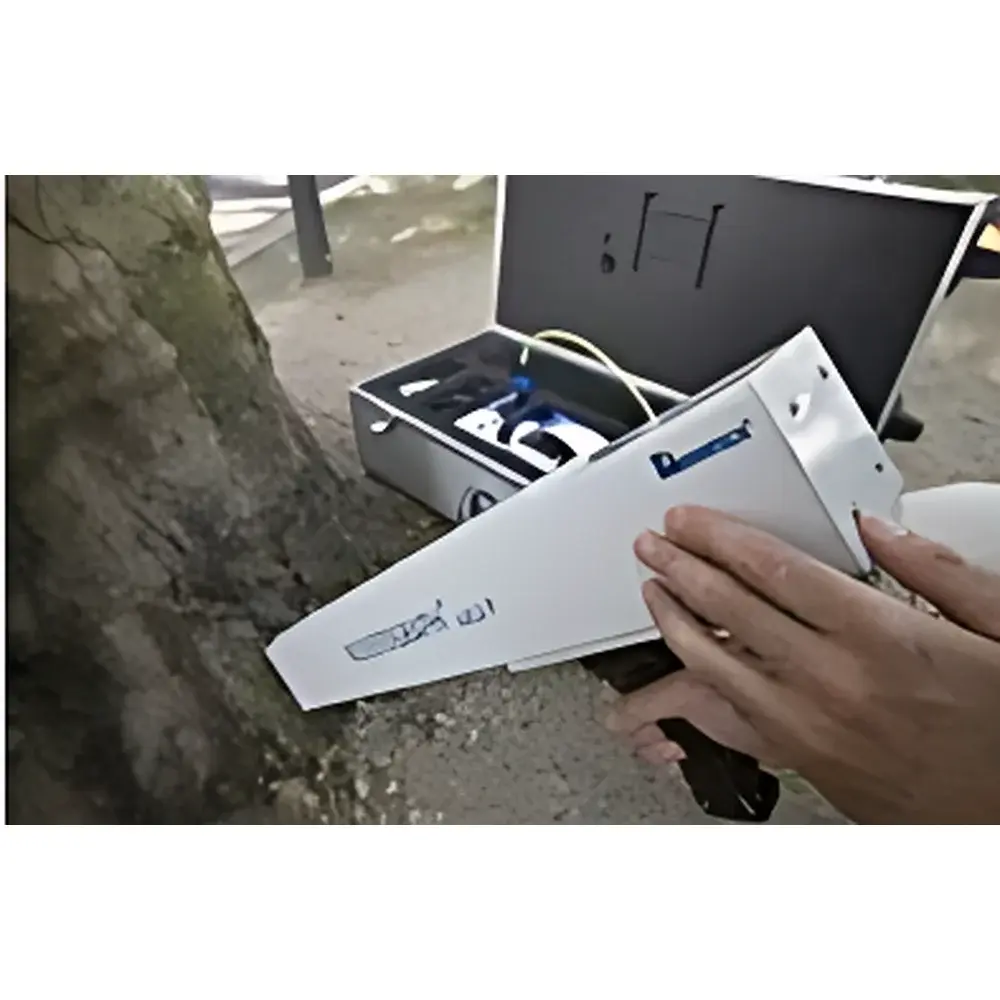
AZ ArborScan Pro Tree Micro-Resistance Drill Probe System
| Brand | AZ (Beijing AoZuo) |
|---|---|
| Origin | Germany |
| Manufacturer | Yes |
| Import Status | Imported |
| Model | ArborScan Pro |
| Pricing | Upon Request |
| Probe Diameter | 1.5 mm |
| Max Standard Penetration Depth | 45 cm (customizable: 30–100 cm) |
| Penetration Speed | Up to 50 cm/min |
| Spatial Resolution | 0.01 mm or 0.1 mm (selectable) |
| Probe Tube Diameter | 75 mm |
| System Weight | 3 kg |
| Integrated Thermal Printer | Yes |
| Real-Time 1 | 1 Analog Strip Chart Output: Yes |
| Data Storage Capacity | Up to 500 radial profiles |
| Software | WinDECOM v5.x (Windows-based, with graphical profile rendering, profile alignment, ring-width measurement, density trend analysis, CSV/Excel export, and GLP-compliant audit trail logging) |
Overview
The AZ ArborScan Pro Tree Micro-Resistance Drill Probe System is a non-destructive, high-resolution dendrological diagnostic instrument engineered for in-situ assessment of wood internal structure via micro-resistivity profiling. Based on the principle of electrical resistance tomography—where minute variations in wood moisture content, density, and cellular integrity produce measurable changes in electrical impedance—the system inserts a calibrated 1.5 mm tungsten-carbide probe into the trunk or timber under controlled axial force and speed. As the probe advances, real-time resistance values are sampled at sub-millimeter intervals (0.01 mm resolution), generating a continuous resistivity profile that correlates strongly with anatomical features including decay zones, cavities, reaction wood, heartwood/sapwood boundaries, and annual growth ring morphology. Designed for field-deployable operation in urban forestry, arboricultural risk assessment, historic timber conservation, and forest health monitoring, the ArborScan Pro delivers quantitative, traceable, and spatially resolved data without compromising structural integrity—consistent with ISO 17941:2016 (Non-destructive testing of trees) and aligned with ASTM D6817 (Standard Guide for Visual Tree Assessment).
Key Features
- Ultra-fine 1.5 mm micro-drill probe minimizes mechanical trauma—typical wound diameter ≤ 2.0 mm, enabling repeated measurements on sensitive or heritage specimens without physiological compromise.
- Programmable penetration speed (0.1–50 cm/min) ensures optimal signal-to-noise ratio across variable wood densities—from soft pines to dense tropical hardwoods.
- Onboard thermal printer provides immediate 1:1 analog strip-chart output for field validation, eliminating reliance on post-processing for preliminary interpretation.
- Integrated data logger stores up to 500 full radial profiles (each ≥ 45 cm) with timestamp, GPS metadata (via optional Bluetooth module), and operator ID—fully compliant with GLP data integrity requirements.
- Ruggedized 3 kg chassis with ergonomic handle, IP54-rated enclosure, and rechargeable Li-ion power pack supports all-day battery life (>8 hrs continuous use) and operation in ambient temperatures from −10 °C to +50 °C.
Sample Compatibility & Compliance
The ArborScan Pro is validated for live standing trees (diameter at breast height ≥ 15 cm), felled logs, structural timbers, and historic wooden architectural elements—including load-bearing posts, beams, and façade components. It accommodates heterogeneous species (e.g., Quercus robur, Fagus sylvatica, Picea abies, Tectona grandis) and degraded substrates (e.g., fungal-infected sapwood, insect-tunneled zones, wet-rotted cores). All hardware and firmware comply with EU CE marking directives (2014/30/EU EMC Directive, 2014/53/EU RED), and software adheres to FDA 21 CFR Part 11 requirements for electronic records and signatures when used in certified arboricultural consulting or municipal tree risk management programs.
Software & Data Management
WinDECOM v5.x is a Windows-native analytical suite supporting raw profile import, multi-profile alignment (for cross-dating), automated ring detection (with manual override), relative density calibration, and longitudinal trend mapping. Each dataset includes embedded audit trail metadata: user login, session start/end timestamps, probe calibration status, and version-controlled processing steps. Export formats include CSV (for statistical modeling in R or Python), PNG/SVG (publication-ready vector graphics), and XML (compatible with GIS platforms such as QGIS and ArcMap). Optional cloud synchronization enables centralized database management for municipal tree inventories under ISO 55001 asset management frameworks.
Applications
- Urban forestry: Prioritization of hazardous tree removal based on quantified decay volume and cavity geometry.
- Conservation biology: Monitoring vitality of ancient or protected specimens (e.g., >300-year-old oaks) without invasive coring.
- Timber engineering: Pre-installation screening of structural members in heritage buildings per EN 384 and DIN 4074-1.
- Dendrochronology labs: High-resolution ring-width series acquisition for climate reconstruction, where traditional increment borer sampling introduces bias in reaction wood or eccentric stems.
- Forest pathology: Early detection of latent decay pathogens (e.g., Ganoderma applanatum, Heterobasidion annosum) prior to visible symptom expression.
FAQ
Is the probe insertion truly non-destructive?
Yes—the 1.5 mm probe creates a wound smaller than standard increment borers (typically 4.3–5.15 mm), and published studies (e.g., *Trees*, 2021;35:1723–1735) confirm negligible impact on cambial activity or long-term growth response in healthy specimens.
Can the system distinguish between water-soaked wood and fungal decay?
Indirectly: While resistivity alone cannot identify microbial species, characteristic low-resistance plateaus combined with spatial continuity and correlation to external symptoms enable high-confidence differentiation—validated against core sampling and CT imaging in peer-reviewed field trials.
Does WinDECOM support automated cross-dating?
It provides robust visual alignment tools and correlation coefficient metrics (Gleichläufigkeit, GLE), but final cross-dating decisions require expert dendrological interpretation per ITRDB standards—not fully automated.
What calibration protocols are recommended?
Annual verification using certified reference wood blocks (e.g., air-dry beech with known density gradient) is advised; factory recalibration every 24 months ensures traceability to NIST-traceable resistance standards.
Is training provided for regulatory compliance reporting?
Yes—AZ offers ISO 17941-aligned certification workshops covering measurement uncertainty estimation, report generation per EN 1995-1-1 Annex B, and integration with municipal tree risk assessment workflows.






