
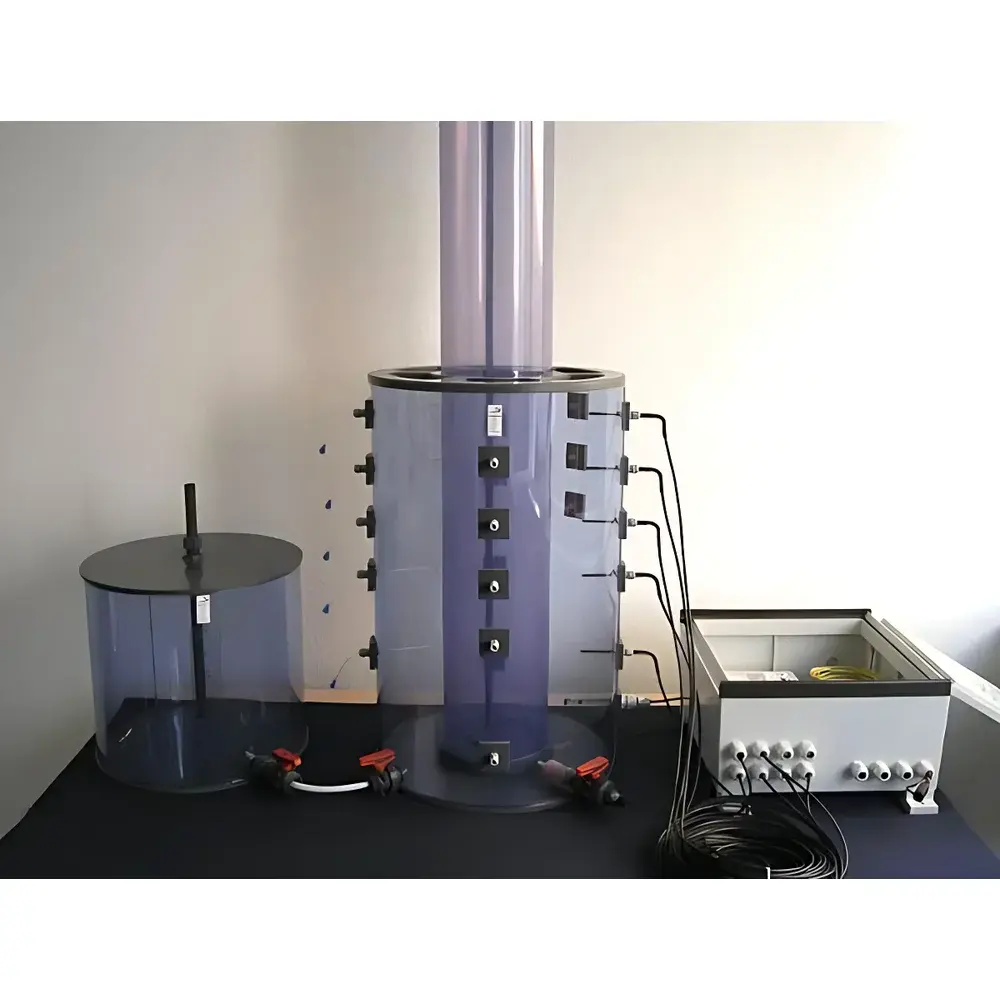
AZ ENVIdata-Redox In-Situ Soil pH and Redox Potential Monitoring System
| Brand | AZ (Beijing AoZuo) |
|---|---|
| Origin | Beijing, China |
| Manufacturer Type | Manufacturer |
| Regional Category | Domestic (China) |
| Model | ENVIdata-Redox |
| Output Range (pH electrode) | −175 to +175 mV (corresponding to pH 4–10, pH 7 = 0 mV) |
| Electrode Diameter (pH) | 6 mm |
| Electrode Length (pH) | 80 mm |
| Protective Sleeve Diameter | 20 mm |
| Protective Sleeve Max Length | 1 m |
| Cable Length | 2 m (customizable) |
| Reference Electrode | Ag/AgCl with 3 M KCl electrolyte, ceramic junction, PVC body |
| Field Reference Electrode Dimensions | Ø12 mm × 110 mm |
| Salt Bridge | Ø25 mm × 400 mm |
| Lab Reference Electrode Dimensions | Ø6 mm × 80 mm |
| Salt Bridge | Ø12 mm × 120 mm |
| Redox Electrode Tip | Pt wire, Ø1 mm × 5 mm |
| Redox Electrode Body | Carbon fiber tube, Ø6 mm |
| Redox Reference Electrode | Ø12 mm × 120 mm |
| Redox Control Module Range | ±1250 mV |
| Resolution | 0.1 mV |
| Accuracy | ±3 mV |
Overview
The AZ ENVIdata-Redox In-Situ Soil pH and Redox Potential Monitoring System is an engineered solution for continuous, long-term, field-deployable measurement of two critical biogeochemical parameters: soil pH and redox potential (EH). Unlike conventional spot-sampling or short-term insertion probes, this system implements a true in-situ electrochemical architecture—based on dual-electrode potentiometric principles—designed specifically for undisturbed soil matrices under variable moisture regimes, including saturated, intermittently flooded, and drained conditions. The pH sensor employs a robust Ag/AgCl reference electrode embedded within a KCl-saturated salt bridge, electrically coupled to the soil via a porous ceramic junction. This configuration minimizes electrolyte leaching and mitigates drift associated with traditional liquid-junction electrodes. The redox electrode utilizes a miniaturized platinum micro-tip (1 mm diameter × 5 mm length), enabling high spatial resolution and low perturbation during insertion into soil columns, rhizospheres, or field profiles. Both electrodes share a common signal conditioning module, ensuring synchronized acquisition and eliminating inter-channel calibration drift. The system operates on fundamental Nernstian electrochemistry: pH is derived from H+-dependent potential shifts relative to the stable reference, while EH reflects the thermodynamic tendency of electron transfer reactions involving Fe(III)/Fe(II), Mn(IV)/Mn(II), SO42−/H2S, and organic redox couples.
Key Features
- In-situ, long-term deployment capability—validated for multi-season operation in temperate and cold climates, including freeze-thaw cycles.
- Dual-parameter co-location: pH and EH measured from physically adjacent, mechanically decoupled electrodes to avoid cross-talk and ensure representative microsite data.
- Field-hardened mechanical design: stainless steel and carbon fiber construction, corrosion-resistant housing, and pressure-balanced salt bridge geometry for stable performance in saturated soils.
- Low-maintenance architecture: no moving parts, no internal pumps or reagents, and minimal field servicing—only periodic verification against buffer standards or certified reference solutions.
- Modular interface compatibility: analog voltage output (±1250 mV range, 0.1 mV resolution) compliant with standard data loggers meeting IEC 61000-4-5 surge immunity and IP67 environmental rating.
- Scalable installation: supports both permanent field arrays (e.g., transects across hydric soil catenas) and controlled lab setups (soil columns, mesocosms, pot experiments).
Sample Compatibility & Compliance
The ENVIdata-Redox system is validated for use in mineral and organic soils—including Gleysols, Histosols, and Fluvisols—with bulk densities ranging from 0.4 to 1.8 g cm−3, and water contents from air-dry to fully saturated states. It maintains functional integrity in clay-rich matrices (up to 60% clay) and coarse sands without clogging or signal hysteresis. Electrode geometry allows installation in undisturbed cores (e.g., 5-cm-diameter monoliths) and direct push deployment in situ. From a regulatory standpoint, the system supports data collection protocols aligned with ISO 10390:2021 (soil pH determination), ASTM D3872-22 (redox potential measurement in saturated soils), and US EPA Method 9045D (field EH monitoring). Its analog output architecture enables integration into GLP-compliant workflows when paired with audit-trail-capable data loggers satisfying FDA 21 CFR Part 11 requirements for electronic records and signatures.
Software & Data Management
The ENVIdata-Redox system outputs calibrated analog signals compatible with industry-standard data acquisition platforms (e.g., Campbell Scientific CR1000X, HOBO U12, Delta-T Devices DL2e). No proprietary software is required; raw mV values are converted to pH and EH using Nernst equation-based calibration functions provided in documented technical appendices. Calibration coefficients are traceable to NIST-certified pH buffers (pH 4.01, 7.00, 10.01 at 25 °C) and Zobell’s seawater reference (EH = +120 mV vs. Ag/AgCl, 3 M KCl). Users may implement automated drift correction routines using in-field reference checks or dual-point field calibration protocols. For long-term studies, timestamped datasets integrate seamlessly into time-series analysis frameworks (e.g., R packages ‘zoo’ and ‘xts’) and GIS-enabled soil process models (e.g., HYDRUS-1D, CoupModel).
Applications
This system addresses methodological gaps in biogeochemical monitoring across multiple domains: wetland restoration assessment, where EH dynamics govern methane and nitrous oxide fluxes; arsenic speciation research, as demonstrated in fen soils where As(III) mobilization correlates strongly with EH < −100 mV; managed aquifer recharge projects requiring real-time redox zoning to predict contaminant attenuation; precision agriculture trials evaluating crop-specific redox thresholds for rice, cranberry, or alfalfa; and climate change impact modeling—particularly in coastal marshes where hourly EH resolution reveals diurnal redox oscillations invisible to weekly sampling. Published validation includes 24-year comparative studies in German Polder Speicherkoog, confirming the necessity of sub-daily EH sampling to resolve transient redox phases driven by tidal, meteorological, and biological forcing.
FAQ
Can the ENVIdata-Redox system operate continuously in permanently saturated soils?
Yes—the Pt redox tip and salt-bridge-integrated reference electrode are explicitly designed for uninterrupted operation in waterlogged and reducing environments, including peat and gleyed mineral soils.
What is the recommended calibration frequency for long-term deployments?
Initial two-point calibration pre-deployment is mandatory. Field recalibration is advised every 3–6 months depending on soil aggressiveness; however, stability validation over 18-month field trials shows drift < ±5 mV for EH and < ±0.15 pH units under typical temperate conditions.
Is the system compatible with wireless telemetry or IoT-based environmental networks?
Yes—its analog voltage output interfaces directly with LoRaWAN-, NB-IoT-, or cellular-enabled data loggers equipped with programmable analog input channels and edge-processing capabilities.
Does the pH electrode require refilling or electrolyte replacement during operation?
No—the sealed salt bridge contains sufficient 3 M KCl reservoir for ≥24 months of continuous operation in most soil types; no user-accessible refill ports are present.
How does temperature affect measurement accuracy, and is compensation applied?
The system assumes ambient temperature measurement at electrode depth; users must record concurrent soil temperature (via integrated or co-located sensor) to apply Nernst slope correction (−59.16 mV/pH unit at 25 °C, adjusted per °C). No built-in thermistor is included, preserving mechanical simplicity and long-term reliability.







