
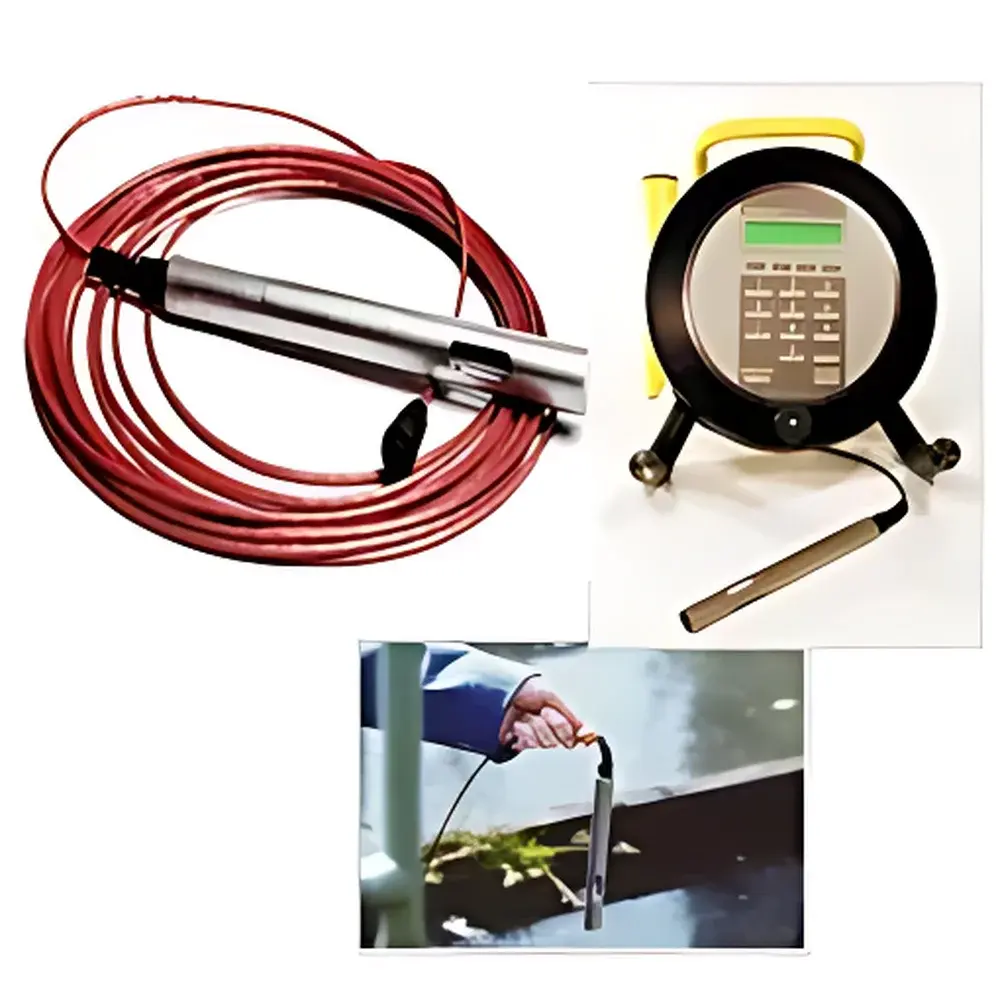
AZ Portable Petroleum Hydrocarbon Analyzer (FOCS-Based Field Sensor)
| Brand | AZ (Beijing Aozuo) |
|---|---|
| Origin | USA |
| Manufacturer | AZ |
| Product Type | Imported |
| Model | AZ |
| Pricing | Upon Request |
Overview
The AZ Portable Petroleum Hydrocarbon Analyzer is the world’s first field-deployable instrument utilizing Fiber-Optic Chemical Sensing (FOCS) technology for real-time, in-situ quantification of total petroleum hydrocarbons (TPH) in water and soil gas matrices. Unlike conventional laboratory-based methods—such as gas chromatography (GC) or infrared spectroscopy—this analyzer eliminates sample transport, extraction, and preparation delays by enabling direct optical measurement at the point of interest. Its core sensing principle relies on evanescent wave modulation: a modulated light source couples into a specialty-coated optical fiber; hydrocarbon adsorption onto the cladding layer alters its refractive index, inducing measurable attenuation in the guided light intensity. This attenuation correlates linearly with TPH concentration across C6+ aliphatic and aromatic compounds—including benzene, toluene, ethylbenzene, and xylenes (BTEX)—with demonstrated linearity >95% against EPA Method 8020 reference data. Engineered for environmental field operations, the system delivers rapid deployment, robust signal stability under variable temperature and humidity, and compliance-ready traceability for regulatory monitoring workflows.
Key Features
- Direct, non-destructive measurement of TPH in aqueous and vapor-phase media without reagents or consumables
- Dual operational modes: quantitative analysis mode (for regulatory-grade reporting) and rapid screening mode (for plume delineation and hotspot identification)
- Integrated FOCS probe with calibrated sensitivity to C6+ hydrocarbons; detection limits of 0.1 ppm (in water) and <10 ppm (in air) for p-xylene
- Self-zeroing capability with automatic baseline compensation during field operation
- Backlit LCD display supporting dual-unit readout (°C/°F), phase selection (water/air), and real-time concentration trending
- Onboard data logging for up to 100 sampling events with timestamp, temperature, and calibration status metadata
- Comprehensive safety certification: UL, cUL, KEMA, and CE compliant; intrinsically safe for Class I, Division 2 environments
- Field-serviceable design: modular probe, hot-swappable battery (8-hour runtime), and 30-meter armored fiber-optic cable
Sample Compatibility & Compliance
The AZ analyzer is validated for use with natural groundwater, surface water, leachate, and unsaturated zone soil gas. It detects hydrocarbons with molecular weights ≥84 g/mol (C6+), including gasoline-range organics (GRO), diesel-range organics (DRO), and BTEX compounds. Third-party verification confirms equivalence to EPA Method 8020 (Flame Ionization Detection) for vapor-phase analysis and ASTM D5057 for aqueous TPH screening. The instrument meets Florida Department of Environmental Protection (FDEP) validation criteria for soil gas surveys and supports GLP-compliant data collection through audit-trail-enabled software. All firmware and calibration protocols are documented per ISO/IEC 17025 requirements for field analytical instrumentation.
Software & Data Management
Data acquisition and configuration are managed via an intuitive menu-driven interface accessible through the front-panel keypad or optional PC connection. Serial communication (RS-232, 9600 baud) enables real-time streaming to external loggers, SCADA systems, or laboratory information management systems (LIMS). Analog outputs (0–2.55 V) provide simultaneous transmission of temperature and concentration signals for integration with telemetry platforms. Calibration records—including date, operator ID, standard lot number, and response slope—are stored internally and exportable in CSV format. Firmware supports traceable recalibration using pre-mixed certified standards (p-xylene in air/water matrix), with built-in drift correction algorithms validated over 12-month field deployments.
Applications
- Real-time assessment of petroleum-contaminated sites during Phase II ESA and remedial investigation
- Long-term monitoring of dissolved plume migration in aquifers and vadose zone gas flux
- Rapid response to UST (underground storage tank) leaks, pipeline breaches, and stormwater runoff events
- Verification of treatment system performance (e.g., air sparging, SVE, bioremediation)
- Regulatory compliance monitoring per state groundwater protection programs and RCRA Corrective Action requirements
- Forensic hydrocarbon fingerprinting support when used in tandem with lab GC-MS confirmation
FAQ
What hydrocarbon fractions does the AZ analyzer detect?
It responds quantitatively to C6+ petroleum hydrocarbons, including BTEX, naphthalene, and alkylated benzenes—covering gasoline, diesel, and jet fuel range compounds.
Can the sensor be used in turbid or saline water?
Yes. The FOCS probe is insensitive to suspended solids, color, or ionic strength; field trials in coastal aquifers and produced water confirm stable baseline performance.
How often does the sensor require recalibration?
Calibration is recommended before each survey campaign or after 30 days of continuous operation; field zeroing is performed automatically prior to each measurement sequence.
Is the instrument compatible with EPA-approved data submission formats?
Raw data files include embedded metadata required for EPA EQuIS ingestion and comply with 21 CFR Part 11 electronic record integrity standards when used with validated software configurations.






