
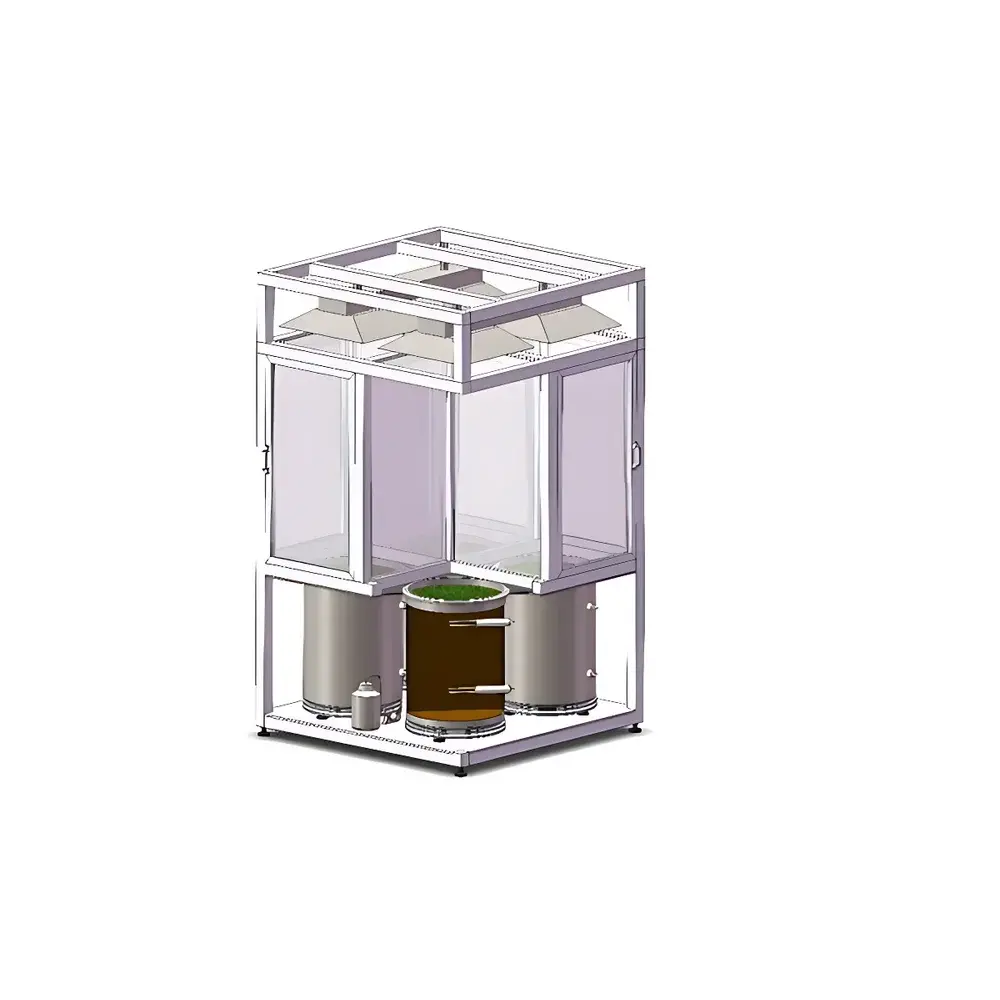
AZ SeedScope Digital Breeding Control and Phenotyping System
| Brand | AZ (Beijing Aozuo Ecological Instruments Co., Ltd.) |
|---|---|
| Origin | Beijing, China |
| Manufacturer Type | OEM Manufacturer |
| Regional Classification | Domestic (China) |
| Model | SeedScope |
| Pricing | Upon Request |
Overview
The AZ SeedScope Digital Breeding Control and Phenotyping System is an integrated environmental monitoring and controlled-condition experimental platform engineered for high-resolution, non-invasive phenotypic characterization across breeding pipelines. It operates on the principle of multi-modal sensor fusion—combining real-time in situ biophysical, biochemical, and edaphic measurements with programmable environmental perturbation—to isolate genotype-specific responses from environmental noise. Unlike conventional germplasm databases or field data loggers that emphasize metadata capture and manual annotation, SeedScope implements continuous, synchronized acquisition of aboveground physiological status (e.g., chlorophyll fluorescence, nitrogen index, drought and pathogen stress indicators) and belowground dynamics (soil redox potential, pH, volumetric water content, temperature, root architecture morphology). Its dual deployment capability—supporting both outdoor breeding plots and indoor climate-controlled chambers—enables longitudinal studies under reproducible conditions aligned with FAO’s Crop Phenotyping Network (CPN) framework and ISO 20672-1:2020 (Plant phenotyping — Vocabulary and general principles).
Key Features
- Modular architecture supporting indoor chamber-based and outdoor field-deployable configurations, including fixed-mount plot systems and mobile cart-based units for flexible experimental design.
- Integrated spectral sensing suite featuring narrowband LED-based optical sensors calibrated for chlorophyll-a/b ratio, SPAD-equivalent nitrogen index, and normalized difference vegetation index (NDVI)-derived stress indices (drought, biotic stress).
- Subsurface monitoring module with multi-depth soil probes measuring Eh (redox potential), pH, θv (volumetric water content), and thermal conductivity at up to 40 cm depth; all sensors comply with ASTM D5128–19 for in situ soil moisture profiling.
- Automated environmental actuation subsystem enabling programmable drought induction (via precision drip suppression), simulated rainfall events (with calibrated nozzle arrays), and dynamic light spectrum modulation (380–780 nm, ±2 nm resolution) to replicate climate variability scenarios.
- Root imaging subsystem utilizing transparent rhizoboxes coupled with time-lapse RGB + near-infrared (NIR) imaging (640 × 480 px, 10-bit depth) for quantitative analysis of root length density, branching angle, and nematode-induced galling morphology—validated against WinRHIZO Pro v2023 reference standards.
- Edge-computing gateway with embedded Linux OS, supporting local data buffering, onboard FFT-based signal conditioning, and TLS 1.3-secured MQTT/HTTPS transmission to cloud or on-premise servers.
Sample Compatibility & Compliance
The SeedScope system is validated for use with dicot and monocot species including but not limited to Zea mays, Oryza sativa, Triticum aestivum, Arabidopsis thaliana, and perennial forage grasses. All hardware components meet IP67 ingress protection rating for outdoor operation and operate within –20 °C to +55 °C ambient range. Sensor calibration protocols adhere to ISO/IEC 17025:2017 requirements for testing and calibration laboratories. Data provenance and audit trails comply with GLP (Good Laboratory Practice) Annex 11 and FDA 21 CFR Part 11 when configured with digital signature and user-role access control modules.
Software & Data Management
The AZ SeedScope Control Suite (v4.2+) provides a web-native interface for experiment scheduling, sensor configuration, real-time dashboard visualization (including heatmap overlays of spatial soil parameters), and batch export in CF-NetCDF 1.7 format compliant with the International Consortium for Agricultural Systems Applications (ICASA) metadata schema. Raw time-series data are stored in HDF5 containers with embedded georeferencing (WGS84) and temporal alignment metadata (ISO 8601 timestamps). The software supports automated generation of FAO-recommended phenotypic descriptors (e.g., growth stage codes, stress response curves) and exports structured reports compatible with BreedBase and Gramene databases.
Applications
- High-throughput screening of drought-tolerant maize hybrids under controlled deficit irrigation regimes.
- Quantitative assessment of root-knot nematode (Meloidogyne incognita) resistance across tomato germplasm collections using longitudinal root morphology metrics.
- Light quality optimization trials for photomorphogenic trait selection in brassica breeding programs.
- Soil-plant-atmosphere continuum (SPAC) modeling input generation via synchronized canopy transpiration estimates and subsurface water flux data.
- Wild relative introgression studies requiring long-term, low-disturbance monitoring of rare germplasm under semi-natural conditions.
FAQ
Can SeedScope be integrated with existing LIMS or breeding management platforms?
Yes—API endpoints support RESTful integration with platforms such as Fieldbook, Breedbase, and proprietary LIMS via OAuth2.0 authentication and JSON-LD payload exchange.
Is remote firmware update supported?
Yes—over-the-air (OTA) updates are delivered through signed package verification and rollback-safe dual-bank flash architecture.
What is the typical deployment lead time for a custom-configured SeedScope system?
Standard configurations ship within 8 weeks; site-specific engineering (e.g., greenhouse integration, power isolation, or regulatory certification) extends lead time to 12–16 weeks.
Does SeedScope provide traceable calibration certificates?
All factory-calibrated sensors include NIST-traceable certificates issued by CNAS-accredited calibration labs (Certificate No. CNAS LXXXXX), valid for 12 months under standard operating conditions.
Related Products







