
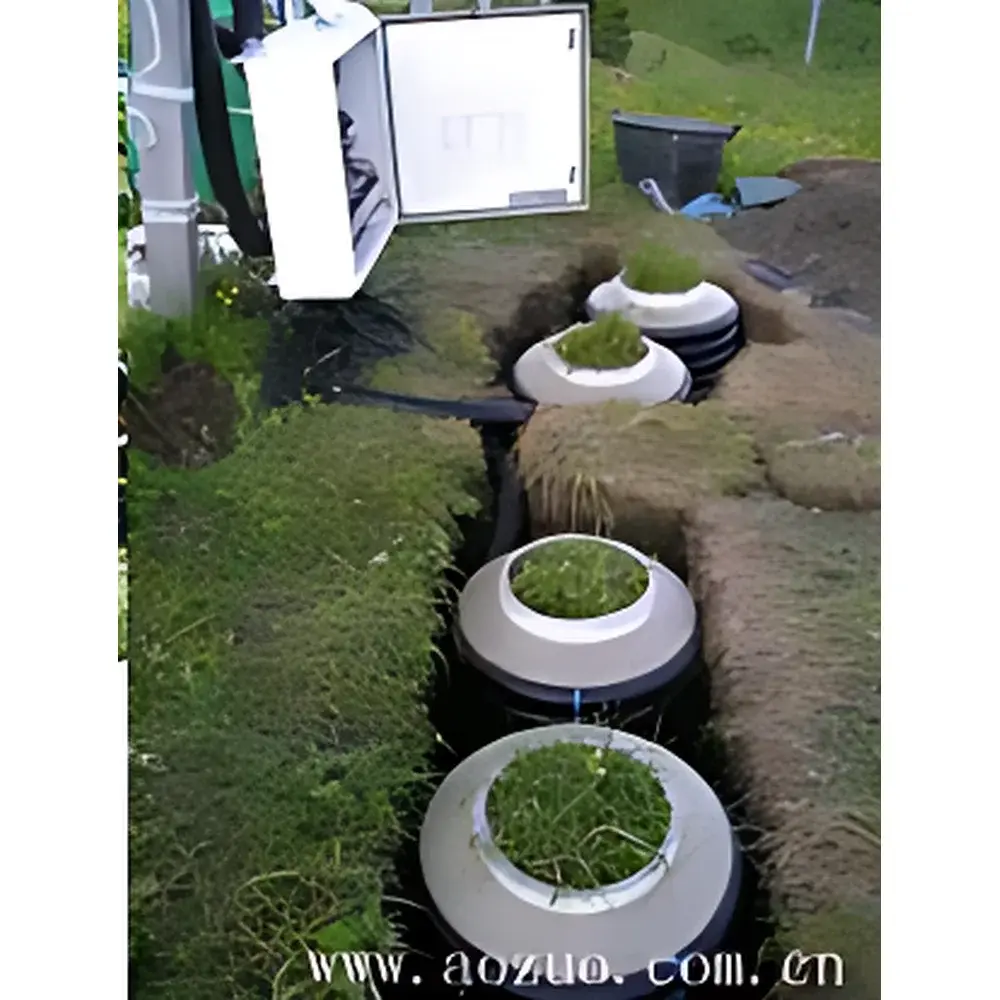
AZ SFLSET In-Situ Mini-Lysimeter System
| Brand | AZ (Beijing Aozuo) |
|---|---|
| Origin | Germany |
| Manufacturer | AZ |
| Product Type | Imported |
| Model | SFLSET |
| Instrument Category | Soil Moisture and Matric Potential Analyzer |
| Key Dimensions | 300 mm diameter, configurable heights (300 mm / 600 mm / 900 mm) |
| Weight Capacity Options | PL50 (0–50 kg), PL100 (0–100 kg), PL200 (0–200 kg) |
| Sensor Integration | Triple-depth soil moisture/temperature/EC (5TE Echo-probe), matric potential (MPS-2), reference tensiometer (T8), lysimeter-scale weighing (IP68/IP69-rated load cells) |
| Data Connectivity | RS485, SDI-12, USB (TensioLINK), analog (0–1/2/5 V), M12 8-pin interface |
| Environmental Rating | Outdoor-rated, lightning-protected, solar-powered autonomous operation |
Overview
The AZ SFLSET In-Situ Mini-Lysimeter System is a field-deployable, high-fidelity instrumentation platform engineered for quantitative in-situ water balance analysis in natural or managed soils. Unlike conventional lysimeters requiring excavation and relocation of soil monoliths, the SFLSET system operates as a minimally invasive, vertically integrated column installed directly into undisturbed field soil—preserving native structure, root architecture, and hydraulic continuity. Its core measurement principle combines gravimetric mass change detection with multi-depth, co-located monitoring of soil water content (θv), matric potential (ψm), temperature, and electrical conductivity. By integrating real-time weight dynamics from precision load cells with concurrent sensor-derived flux boundary conditions (infiltration, drainage, evapotranspiration), the system enables direct quantification of net water storage change (ΔS), percolation volume, and actual evapotranspiration (ETa) at the plot scale. Designed for long-term unattended operation under variable climatic conditions, it supports rigorous validation of vadose zone hydrological models—including Richards’ equation-based simulators—and contributes to process-level understanding of soil hydraulic function, root-zone water uptake efficiency, and climate–soil feedback mechanisms.
Key Features
- Modular in-situ stainless-steel lysimeter columns (300 mm diameter) available in three standard heights: 300 mm, 600 mm, and 900 mm—optimized for shallow root zones, deep profile characterization, or layered soil horizon studies.
- Triple-depth sensor arrays: Two 5TE Echo-probe sensors and two MPS-2 matric potential sensors installed at three distinct depths (e.g., 5/30/55 cm for SFL-600), enabling vertical resolution of water movement, hysteresis, and capillary rise dynamics.
- Dual-mode bottom boundary control: A bidirectional pump system regulates outflow based on either real-time field-matrix potential feedback (via T8 reference tensiometer) or user-defined setpoints—supporting both natural drainage and controlled tension experiments.
- High-stability gravimetric measurement: PL-series load platforms (PL50/PL100/PL200) feature C4–C5 grade load cells with IP68/IP69 ingress protection, ±0.02% full-scale error, and dual analog/digital output (RS485, SDI-12, TensioLINK).
- Integrated field reference: A co-located T8 tensiometer provides continuous comparison between column-internal and ambient field matric potential—critical for assessing lateral flow effects and boundary condition representativeness.
- Autonomous power & telemetry: DT-80M data logger with embedded GPRS/3G modem, 12 V / 26 Ah rechargeable battery, solar charging kit, and built-in surge protection for remote, year-round deployment.
Sample Compatibility & Compliance
The SFLSET system is compatible with mineral, organic, and mixed-texture soils across USDA texture classes—from sandy loam to heavy clay—provided structural integrity permits stable column emplacement. Its non-destructive installation preserves macroporosity, bioturbation features, and natural root networks, satisfying requirements for GLP-aligned environmental monitoring and long-term ecological research. All sensors and electronics comply with IEC 60529 (IP68/IP69K), EN 61000-4-5 (surge immunity), and ISO 9001-certified manufacturing standards. Data acquisition adheres to FAO-recommended lysimeter protocols and supports traceable audit trails compatible with ISO/IEC 17025 laboratory quality systems. While not FDA 21 CFR Part 11 certified by default, optional configuration with secure user authentication, electronic signatures, and immutable data logging meets GxP documentation prerequisites for regulatory environmental impact assessments.
Software & Data Management
Data collection is managed via the DT-80M intelligent logger, supporting scheduled or event-triggered sampling (1 min to 24 h intervals). Raw sensor outputs—including θv, ψm, T, EC, and mass—are time-stamped and stored locally on microSD cards with redundant backup. Communication protocols include SDI-12 (for 5TE and MPS-2), TensioLINK (for T8), and RS485 Modbus RTU (for load cells and pump controller). Cloud synchronization is enabled through GPRS/3G with configurable upload frequency and TLS 1.2 encryption. Post-acquisition processing leverages AZ’s LysCalc Toolkit—a Python-based open-architecture software suite that computes daily ETa, drainage flux, cumulative infiltration, and residual storage change using mass-balance closure diagnostics and uncertainty propagation (based on sensor accuracy specifications and weighing repeatability). Export formats include CSV, NetCDF, and MIASE-compliant metadata headers for interoperability with HydroShare, CZO Data Portal, and FAO WaPOR databases.
Applications
- Quantifying crop-specific evapotranspiration under deficit irrigation regimes and validating FAO-56 Kc coefficients.
- Calibrating and verifying numerical models of unsaturated flow (e.g., HYDRUS-1D, SWAP, RSWMS) using observed drainage and storage dynamics.
- Assessing soil hydraulic buffering capacity and hysteresis effects across wetting–drying cycles.
- Evaluating root water uptake depth distribution and compensatory extraction under drought stress.
- Supporting climate change impact studies on groundwater recharge rates and vadose zone residence times.
- Providing benchmark datasets for satellite-based ET downscaling (e.g., SEBAL, METRIC) and eddy covariance gap-filling.
- Long-term monitoring of landfill cover performance, mine reclamation sites, and green infrastructure infiltration basins.
FAQ
What distinguishes the SFLSET from traditional large-scale lysimeters?
The SFLSET eliminates the need for soil monolith excavation and transport, preserving in-situ hydraulic properties and reducing installation disturbance. Its compact size (300 mm diameter) enables replication across heterogeneous fields and integration into existing experimental plots without major land-use disruption.
Can the system operate autonomously for over one year?
Yes—when equipped with the 12 V / 26 Ah battery and ≥40 W solar panel (standard configuration), the system achieves >12 months of continuous operation in mid-latitude temperate climates, including winter periods with reduced irradiance.
How is drainage water collected and measured?
Drainage passes through a quartz-sand matrix into three ceramic-cup samplers mounted beneath the column base. The PL10 load platform continuously weighs the 10 L collection vessel, enabling high-temporal-resolution drainage flux calculation independent of manual sampling.
Is calibration of the 5TE Echo-probe required for accurate volumetric water content?
Factory calibration is provided for mineral soils; however, site-specific calibration using gravimetric samples is recommended for organic-rich or saline soils (>7 dS/m) to maintain ±1% accuracy in the 0–40% θv range.
Can multiple SFLSET units be synchronized for spatially distributed monitoring?
Yes—the DT-80M loggers support time-synchronized sampling across up to four parallel columns via GPS-disciplined clock alignment and shared cellular network timestamps, enabling spatiotemporal analysis of lateral variability.







