
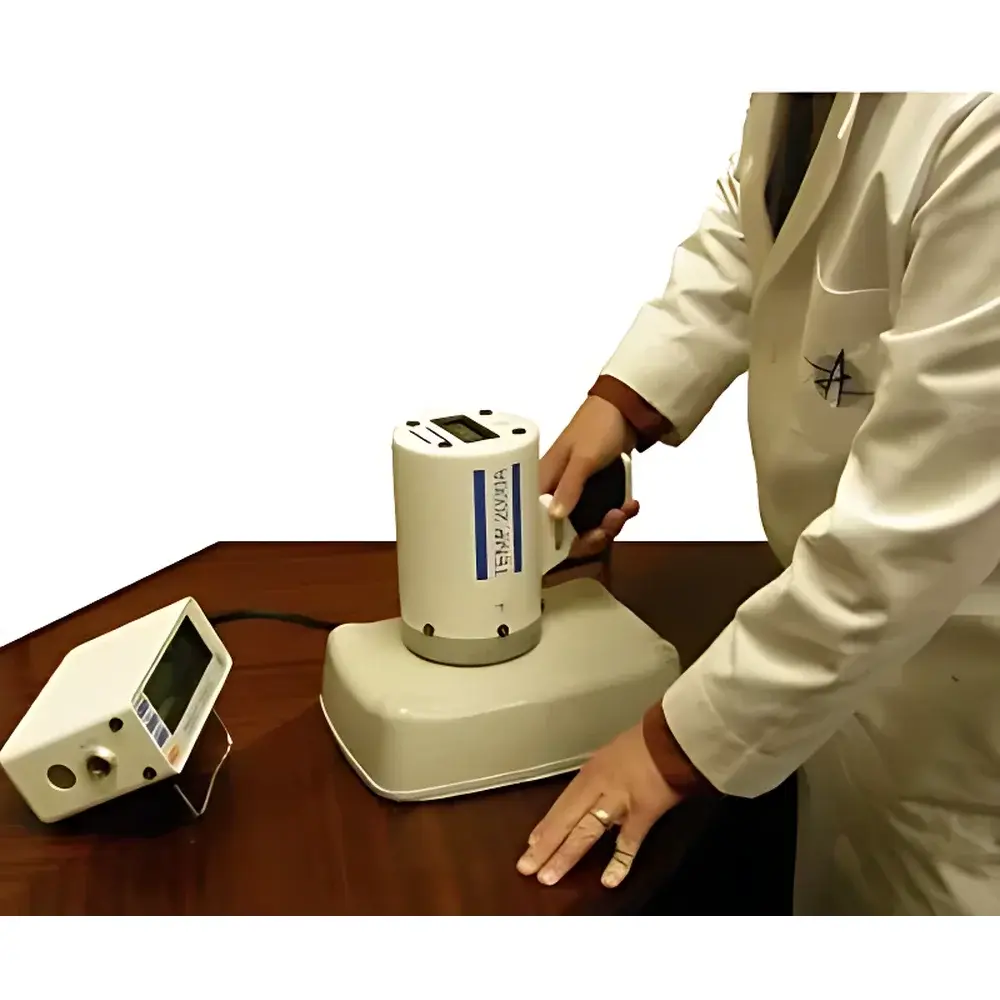
AZ Technology TEMP 2000A Portable Infrared Emissivity and Reflectance Analyzer
| Brand | AZ Technology |
|---|---|
| Origin | USA |
| Manufacturer Type | Authorized Distributor |
| Import Status | Imported |
| Model | TEMP 2000A |
| Price | Upon Request |
| Measurement Range (Reflectance) | 0.00–1.00 |
| Spectral Range (Broadband IR) | 3–35 µm |
| Emissivity Reference Temperature | 300 K |
| Angular Configuration | Normal-incidence & Hemispherical |
| Sample Diameter Requirements | ≥1 cm (flat), ≥16.5 cm (concave), ≥2.5 cm (convex) |
| Accuracy (Gray Samples) | ±1% FS |
| Accuracy (Non-Gray Samples) | ±3% FS |
| Repeatability | ±0.5% FS or better |
| Display | Digital LCD with selectable emissivity/reflectance output |
| Optical Head Dimensions | 5.25″ × 6.8″ (Ø × L) |
| Control Unit Dimensions | 4.5″ × 7.75″ × 7″ |
| Carrying Case Dimensions | 12.5″ × 17″ × 11″ |
| Weight | Optical Head: 5 lb, Control Unit: 4 lb, Case: 11 lb |
| Warranty | 1 year parts and labor |
Overview
The AZ Technology TEMP 2000A is a field-deployable, calibrated infrared emissivity and reflectance analyzer engineered for precision characterization of thermal radiation properties in laboratory, aerospace, and industrial environments. It operates on the principle of broadband directional-hemispherical reflectance measurement within the mid- to far-infrared spectrum (3–35 µm), enabling direct determination of normal and hemispherical emissivity at ambient temperature (300 K) via Kirchhoff’s law of thermal radiation. Unlike integrating sphere-based systems requiring sample mounting in controlled chambers, the TEMP 2000A employs a collimated optical path with thermoelectrically stabilized detectors and high-emissivity blackbody reference cavities—ensuring traceable calibration without cryogenic cooling. Its design replaces legacy instruments such as the discontinued Gier Dunkle DB-100 E408, while extending spectral coverage through optimized interference filters and multilayer dielectric coatings on all critical optics.
Key Features
- Portable, battery-compatible architecture with integrated control unit and detachable optical head for on-site measurements on large or immobile components (e.g., spacecraft thermal blankets, turbine blades, building envelope materials)
- Broadband IR reflectance measurement across 3–35 µm—covering atmospheric windows and key thermal emission bands relevant to space thermal control and energy efficiency standards
- Simultaneous acquisition of normal-incidence reflectance and derived normal/hemispherical emissivity at 300 K, compliant with ASTM C1371 and ISO 10545-10 test frameworks
- High-stability reference blackbody cavity with <0.998 emissivity and active temperature monitoring, referenced to NIST-traceable calibration certificates
- Digital LCD interface with real-time toggling between reflectance (0.00–1.00) and emissivity display modes; no external PC required for basic operation
- Mechanically robust housing rated IP54 for dust and splash resistance; optical head sealed against humidity ingress during outdoor deployment
Sample Compatibility & Compliance
The TEMP 2000A accommodates diverse material classes—including polished metals, anodized aluminum, ceramic coatings, polymer films, and fibrous insulators—without surface preparation beyond standard cleaning. Minimum sample dimensions are defined by geometric constraints of the measurement aperture: flat specimens require ≥1 cm diameter; concave surfaces must exceed 16.5 cm curvature diameter to avoid vignetting; convex samples require ≥2.5 cm radius of curvature. The system meets functional requirements for NASA MSFC-SPEC-250, ECSS-Q-ST-70-08C, and MIL-STD-810H environmental testing protocols. All firmware and hardware configurations support audit-ready documentation per FDA 21 CFR Part 11 when used in GLP/GMP-regulated thermal qualification workflows.
Software & Data Management
While standalone operation is fully supported, optional USB-connected PC software enables advanced data logging, spectral averaging, batch reporting, and export to CSV, XML, or PDF formats compliant with ISO/IEC 17025 record retention policies. Software includes built-in uncertainty propagation modules that compute combined standard uncertainty based on detector noise, reference cavity stability, alignment drift, and sample geometry inputs. Audit trails log operator ID, timestamp, calibration status, and environmental conditions (ambient T/RH if external sensors are connected). Exported reports include instrument serial number, calibration expiration date, and traceability statement referencing NIST SRM 2035 or equivalent.
Applications
- Aerospace thermal management: qualification of second-surface mirrors, MLI outer layers, and radiator coatings for low-E/high-R performance verification
- Renewable energy R&D: solar absorber selectivity assessment (when paired with optional TESA 2000 spectral module for 250–2500 nm UV-VIS-NIR)
- Building science: in-situ evaluation of roof coatings, low-emissivity window films, and radiant barrier systems per ASHRAE 90.1 and ISO 6946
- Defense & security: validation of camouflage netting emissivity signatures across IR threat bands (3–5 µm and 8–12 µm)
- Materials development: iterative feedback for sol-gel, sputtered, and spray-coated IR-functional thin films
FAQ
Can the TEMP 2000A measure emissivity at elevated temperatures?
No—the base model is configured for ambient-temperature (300 K) emissivity derivation from reflectance. High-temperature emissivity requires supplementary furnace integration and is supported only in custom-configured variants.
Is spectral resolution adjustable within the 3–35 µm range?
The TEMP 2000A provides broadband integrated reflectance over the full range. Discrete wavelength analysis requires the TESA 2000 add-on module with monochromator and Si/InSb detector array.
How often does the system require recalibration?
Annual recalibration is recommended per ISO/IEC 17025; however, daily verification using the onboard reference cavity and documented zero-check procedure satisfies routine QC requirements.
Does the instrument comply with electromagnetic compatibility (EMC) directives for lab use?
Yes—certified to IEC 61326-1:2013 for EMC immunity and emissions in laboratory environments (Class A), with conducted/radiated emissions tested per CISPR 11.
Can non-flat samples be measured without correction factors?
Concave and convex geometries are supported within specified curvature limits; however, users must input radius-of-curvature data into the software to apply validated geometric compensation algorithms per ASTM E1933.




