
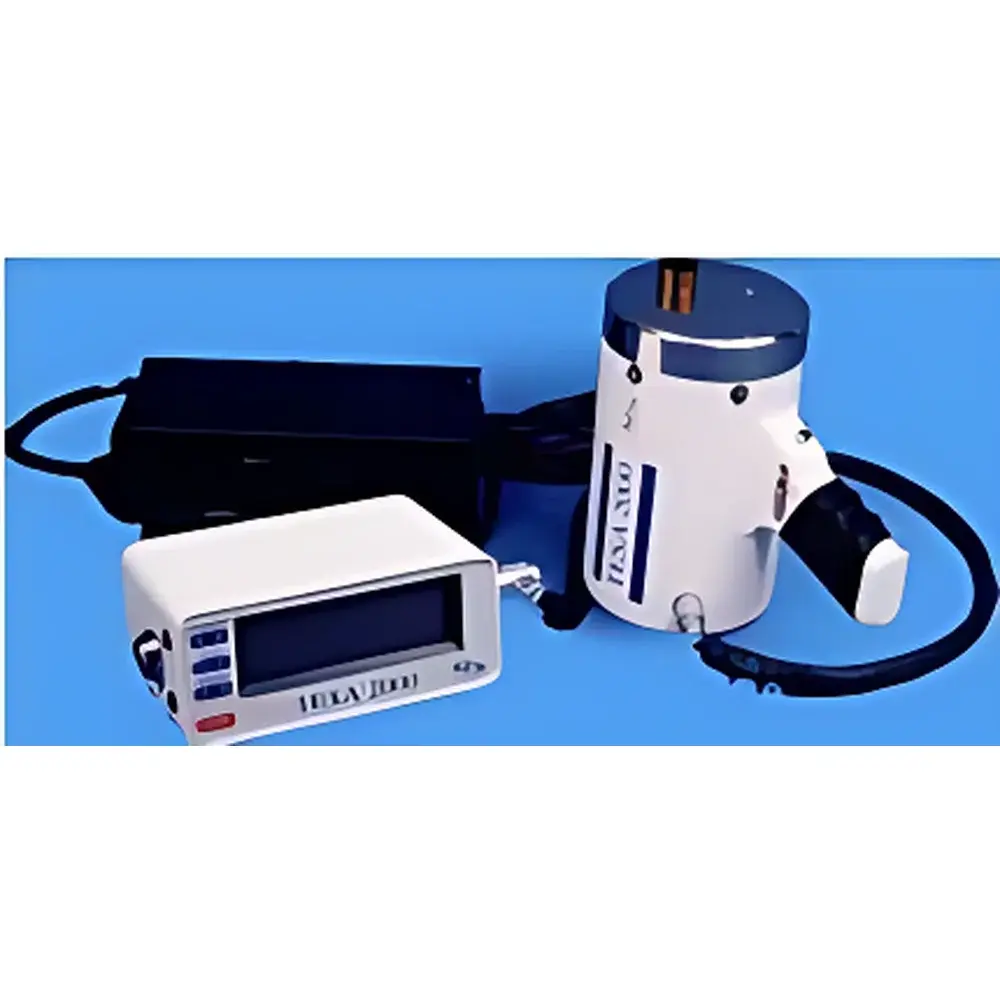
AZ Technology TESA 2000 Portable Solar Reflectometer and Hemispherical Emissometer
| Brand | AZ Technology |
|---|---|
| Origin | USA |
| Model | TESA 2000 |
| Spectral Range (Reflectance) | 250–2500 nm |
| Spectral Range (Emittance) | <3–>35 µm |
| Measurement Accuracy | ±1% FS (gray samples), ±3% FS (non-gray samples) |
| Repeatability | ±0.5% FS or better |
| Sample Diameter Requirement | ≥1 cm |
| Operating Temperature | Ambient |
| Display | Digital LCD with selectable solar reflectance / solar absorptance / IR emittance readouts |
| Optical Head Dimensions | 127 mm × 203 mm |
| Control Unit Dimensions | 190 mm × 140 mm × 76 mm |
| Total System Weight (incl. battery & case) | ~29 kg |
| Compliance | ASTM E408, ISO 9050 (implied), GLP-supporting measurement traceability |
Overview
The AZ Technology TESA 2000 is a dual-mode, field-deployable optical measurement system engineered for the simultaneous determination of solar spectral hemispherical reflectance and ambient-temperature total hemispherical emittance of solid surfaces. Unlike conventional spectrophotometers requiring external integration spheres or cryogenic calibration sources, the TESA 2000 integrates a patented ellipsoidal collector (U.S. Patent No. 5,659,397) to achieve high-efficiency, alignment-stable optical collection across two distinct spectral domains: the solar spectrum (250–2500 nm) and the thermal infrared (sub-3–>35 µm). Its design follows the fundamental radiometric principles defined in ASTM E408—Standard Test Methods for Total Emittance of Surfaces Using Inspection-Meter Techniques—and extends functionality beyond legacy instruments such as the discontinued Gier Dunkle DB-100. The instrument operates on the principle of optically integrated hemispherical reflectance measurement: incident broadband radiation is collected and compared against a reference standard via calibrated thermopile detectors, enabling direct calculation of solar reflectance (ρsolar) and total emittance (ε) without spectral deconvolution or empirical modeling.
Key Features
- Patented ellipsoidal optical collector ensures >92% collection efficiency and inherent immunity to misalignment during transport or repeated field deployment
- Dual-spectrum capability: seamless transition between solar reflectance (250–2500 nm) and thermal emittance (35 µm) modes using a single, filter-free optical path
- True hemispherical geometry: compliant with ASTM E408 requirements for total emittance measurement; no assumptions about surface BRDF required
- Portable architecture: modular design with detachable optical head (6 lb), control/display unit (3.25 lb), and rechargeable battery pack (11 lb), all housed in FAA-compliant carry cases (12.5″ × 17″ × 11″)
- Ambient-temperature operation: eliminates need for sample heating/cooling stages or environmental chambers; valid for surfaces at stable room temperature (15–30°C)
- Digital LCD interface with real-time toggling among solar reflectance (ρsolar), solar absorptance (αsolar = 1 − ρsolar), and IR emittance (ε) outputs
- Calibration traceability: factory-calibrated against NIST-traceable standards; optional annual recalibration service available with full uncertainty budget documentation
Sample Compatibility & Compliance
The TESA 2000 accommodates a broad class of opaque, planar materials without surface preparation: metallic foils, ceramic coatings, polymer films, architectural finishes, roofing membranes, and thermal insulation substrates. Minimum sample diameter is 1 cm; no vacuum, purge gas, or contact pressure is required. Specular, diffuse, and hybrid-reflecting surfaces are supported, with accuracy specifications differentiated per ASTM E408 Annex A2 for gray vs. non-gray emitters. The system meets functional equivalence requirements for LEED v4.1 MR Credit: Building Product Disclosure and Optimization – Environmental Product Declarations (EPDs), and supports compliance reporting under ASHRAE 90.1-2022 Appendix G for cool roof qualification. All firmware and measurement logic adhere to ALCOA+ data integrity principles, with audit-ready timestamped logs exportable via USB—enabling alignment with FDA 21 CFR Part 11 and ISO/IEC 17025 laboratory quality management systems when operated under documented SOPs.
Software & Data Management
The TESA 2000 operates autonomously via embedded firmware; no host PC is required for acquisition. All measurements are stored internally with UTC timestamps, operator ID fields (configurable), and metadata including ambient temperature, battery voltage, and calibration epoch. Data export is performed via USB 2.0 to CSV format, preserving full 16-bit detector resolution and error-flagged readings. Optional AZTech DataLink software (Windows 10/11 compatible) provides batch analysis, statistical trending (X̄-R charts), outlier detection per ISO 5725-2, and automated report generation compliant with GLP Annex 11 templates. Raw thermopile output voltages and normalized reflectance/emittance values are retained separately to support third-party uncertainty propagation analysis per GUM (JCGM 100:2018).
Applications
- Cool roof material certification per CRRC-1, ASTM C1549, and ENERGY STAR Roof Products Program requirements
- Thermal barrier coating (TBC) performance validation in aerospace maintenance depots
- Quality control of low-emissivity (low-e) window films and vacuum insulated panels (VIPs)
- Field verification of solar absorber coatings on concentrated solar power (CSP) receivers
- Research-grade characterization of metamaterials and selective solar absorbers in photothermal conversion studies
- Building envelope commissioning per ASHRAE Guideline 0 and ISO 52016-1 energy performance simulation input parameterization
FAQ
Does the TESA 2000 require annual recalibration?
Yes. AZ Technology recommends annual recalibration against NIST-traceable standards to maintain conformance with ASTM E408 Clause 8.2. Certificate includes expanded uncertainty (k=2) for both reflectance and emittance channels.
Can it measure curved or textured surfaces?
Only flat, rigid samples ≥1 cm in diameter are supported. Curved, flexible, or highly porous substrates introduce geometric errors exceeding ±3% FS and fall outside ASTM E408 scope.
Is spectral data output available?
No. The TESA 2000 delivers optically integrated values only—i.e., weighted averages across the full 250–2500 nm and 35 µm bands. For wavelength-resolved analysis, a Fourier-transform infrared (FTIR) spectrometer with integrating sphere is required.
How is measurement repeatability verified?
Repeatability is validated per ASTM E408 Section 10.3 using a certified Inconel 600 reference tile; users receive a factory test report demonstrating ≤±0.5% FS deviation over 20 consecutive cycles.
Does it comply with ISO 9050 for glass solar heat gain coefficient (SHGC) derivation?
While not a direct SHGC instrument, TESA 2000 solar reflectance data satisfies the ρsolar input requirement for ISO 9050-2003 Annex B calculations when paired with independent transmittance measurements from a UV-Vis-NIR spectrophotometer.





