
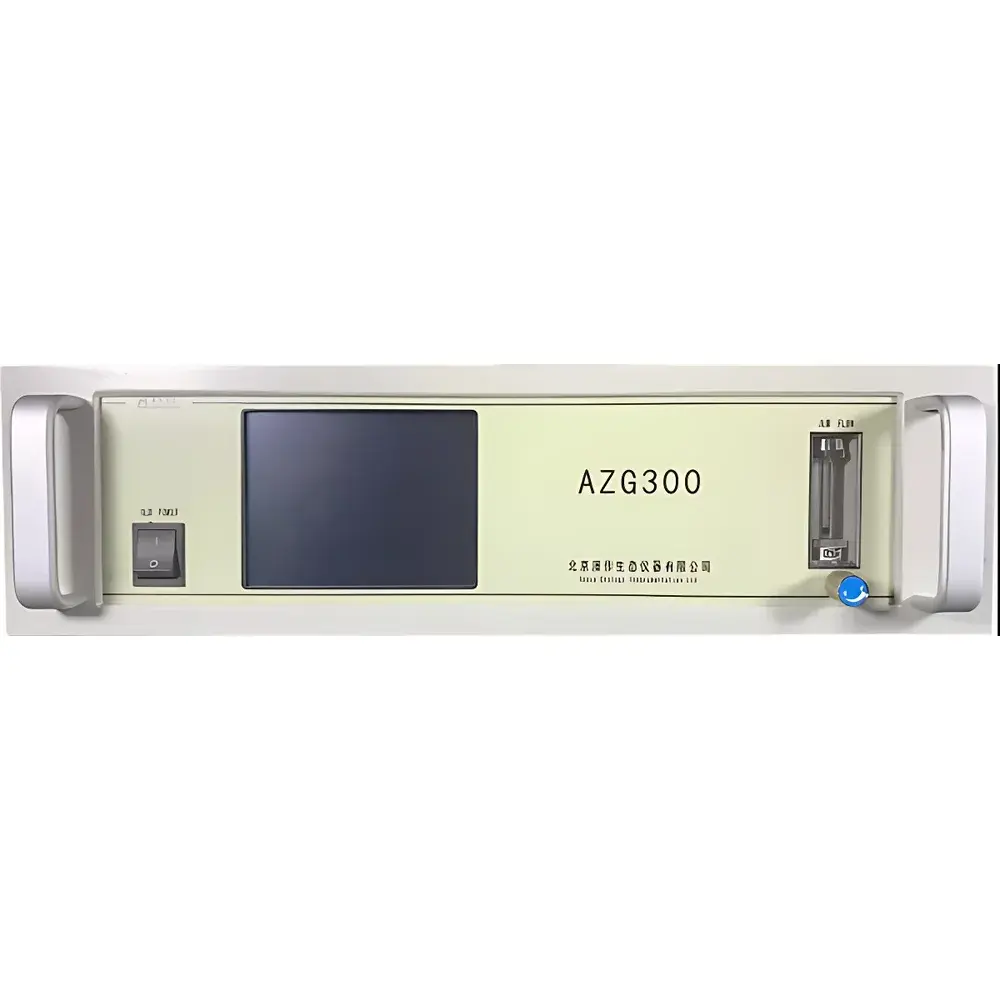
AZG-300 CO2 & CH4 Online Gas Flux Monitoring System
| Brand | AZ (Beijing Aozuo Ecological Instruments Co., Ltd.) |
|---|---|
| Origin | Beijing, China |
| Manufacturer Type | OEM Manufacturer |
| Country of Origin | China |
| Model | AZG-300 |
| Price | Upon Request |
| Measurement Principle | NDIR for CO₂ |
| CO₂ Range | 0–2000 ppm (optional: 0–5000 / 0–10,000 / 0–80,000 ppm) |
| CH₄ Range | 0–100 ppm (optional: 0–100% vol) |
| CO₂ Resolution | 0.01 ppm |
| CH₄ Resolution | 0.1 ppm |
| Accuracy | ≤ ±1% F.S. |
| Gas Flow Control | 0.1–1 L/min |
| Warm-up Time | 20 min |
| Response Time (T₉₀) | 2 s |
| Output Interface | RS232 |
| Display | Color TFT touchscreen |
| Operating Temp. | 0–45 °C |
| Operating Humidity | 1–98% RH (non-condensing) |
| Power Supply | AC 85–265 V, 40 W |
| Dimensions (Analyzer) | 57 × 41 × 22 cm |
| iChamber Options | Ø0.35 m × 0.5 m (0.08 m²), Ø0.62 m × 0.8 m (0.3 m²), Ø1.2 m × 1.5 m (1.0 m²) |
Overview
The AZG-300 CO₂ & CH₄ Online Gas Flux Monitoring System is a field-deployable, dual-gas analyzer engineered for continuous, in-situ quantification of carbon dioxide and methane concentrations in ambient air and soil-atmosphere interface environments. It employs non-dispersive infrared (NDIR) spectroscopy for CO₂ detection and tunable diode laser absorption spectroscopy (TDLAS) for CH₄—two industry-standard optical techniques offering high selectivity, long-term baseline stability, and minimal cross-sensitivity. Designed explicitly for ecosystem-scale greenhouse gas (GHG) research, the system supports both open-path atmospheric monitoring and closed-chamber flux measurements when integrated with the iChamber automatic soil chamber. Its thermally stabilized optical cell ensures zero drift suppression and consistent calibration integrity under variable field conditions—critical for multi-season, unattended deployments across forests, grasslands, agricultural soils, peatlands, and wetlands.
Key Features
- Simultaneous real-time measurement of CO₂ and CH₄ with independent optical paths and dedicated detectors
- Integrated temperature-controlled measurement cell maintaining thermal equilibrium (±0.1 °C) to eliminate thermal drift effects on zero and span stability
- High-resolution display and intuitive touchscreen interface enabling on-site configuration, diagnostics, and data review without external hardware
- Onboard data logging capacity supporting >1 million timestamped records with automatic time-stamping (RTC-backed)
- RS232 serial interface and TCP/IP Ethernet connectivity for remote telemetry, SCADA integration, or direct PC synchronization
- Auto-calibration protocol compatible with certified span gases (e.g., CO₂/N₂ and CH₄/N₂ mixtures), configurable via software or manual trigger
- Ruggedized industrial enclosure rated IP54 for outdoor operation under rain, dust, and wind exposure up to 12 Beaufort scale
- Modular power architecture accepting universal AC input (85–265 V), optimized for low-power off-grid sites using solar-battery systems
Sample Compatibility & Compliance
The AZG-300 is validated for use in heterogeneous terrestrial ecosystems where representative sampling requires spatial flexibility and temporal continuity. Its compatibility extends across soil types (sandy, loamy, clayey), moisture regimes (from arid to saturated), and vegetation structures (bare soil, crop canopies, shrubland, forest floor). When coupled with the iChamber automatic chamber, the system adheres to established GHG flux measurement protocols aligned with IPCC Tier 1 methodology and ASTM D6348-15 (Standard Test Method for Determination of Gaseous Compounds by Extractive Direct Barometric Pressure Ionization Mass Spectrometry). The analyzer’s response linearity, repeatability (<0.5% RSD over 24 h), and detection limits meet requirements for GLP-compliant environmental monitoring programs. While not FDA 21 CFR Part 11 certified out-of-the-box, audit-trail functionality—including user login logs, parameter change history, and calibration event timestamps—is fully supported within Ecograph software for regulated research applications.
Software & Data Management
Ecograph is a domain-specific data acquisition and flux computation platform developed by Beijing Aozuo for ecological observatory networks. Built on a modular C++ framework, it natively ingests time-series data from AZG-300 units via RS232 or TCP/IP, synchronizes timestamps across distributed sensor nodes, and applies standardized HMR (Hutchinson-Mosier-Robertson) or linear regression algorithms to compute soil gas flux rates (µmol·m⁻²·s⁻¹). The software supports dual-Y-axis plotting, multi-parameter overlay (e.g., CO₂ flux vs. soil temperature and volumetric water content), and customizable export formats (CSV, NetCDF, Excel) compliant with FluxNet, AmeriFlux, and ICOS metadata standards. All raw and processed datasets are stored locally with SHA-256 checksum verification; optional cloud backup is available through secure HTTPS endpoints. The GUI operates exclusively in Chinese—no English localization is provided—but all exported data files contain English column headers and SI-unit annotations.
Applications
- Long-term monitoring of soil CO₂ and CH₄ efflux across climate gradients and land-use transitions (e.g., afforestation, cropland abandonment, peatland restoration)
- Process-level studies linking microbial community dynamics (via qPCR or metagenomics) with real-time gas production rates under controlled moisture-temperature-pH perturbations
- Validation of eddy covariance tower data at footprint scales using spatially distributed chamber networks
- Urban-rural gradient analysis of anthropogenic CH₄ sources (landfills, wastewater treatment, natural gas leakage) and biogenic sinks
- Controlled-environment experiments assessing fertilizer type, irrigation regime, or tillage intensity impacts on net ecosystem exchange (NEE)
- Calibration and intercomparison campaigns involving cavity ring-down spectrometers (CRDS) and gas chromatography systems
FAQ
What gas concentration ranges are standard, and how are extended ranges configured?
The base configuration covers CO₂: 0–2000 ppm and CH₄: 0–100 ppm. Extended CO₂ ranges (up to 80,000 ppm) require optical path length adjustment and custom calibration gas certification; these are factory-installed options ordered at time of purchase.
Can the AZG-300 operate autonomously for unattended field deployment?
Yes—when powered by AC mains or a solar-charged battery bank (≥12 V, 20 Ah), the unit supports continuous operation for >30 days with full data logging and periodic self-diagnostics enabled.
Is Ecograph software compatible with Windows 10/11 and macOS?
Ecograph is a native Windows application (x64, Windows 10/11 only); virtualization or Boot Camp is required for macOS usage.
Does the iChamber support automated sequential measurements across multiple collars?
The iChamber itself is a single-point chamber; sequential multi-collaring requires external multiplexer hardware (e.g., AZ-MUX series) and Ecograph script-based scheduling.
What maintenance intervals are recommended for field longevity?
Optical windows should be inspected and cleaned every 3 months; annual recalibration against traceable NIST-certified standards is advised for regulatory-grade data reporting.







