
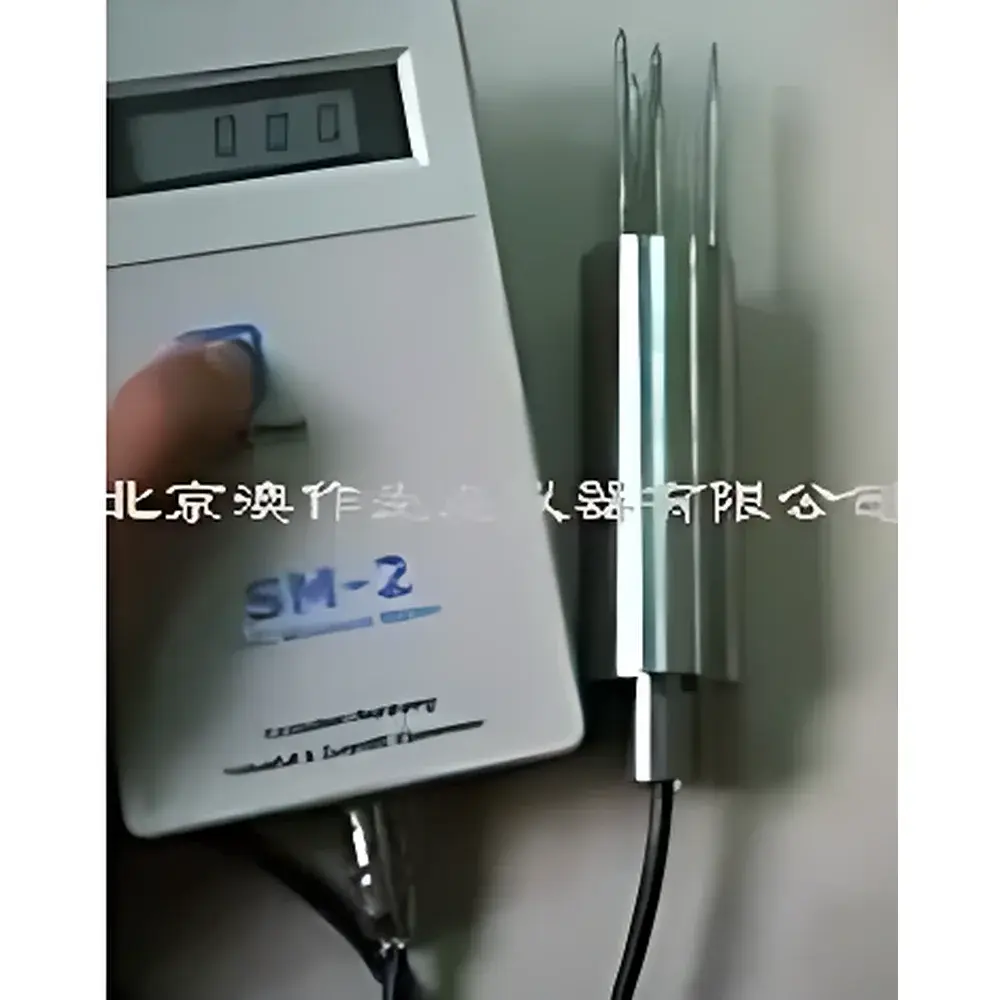
AZS-2 Soil Moisture Meter
| Origin | Beijing, China |
|---|---|
| Manufacturer Type | Distributor |
| Origin Category | Domestic (China) |
| Model | AZS-2 |
| Price | Upon Request |
Overview
The AZS-2 Soil Moisture Meter is a field-deployable, time-domain electromagnetic (TDR-inspired) sensor system engineered for rapid, non-destructive determination of volumetric water content (θv) in soils and granular media. It operates on the principle that the dielectric permittivity (ε) of soil is strongly correlated with its water content—air (ε ≈ 1) and dry mineral matrix (ε ≈ 3–5) exhibit stable low permittivity, whereas liquid water has ε ≈ 80 at 20°C. The AZS-2 probe emits a high-frequency electromagnetic signal (typically in the 20–100 MHz range) along parallel stainless-steel rods; the propagation velocity and reflected waveform characteristics are functionally related to √ε. By measuring the output DC voltage (0–1.2 V), which exhibits linearity with √ε under calibrated conditions, the instrument derives θv using empirically validated calibration functions. This method avoids direct contact with pore water chemistry and remains insensitive to soil salinity up to moderate EC levels (<4 dS/m), making it suitable for agricultural, ecological, and civil engineering applications where robustness and field portability are prioritized over ultra-high resolution.
Key Features
- Two-mode deployment: supports both portable spot measurement and long-term in-situ monitoring via buried probe installation
- Fast response time: <5 seconds per reading, enabling high-throughput field surveys
- Integrated dual-component system: AZS-2 probe + SM-3 handheld display unit with direct %v/v readout
- Wide operational temperature range: 0°C to +50°C, validated for temperate and subtropical field environments
- Flexible cabling: standard 1.5 m shielded coaxial cable (extendable up to 100 m without signal degradation)
- Low-power DC operation: probe accepts 6–15 V DC input; SM-3 display powered by a single 9 V alkaline battery (rated for ≥6,500 measurements)
- Calibration flexibility: factory-calibrated for common mineral soils; user-adjustable offset/slope parameters support site-specific validation against gravimetric standards (ASTM D4959, ISO 11274)
Sample Compatibility & Compliance
The AZS-2 probe is compatible with mineral soils (sand, loam, clay), organic substrates (peat, compost), construction materials (concrete admixtures, asphalt base layers), and industrial bulk solids (grains, flour, powdered feed). Its stainless-steel rod geometry (standard 12 cm length × 3 mm diameter) ensures mechanical stability in coarse or compacted media. While not certified to IEC 61326-1 (EMC) or IP68, the probe meets functional environmental requirements for outdoor use per IEC 60529 IP54 (dust-protected, splash-resistant housing). Data acquisition protocols align with GLP-compliant field documentation practices; output voltage signals are compatible with third-party data loggers supporting 0–1.2 V analog input (e.g., Campbell Scientific CR1000X, HOBO U12). Calibration traceability follows ISO/IEC 17025 principles when performed using NIST-traceable reference standards.
Software & Data Management
The AZS-2 itself is hardware-only and does not include embedded firmware or proprietary software. However, its analog voltage output enables seamless integration into existing environmental monitoring infrastructures. When paired with compliant data loggers, users may configure automated sampling intervals (1 min to 24 h), apply linear or polynomial conversion equations (e.g., θv = a·V + b or θv = a·√V + b), and export timestamped CSV files for post-processing in MATLAB, Python (NumPy/Pandas), or R. The SM-3 handheld unit stores no internal data but supports manual logging via external notebooks or mobile apps. For regulatory contexts requiring audit trails (e.g., USDA NRCS monitoring networks or EU CAP compliance reporting), external logging systems must implement 21 CFR Part 11–compliant electronic signatures and change control logs.
Applications
- Agricultural irrigation scheduling: real-time feedback for drip or pivot systems to minimize water waste and optimize yield
- Ecological research: long-term soil moisture profiling across transects in forest, grassland, or wetland ecosystems
- Civil engineering: moisture monitoring during earthwork compaction, landfill cover installation, or roadbed stabilization
- Food processing QA: inline verification of grain, cereal, or powder moisture prior to storage or packaging (per USP & FDA guidance on moisture-critical products)
- Construction material testing: hydration tracking in fresh concrete, mortar, or stabilized soil blocks per ASTM C172 and EN 12350-2
FAQ
What is the measurement principle used by the AZS-2?
It employs frequency-domain reflectometry (FDR), where probe output voltage correlates linearly with the square root of soil dielectric permittivity (√ε), which is dominated by water content.
Can the AZS-2 be used in saline soils?
Yes, within limits: accuracy degrades above electrical conductivity (EC) of ~4 dS/m; field calibration with local saline soil samples is recommended.
Is the probe suitable for frozen soil measurement?
No—dielectric behavior of ice differs significantly from liquid water; measurements below 0°C are invalid unless thawed conditions are confirmed.
How often should calibration be verified?
Annually under stable field conditions; immediately after probe relocation or exposure to extreme physical impact or corrosion.
Does the system support wireless telemetry?
Not natively—the AZS-2 provides only analog voltage output; wireless capability requires integration with third-party LoRaWAN, NB-IoT, or cellular-enabled data loggers.
Related Products







