
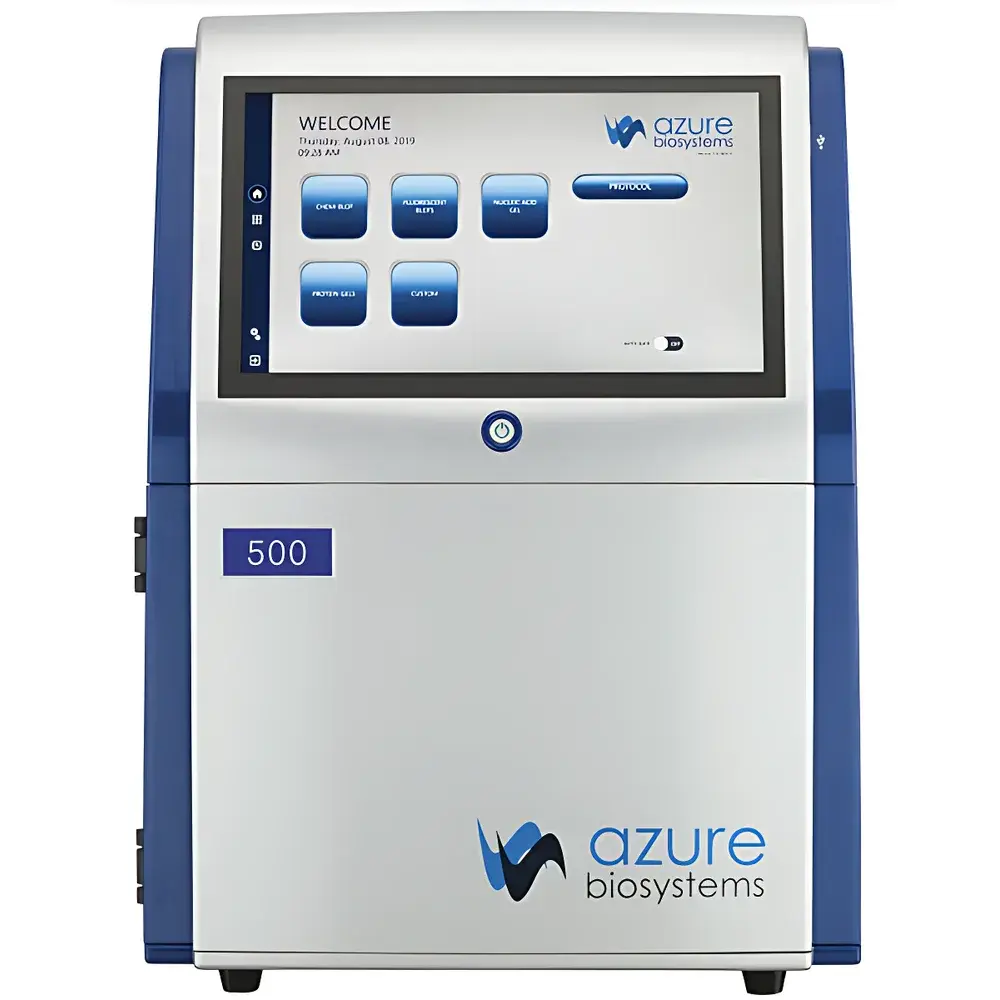
Azure Biosystems Azure 500 Multispectral Fluorescence Gel Imaging System
| Brand | Azure Biosystems |
|---|---|
| Origin | USA |
| Model | Azure 500 |
| Instrument Type | Multispectral Fluorescence Gel Imaging System |
| CCD Resolution | 9.1 MP |
| Bit Depth | 16-bit |
| Dynamic Range | 4.8 OD |
| CCD Sensor Size | 2/3" |
| Detection Sensitivity | fg-level |
| Signal-to-Noise Ratio | High |
| Lens System | Motorized Autofocus |
| Integrated Display | 13.3" HD Touchscreen PC |
Overview
The Azure Biosystems Azure 500 Multispectral Fluorescence Gel Imaging System is a fully integrated, benchtop imaging platform engineered for quantitative molecular biology applications. It employs high-quantum-efficiency scientific CMOS/CCD detection coupled with precisely calibrated excitation sources—including dual-wavelength UV (254 nm and 365 nm), narrow-band blue light (470 nm), and two independent solid-state near-infrared lasers (685 nm and 785 nm)—to enable simultaneous or sequential multispectral acquisition across visible, UV, and NIR spectral domains. The system operates on the principle of epifluorescence detection: excitation light is directed onto the sample via optimized optical pathways, and emitted fluorescence is collected through a high-transmission, multi-bandpass filter turret and imaged onto a cooled 9.1-megapixel sensor with 16-bit digitization. This architecture ensures linear signal response over a 4.8 optical density (OD) dynamic range—critical for accurate quantitation across wide-abundance protein or nucleic acid bands. Its embedded 13.3-inch HD touchscreen computer eliminates external hardware dependencies, reducing footprint and electromagnetic interference while maintaining full computational capability for real-time image processing.
Key Features
- Integrated 13.3-inch HD touchscreen PC running Windows OS—no external computer required for routine operation
- Dual-laser NIR excitation (685 nm and 785 nm) with independently adjustable power control for optimal signal-to-background in multiplexed western blotting
- Motorized autofocus system with real-time focus validation, ensuring consistent focal plane across sample batches and gel types
- Automated exposure and excitation intensity optimization—user-defined protocols store all imaging parameters (filter, laser power, exposure time, binning) for strict inter-experimental reproducibility
- Cooled 2/3-inch format sensor with thermoelectric stabilization to minimize dark current noise and support long-exposure chemiluminescence imaging
- Modular filter turret accommodating up to six user-replaceable bandpass filters, supporting custom fluorophore configurations beyond factory presets
Sample Compatibility & Compliance
The Azure 500 supports standard electrophoretic formats including mini and midi SDS-PAGE gels, agarose gels (up to 15 × 15 cm), western blot membranes (PVDF and nitrocellulose), and stained tissue sections. It accommodates both wet and dry imaging modalities and is compatible with common fluorescent dyes (SYBR Safe, SYPRO Ruby), chemiluminescent substrates (Luminata Forte, ECL Prime), and NIR-conjugated secondary antibodies (e.g., IRDye 680RD, IRDye 800CW). From a regulatory perspective, the system’s software suite supports audit-trail-enabled workflows compliant with GLP and GMP environments. Optional 21 CFR Part 11 compliance packages include electronic signatures, role-based access control, and immutable raw-data archiving—meeting requirements for preclinical assay documentation and submission-ready data packages.
Software & Data Management
Acquisition and analysis are performed using AzureSpot™ Software—a validated, version-controlled application designed for life science quantitation. It provides non-linear background subtraction, lane/profile tracing, molecular weight calibration, and multiplex ratio analysis (e.g., target protein vs. loading control across NIR channels). All image metadata—including instrument settings, timestamp, user ID, and calibration history—is embedded in TIFF and XML sidecar files. Raw images are stored in lossless 16-bit format; processed data exports to CSV, Excel, and publication-ready PDF/PNG with embedded scale bars and annotation layers. Network deployment options allow centralized license management and secure DICOM-compliant data routing to LIMS or ELN systems.
Applications
- Quantitative analysis of nucleic acids in ethidium bromide- or SYBR-stained agarose gels
- Detection and densitometric quantification of proteins in Coomassie- or silver-stained SDS-PAGE gels
- High-sensitivity chemiluminescent western blot imaging with dynamic exposure bracketing
- Multiplexed NIR western blotting using spectrally distinct 685 nm and 785 nm channels for co-detection of multiple targets on a single membrane
- Fluorescent in-gel digestion monitoring and post-electrophoretic staining validation
- Documentation of colorimetric ladder standards under white-light transillumination mode
FAQ
Does the Azure 500 support time-lapse or kinetic imaging?
No—the system is optimized for endpoint imaging rather than continuous acquisition; however, sequential multi-channel captures can be scheduled with programmable inter-frame delays.
Can third-party antibodies or dyes be used with the NIR lasers?
Yes—provided they exhibit excitation maxima within ±10 nm of 685 nm or 785 nm and emission maxima compatible with the installed emission filters.
Is calibration traceable to NIST standards?
Yes—intensity calibration is performed using certified neutral-density step tablets and fluorescent reference standards, with certificates available upon request.
What file formats are natively supported for export?
TIFF (16-bit, metadata-embedded), PNG, JPEG, CSV, XLSX, and PDF—with optional XML-based assay definition files for reproducible reprocessing.
How is firmware updated?
Updates are delivered via encrypted USB drive or secure HTTPS download through the embedded OS; each release includes version-signed changelogs and rollback capability.






