
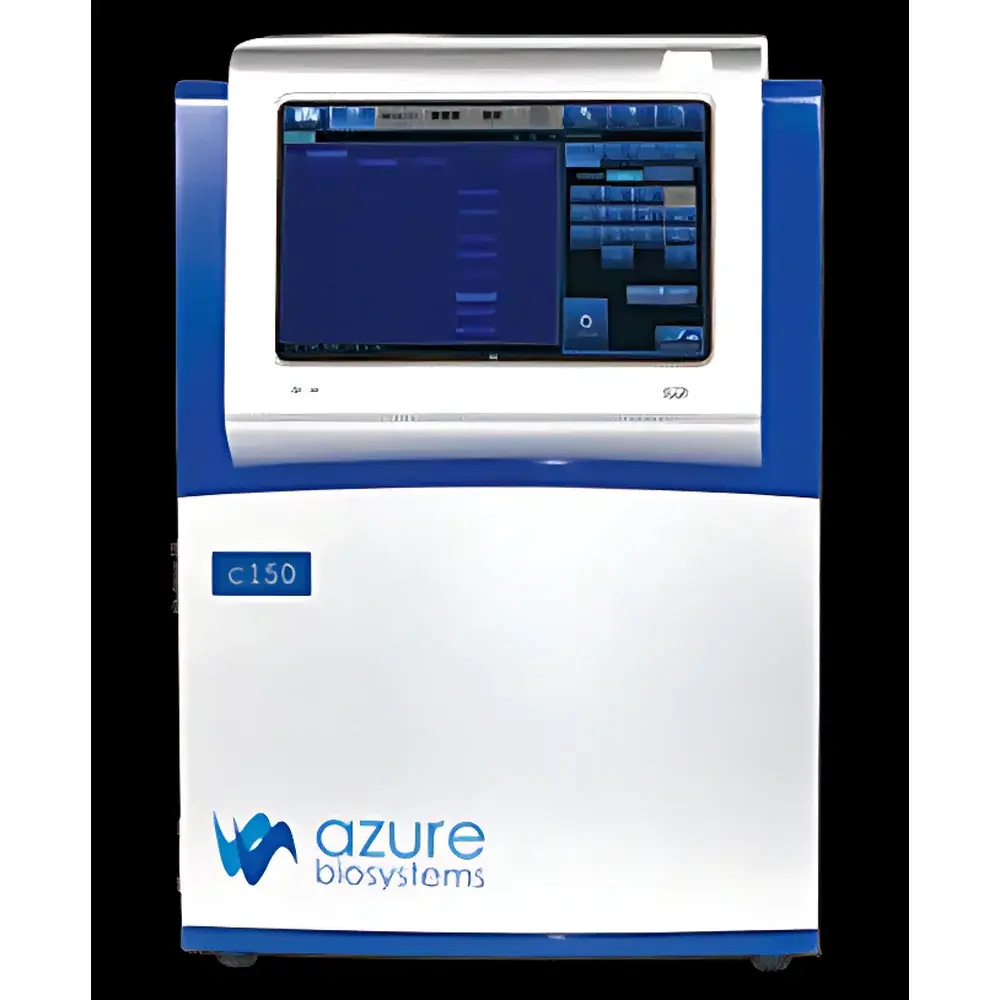
Azure Biosystems C150 Gel Imaging System
| Brand | Azure Biosystems |
|---|---|
| Origin | USA |
| Model | C150 |
| Instrument Type | Standard Gel Imaging System |
| CCD Resolution | 3.2 Megapixels |
| Bit Depth | 16-bit |
| Dynamic Range | 3.6 OD |
| CCD Sensor Size | 3/4-inch |
| Detection Sensitivity | >0.05 ng DNA (with ethidium bromide) |
| Signal-to-Noise Ratio | >56 dB |
| Lens | 6x Zoom Motorized Lens |
| Illumination Modes | UV (302 nm), Blue Light (470 nm), White Light (LED) |
Overview
The Azure Biosystems C150 Gel Imaging System is a fully integrated, real-time digital imaging platform engineered for reproducible and quantitative analysis of nucleic acid and protein gels. Built upon a high-sensitivity monochrome CCD architecture with 16-bit digitization and a 3.6 optical density (OD) dynamic range, the system captures subtle intensity gradients across broad signal amplitudes—enabling accurate densitometric quantification of bands from faint low-abundance targets to saturated high-intensity regions. Its core optical design employs a motorized 6× zoom lens with fixed focal plane geometry, eliminating manual focusing and positional constraints during sample loading. This autofocus-free architecture ensures consistent magnification and spatial calibration across repeated acquisitions—critical for longitudinal studies and inter-laboratory data comparability. The system supports three independent illumination modalities: 302 nm UV transillumination for ethidium bromide–stained DNA gels and gel excision; 470 nm blue light transillumination optimized for SYBR® Safe, SYBR® Green I/II, and other non-mutagenic nucleic acid dyes; and uniform white LED epi-illumination for Coomassie Brilliant Blue– and silver-stained protein gels. All illumination sources are electronically synchronized with exposure control to minimize photobleaching and maximize signal fidelity.
Key Features
- Motorized 6× zoom lens with fixed working distance—no refocusing required between samples or runs
- 3.2-megapixel monochrome CCD sensor with 16-bit analog-to-digital conversion for high-fidelity grayscale capture
- 3.6 OD dynamic range enables linear quantification across >2,500-fold intensity variation within a single exposure
- Detection sensitivity of <0.05 ng double-stranded DNA (with EtBr staining) under standard acquisition conditions
- Signal-to-noise ratio exceeding 56 dB (measured at full well capacity), supporting low-background detection in low-light applications
- Integrated triple-illumination module: UV (302 nm), blue light (470 nm), and white LED (epi-illumination)
- Real-time preview and auto-exposure optimization prior to final image acquisition
- Compact footprint (W × D × H: 40 × 42 × 58 cm) with built-in darkroom enclosure and safety interlock for UV operation
Sample Compatibility & Compliance
The C150 accommodates standard electrophoresis formats including mini-gels (up to 15 × 15 cm), midi-gels, and multi-well plates (e.g., 96-well PCR plates for colony screening). It supports both horizontal (agarose) and vertical (polyacrylamide) gel configurations without mechanical reconfiguration. For regulatory environments, the system operates in alignment with GLP-compliant documentation workflows when paired with AzureSpot™ software’s audit-trail-enabled acquisition logs. While not FDA-cleared as a diagnostic device, its hardware and software architecture conform to general laboratory instrumentation requirements outlined in ISO/IEC 17025:2017 (clause 6.4 on equipment verification) and support traceable calibration via included NIST-traceable step tablet references. UV exposure time logging and shutter actuation history are retained per image file for internal QA review.
Software & Data Management
Controlled exclusively through AzureSpot™ Software (v7.x or later), the C150 provides a validated, menu-driven interface compatible with Windows 10/11 (64-bit). The software implements automated background subtraction, lane/band detection with adjustable thresholding, molecular weight estimation using reference ladders, and relative quantification normalized to internal standards or total lane intensity. Export options include TIFF (uncompressed, 16-bit), PNG, JPEG, and PDF reports with embedded metadata (exposure time, lens zoom position, illumination mode, date/time stamp). Raw image files retain EXIF-compatible headers compliant with MIAME and MIAPE reporting guidelines. Audit trail functionality records user ID, acquisition parameters, and timestamped edits—supporting 21 CFR Part 11 readiness when deployed with network-based authentication and electronic signature modules.
Applications
- Quantitative analysis of PCR products, restriction digests, and DNA laddering assays
- Densitometric evaluation of Western blot transfer efficiency and antibody binding signals
- Validation of CRISPR/Cas9 editing outcomes via T7E1 or Surveyor nuclease assays
- Documentation and archiving of SDS-PAGE gels for QC release testing in biomanufacturing
- High-throughput colony screening from transformation or library plating experiments
- Comparative expression profiling across tissue lysates or time-course treatments
FAQ
Does the C150 require routine optical calibration?
No—its fixed-focus, motorized zoom lens and factory-aligned illumination paths eliminate the need for user-performed optical recalibration. Annual verification using the included step tablet is recommended for ISO/IEC 17025 compliance.
Can the system be used for chemiluminescent detection?
No—the C150 is designed for fluorescence and absorbance-based gel imaging only. Chemiluminescence requires longer exposures and cooled CCDs not present in this configuration.
Is remote operation supported?
Yes—AzureSpot™ allows networked acquisition and image review via secure RDP or VNC sessions; however, direct hardware control (e.g., lens movement, illumination switching) must occur from the host PC physically connected to the system.
What file formats are generated during acquisition?
Primary output is 16-bit TIFF. Secondary exports include annotated PDF reports, CSV-formatted quantification tables, and PNG/JPEG thumbnails for presentations.
How is UV safety enforced during operation?
A dual-interlock mechanism disables UV illumination unless both the front door is fully closed and the safety latch is engaged; status LEDs and software alerts provide real-time feedback on interlock state.




