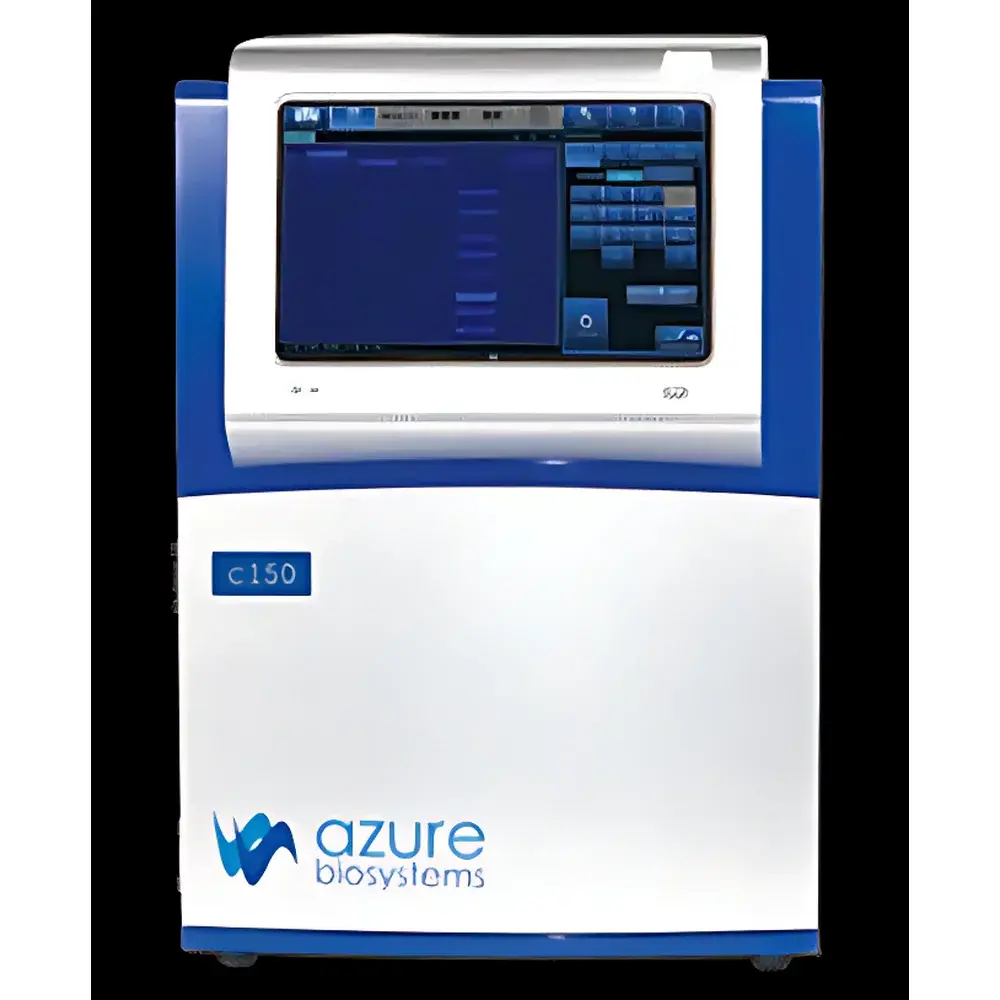
Azure Biosystems C300 Chemiluminescence Imaging System
| Brand | Azure Biosystems |
|---|---|
| Origin | USA |
| Model | C300 |
| Instrument Type | Chemiluminescence Gel Imaging System |
| CCD Resolution | 8.3 MP |
| Bit Depth | 16-bit |
| Dynamic Range | 4.8 OD |
| CCD Sensor Size | 3/4" |
| Detection Sensitivity | >0.02 ng (for standard chemiluminescent Western blots) |
| Signal-to-Noise Ratio | >56 dB |
| Lens | Motorized 6x Zoom Lens |
| Light Sources | UV (302 nm), Blue Light (470 nm), White LED Transilluminator & Reflected Illuminator |
| Touchscreen Interface | Integrated 10.1" Capacitive Touch Display |
| Upgrade Path | Compatible with C400/C500/C600 modular expansion |
Overview
The Azure Biosystems C300 Chemiluminescence Imaging System is a fully integrated, benchtop molecular imaging platform engineered for high-fidelity detection and quantitative analysis of chemiluminescent, fluorescent, and visible-light signals across diverse life science applications. Utilizing a cooled scientific-grade CCD sensor with thermoelectric stabilization, the system operates on the principle of photon capture under controlled darkroom conditions—eliminating the need for external light-tight enclosures. Its optical architecture is optimized for low-noise, high-dynamic-range imaging of Western blots, nucleic acid gels, stained protein gels, tissue sections, microplates, and blot membranes. Designed for compliance with laboratory quality standards, the C300 supports audit-ready workflows through timestamped image metadata, user-access logs, and exportable raw data files compatible with third-party analysis tools.
Key Features
- Scientific-grade 8.3-megapixel CCD sensor with 16-bit digitization and 4.8 optical density (OD) dynamic range—enabling precise quantification across wide signal intensities without saturation or loss of low-abundance bands.
- Motorized 6x zoom lens with fixed f/1.2 aperture ensures consistent illumination geometry and reproducible magnification across repeated acquisitions—critical for longitudinal comparative studies.
- Integrated multi-spectral illumination: 302 nm UV transilluminator (for ethidium bromide and SYBR® Safe-stained DNA gels), 470 nm blue light source (optimized for SYBR® Green I/II and other non-toxic nucleic acid dyes), and uniform white LED illumination (for Coomassie- and silver-stained SDS-PAGE gels, as well as membrane-based assays).
- One-touch “Stain-Free” imaging mode automates exposure optimization for total protein normalization—supporting label-free quantitation in Western blot workflows per current best practices (e.g., JBC guidelines).
- Embedded 10.1-inch capacitive touchscreen interface enables standalone operation—no external PC required. All acquisition parameters (exposure time, binning, lens position, illumination channel) are programmable and recallable via saved protocols.
- Modular hardware architecture allows field-upgradable expansion to C400 (near-infrared fluorescence), C500 (multi-channel multiplex imaging), or C600 (high-throughput microplate and petri dish imaging) configurations—protecting long-term capital investment.
Sample Compatibility & Compliance
The C300 accommodates standard electrophoretic formats including mini- and midi-gels (up to 20 × 20 cm), nitrocellulose and PVDF membranes, X-ray film (digitization mode), histological sections (on glass slides), 6–96-well microplates, and Petri dishes. Sample handling complies with ISO/IEC 17025 documentation requirements for image acquisition traceability. Raw TIFF files retain unprocessed pixel values and embedded EXIF metadata—including exposure settings, lens position, temperature log, and operator ID—facilitating GLP/GMP-aligned validation. The system supports optional 21 CFR Part 11-compliant software modules for electronic signatures, audit trails, and role-based access control when deployed in regulated environments.
Software & Data Management
AzureSpot™ Analysis Software (v7.x) provides full instrument control, real-time preview, auto-exposure optimization, background subtraction, band/spot detection, molecular weight calibration, and relative quantitation using internal loading controls or total lane intensity normalization. All analysis pipelines are scriptable via Python API integration, enabling automated batch processing and LIMS interoperability. Export options include publication-ready TIFF/PNG, annotated PDF reports, and spreadsheet-compatible CSV files containing integrated density values, coefficient-of-variation (CV) metrics, and statistical summaries. Image archives adhere to MIAME-compliant metadata tagging and support DICOM-SR export for institutional PACS integration where applicable.
Applications
- Quantitative Western blotting with chemiluminescent substrates (e.g., luminol/peroxide-based systems) at sub-femtogram sensitivity levels.
- DNA/RNA gel documentation and fragment sizing using UV or blue-light excitation—compatible with FDA-recommended alternatives to ethidium bromide.
- Protein gel analysis (Coomassie, silver, and fluorescent stains) with linear dynamic response across 4+ orders of magnitude.
- Chemiluminescent ELISA and cell-based reporter assays in microplate format using reflected white-light illumination.
- Longitudinal monitoring of gene expression via multiplexed blot re-probing, supported by precise exposure repeatability and spectral channel registration.
- Teaching laboratory deployment—intuitive interface and preconfigured protocols reduce training overhead while maintaining research-grade data integrity.
FAQ
Does the C300 require a dedicated darkroom?
No—the system incorporates a light-tight imaging chamber with interlocked door sensors and ambient-light compensation algorithms, enabling reliable chemiluminescent imaging in standard laboratory lighting conditions.
Can I export raw image data for third-party analysis?
Yes—TIFF files contain unprocessed 16-bit pixel arrays with embedded metadata (EXIF + custom Azure tags), supporting import into ImageJ/Fiji, MATLAB, or commercial bioinformatics platforms.
Is the C300 validated for regulatory submissions?
While the base configuration meets analytical instrument qualification (AIQ) criteria, full 21 CFR Part 11 compliance requires installation of the optional AzureSecure module with electronic signature enforcement and immutable audit logging.
What maintenance is required for the CCD sensor?
The thermoelectrically cooled sensor requires no routine maintenance; periodic verification of dark current performance and flat-field calibration is recommended annually or after 1,000 imaging cycles.
How does the 6x zoom lens improve quantitative reproducibility?
Fixed f-number and motorized zoom positioning eliminate manual focus drift and parallax error—ensuring identical optical path length and magnification across users, sessions, and timepoints.