
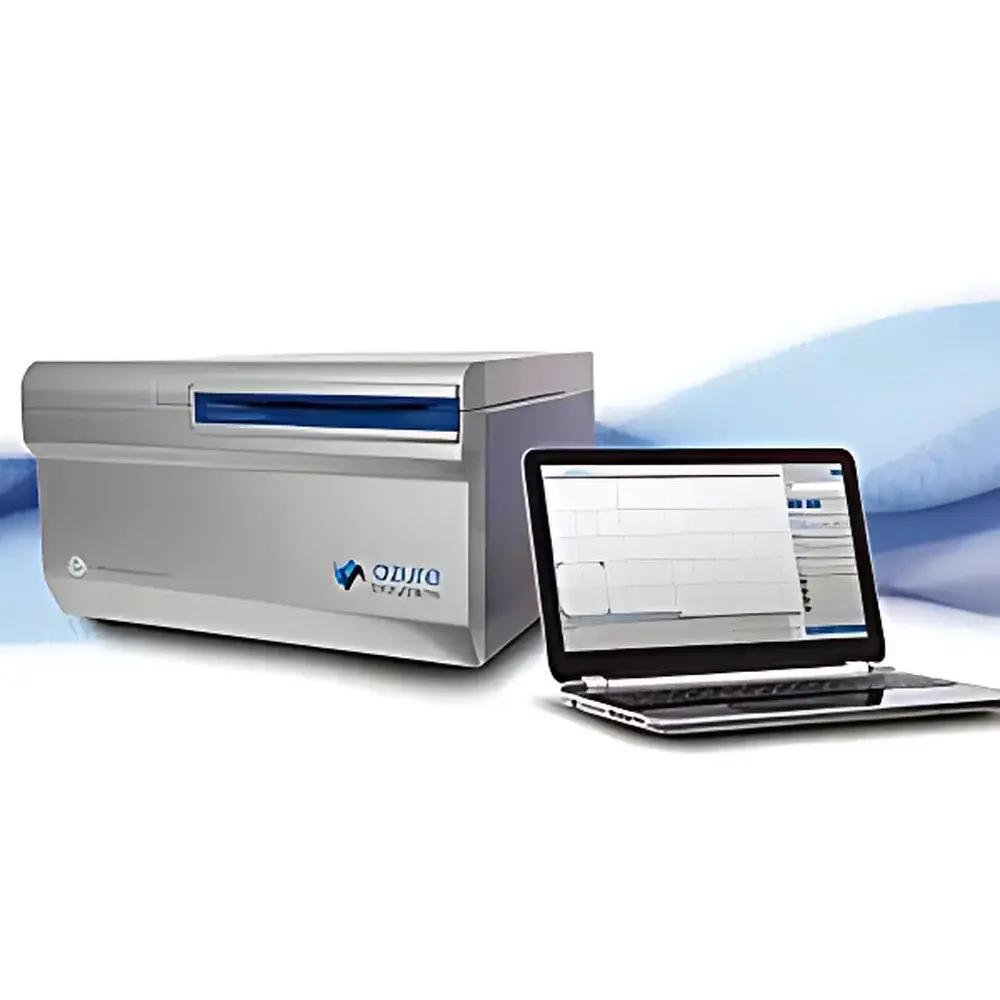
Azure Biosystems Sapphire Dual-Mode Multispectral Imager
| Brand | Azure Biosystems |
|---|---|
| Origin | USA |
| Model | Sapphire |
| Instrument Type | Multicolor Fluorescent Gel Imaging System |
| CCD Resolution | 6.1 MP |
| Bit Depth | 16-bit |
| Dynamic Range | 0–6 OD |
| CCD Sensor Size | 1-inch |
| Detection Sensitivity | fg-level protein |
| Signal-to-Noise Ratio | ≥72 dB |
| Lens | Motorized Autofocus |
| Excitation Sources | Four Solid-State Lasers (488 nm, 520 nm, 658 nm, 785 nm) |
| Detection Modalities | PMT (blue/chemiluminescence/phosphorimaging), APD (green/red/NIR), CCD (high-sensitivity chemiluminescence/visible) |
Overview
The Azure Biosystems Sapphire Dual-Mode Multispectral Imager is a high-performance biomolecular imaging platform engineered for precision, reproducibility, and modality flexibility in modern life science laboratories. Unlike conventional gel imagers constrained by single-detection architecture, the Sapphire integrates three distinct detection technologies—photomultiplier tube (PMT), avalanche photodiode (APD), and scientific-grade CCD—within a unified optical chassis. This dual-mode (scanning + wide-field CCD) design enables simultaneous optimization of sensitivity, spatial resolution, and dynamic range across diverse detection modalities: visible-light imaging, chemiluminescence, fluorescence (4-color), phosphorimaging, and near-infrared (NIR) detection. The system operates on a laser-scanning principle for high-resolution fluorescence and phosphorimaging, while leveraging its cooled 1-inch, 6.1-megapixel CCD for quantitative chemiluminescent and white-light applications. Its 16-bit digitization and 0–6 OD dynamic range support accurate quantitation of both low-abundance targets (e.g., fg-level proteins in Western blots) and saturated high-expression bands without signal clipping or re-exposure.
Key Features
- Four independently addressable solid-state lasers (488 nm, 520 nm, 658 nm, 785 nm) enable precise excitation of common fluorophores—including Cy2, Cy3, Cy5, IRDye 680/800, Alexa Fluor dyes—and phosphor screens.
- Hybrid detector architecture: PMT for high-gain blue-channel fluorescence and phosphorimaging; three spectrally optimized APDs for green, red, and NIR fluorescence; and a thermoelectrically cooled CCD for ultra-low-noise chemiluminescence and visible-light imaging.
- Motorized autofocus lens with real-time focus validation ensures consistent image sharpness across sample types—from thin SDS-PAGE gels to thick tissue sections or membrane-based assays.
- 10 µm effective spatial resolution in scanning mode supports detailed analysis of 2D-DIGE gels, in-cell Westerns, and microarray spots.
- True multispectral unmixing capability via Sapphire Capture software allows deconvolution of overlapping emission spectra, minimizing crosstalk in multiplexed fluorescent experiments.
Sample Compatibility & Compliance
The Sapphire accommodates a broad range of sample formats including polyacrylamide and agarose gels, PVDF and nitrocellulose membranes, glass slides (for tissue sections and arrays), and phosphor storage plates. It supports standard electrophoretic and blotting workflows compliant with ISO/IEC 17025 and GLP requirements. All imaging protocols—including exposure time, laser power, gain settings, and binning—are fully auditable and exportable as metadata, facilitating alignment with FDA 21 CFR Part 11 electronic record and signature compliance when deployed in regulated environments. The system meets IEC 61000-6-3 (EMC) and IEC 61000-6-2 (immunity) standards for laboratory instrumentation.
Software & Data Management
Sapphire Capture is the native acquisition software, offering intuitive hardware control, real-time preview, and automated protocol execution. AzureSpot provides advanced quantitative analysis—band/spot volume calculation, background subtraction, normalization against loading controls, and statistical comparison across replicates. Both applications generate FAIR-compliant output (Findable, Accessible, Interoperable, Reusable), exporting TIFF, PNG, and vendor-neutral .ims files compatible with ImageJ/Fiji, PDQuest, and commercial bioinformatics pipelines. Audit trails log all user actions, parameter changes, and calibration events, supporting traceability in QC/QA and regulatory submissions.
Applications
- Quantitative Western blotting with multiplex fluorescent detection (e.g., simultaneous actin/GAPDH and target protein)
- Two-dimensional difference gel electrophoresis (2D-DIGE) with CyDye labeling
- In-cell Western assays for intracellular protein expression profiling
- High-sensitivity chemiluminescent detection of low-abundance antigens
- Phosphorimaging of 32P- or 33P-labeled nucleic acids and proteins
- NIR fluorescence imaging of tissue sections labeled with IRDye conjugates
- Microarray and macroarray analysis using fluorescent or chemiluminescent reporters
FAQ
What distinguishes the Sapphire’s dual-mode architecture from conventional CCD-only imagers?
It combines laser scanning (for high-resolution, high-sensitivity fluorescence and phosphorimaging) with wide-field CCD imaging (for rapid, high-dynamic-range chemiluminescence and visible-light capture)—eliminating trade-offs between speed, sensitivity, and resolution.
Can the Sapphire perform spectral unmixing for overlapping fluorophores?
Yes—using multi-wavelength acquisition and linear unmixing algorithms embedded in Sapphire Capture, users can separate signals from spectrally adjacent dyes such as Cy3/Cy5 or Alexa 647/Alexa 750.
Is the system compatible with third-party analysis software?
All acquired images are saved in open-format TIFF or standardized .ims files, enabling direct import into ImageJ, Fiji, GraphPad Prism, and commercial proteomics platforms.
How is calibration maintained across instruments and over time?
The Sapphire includes factory-calibrated reference standards for intensity, resolution, and wavelength accuracy; optional annual performance verification kits support ongoing traceability to NIST-traceable references.
Does the software support audit trail generation for regulated environments?
Yes—Sapphire Capture and AzureSpot automatically record operator ID, timestamp, instrument parameters, and processing steps in encrypted logs compliant with 21 CFR Part 11 requirements.




