
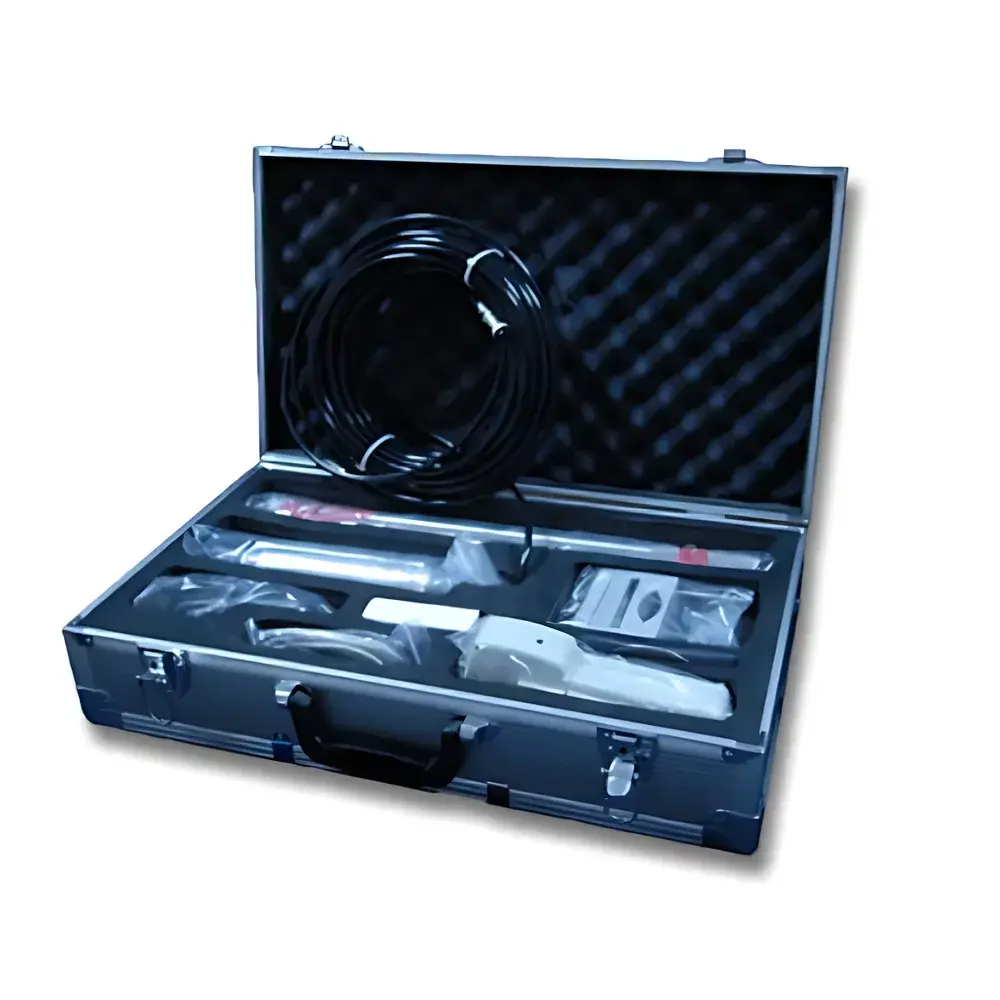
Azure Cloud & Wind Confluence YL-CQC10 Ultrasonic Doppler Velocity and Flow Meter
| Brand | Azure Cloud & Wind Confluence |
|---|---|
| Origin | Jiangsu, China |
| Manufacturer Type | Authorized Distributor |
| Country of Origin | China |
| Model | YL-CQC10 |
| Instrument Type | Online Water Quality Analyzer |
| Measurement Parameters | Velocity, Depth, Flow Rate, Temperature |
| Flow Range | 0.01–6.50 m/s |
| Velocity Accuracy | ±1.0% ± 1.2 cm/s |
| Velocity Resolution | 0.75 mm |
| Water Temperature Range | Not specified (standard ambient range) |
| Temperature Accuracy | ±0.8 °C |
| Water Level Range | 0–10 m |
| Level Accuracy | ±0.2% ± 0.2 cm |
| Flow Rate Range | 1 L/s – 99,999,999 m³/h |
| Power Supply | Internal Li-ion battery |
| Communication | RS485, Modbus RTU protocol |
| Data Storage | 100,000 records |
| Measurement Modes | Manual & automatic (interval configurable from 0 to 120 min in 5-min increments) |
| velocity averaging duration | 10–120 s (auto), 60/100 s (manual) |
| Physical Configuration | Portable host unit with submersible sensor, telescoping pole (2 m standard, customizable extension) |
| Display | Backlit LCD |
Overview
The Azure Cloud & Wind Confluence YL-CQC10 Ultrasonic Doppler Velocity and Flow Meter is an industrial-grade online monitoring instrument engineered for continuous, non-intrusive measurement of open-channel flow dynamics in natural and engineered water systems. Based on the principle of ultrasonic Doppler shift detection, the device transmits high-frequency acoustic pulses into the water column and analyzes frequency shifts in the returned echoes caused by suspended particles or bubbles—serving as natural acoustic scatterers. This method enables direct velocity profiling without mechanical contact, eliminating wear, calibration drift from moving parts, or hydraulic disturbance. Designed for deployment in small-to-medium rivers, irrigation canals, wastewater conveyance channels, and stormwater infrastructure, the YL-CQC10 delivers synchronized real-time data for velocity (0.01–6.50 m/s), water level (0–10 m), temperature (±0.8 °C), and derived volumetric flow rate (1 L/s to 99,999,999 m³/h). Its compact, portable architecture supports both fixed-installation telemetry and field-deployed spot verification—making it suitable for long-term unattended operation under varying hydraulic and environmental conditions.
Key Features
- Non-mechanical Doppler sensing: No rotating elements, impellers, or orifices—immune to sediment clogging, aquatic vegetation entanglement, or biofouling-induced signal attenuation.
- High-resolution velocity detection: 0.75 mm resolution with ±1.0% ±1.2 cm/s accuracy across full dynamic range—including low-flow regimes (<0.1 m/s) critical for ecological baseflow assessment.
- Dual-power architecture: Integrated rechargeable lithium-ion battery (DC 12 V ±10%) with optional solar charging interface ensures multi-month autonomy in remote locations.
- RS485 serial interface compliant with Modbus RTU protocol: Enables seamless integration into SCADA, PLC, and centralized telemetry networks (e.g., NB-IoT, LoRaWAN gateways via external RTU).
- Embedded real-time clock with NTP-capable time synchronization: Supports timestamped data logging, audit-ready event sequencing, and alignment with regulatory reporting windows (e.g., EPA 40 CFR Part 136 compliance timelines).
- Field-configurable measurement strategy: Adjustable averaging duration (10–120 s), sampling interval (5–120 min), and manual trigger capability for validation campaigns or transient flow characterization.
Sample Compatibility & Compliance
The YL-CQC10 is validated for use in turbid, aerated, and debris-laden waters where traditional propeller or electromagnetic meters exhibit reduced reliability. It requires minimum suspended solids concentration (~20 mg/L) or microbubble presence for consistent Doppler return—conditions typical of most surface water and effluent streams. The system conforms to IP68 submersion rating for the sensor housing and meets IEC 60529 environmental protection standards. While not certified to ISO/IEC 17025 for accredited laboratory testing, its operational performance aligns with ASTM D5471-22 (Standard Guide for Open-Channel Flow Monitoring Using Acoustic Doppler Instruments) and supports data integrity requirements under EPA Method 1604 and ISO 5814:2012 (Determination of dissolved oxygen—electrochemical probe method, where concurrent temperature and flow inform correction algorithms). All firmware and data handling routines support GLP-compliant metadata tagging (operator ID, location tag, calibration date).
Software & Data Management
The YL-CQC10 includes proprietary Windows-based desktop software for configuration, data retrieval, visualization, and export. Raw measurements are stored onboard in non-volatile memory (100,000 records capacity) with full time-stamping, sensor status flags, and diagnostic logs. Export formats include CSV, Excel (.xlsx), and PDF reports—with configurable templates for daily summary tables, hydrograph plots, and anomaly alerts. The software implements basic QA/QC filters (e.g., velocity outliers, level saturation detection) and allows manual annotation of field conditions (e.g., “post-rainfall turbidity,” “algal bloom observed”). Though not natively 21 CFR Part 11 compliant, audit trails can be enabled via external database logging when deployed with enterprise-level middleware (e.g., Ignition SCADA or OSIsoft PI System).
Applications
- Real-time discharge monitoring at gauging stations and weirs for flood forecasting and water allocation modeling.
- Performance verification of wastewater treatment plant influent/effluent channels and combined sewer overflow (CSO) outfalls.
- Regulatory compliance reporting for NPDES permits requiring continuous flow and temperature data.
- Irrigation district water balance studies, including diversion measurement and leakage detection in earthen canals.
- Ecological flow assessment in low-gradient streams supporting instream habitat modeling (e.g., PHABSIM inputs).
- Calibration reference for stage-discharge rating curves using concurrent velocity-area integration.
FAQ
What minimum suspended solids concentration is required for reliable Doppler signal acquisition?
A nominal concentration of ≥20 mg/L is recommended; however, successful operation has been documented in clear water with naturally occurring microbubbles or fine silt entrainment.
Can the YL-CQC10 be integrated with third-party telemetry platforms?
Yes—via RS485/Modbus RTU, it interfaces directly with industrial RTUs, cellular gateways, and cloud-based IoT platforms supporting standard Modbus register mapping.
Is factory calibration traceable to national metrology institutes?
Calibration is performed against NIST-traceable flow test rigs per internal quality procedure QCP-FL-003; certificate of conformance is provided with each unit.
How is sensor alignment verified during installation?
The system includes a bubble-level vial on the mounting bracket and angular tolerance indicators in the setup wizard; field validation is conducted using known-velocity reference sections or portable ADCP cross-checks.
Does the device support remote firmware updates?
Firmware updates require local USB connection to the host unit; over-the-air updates are not supported in current revision.
Related Products







