
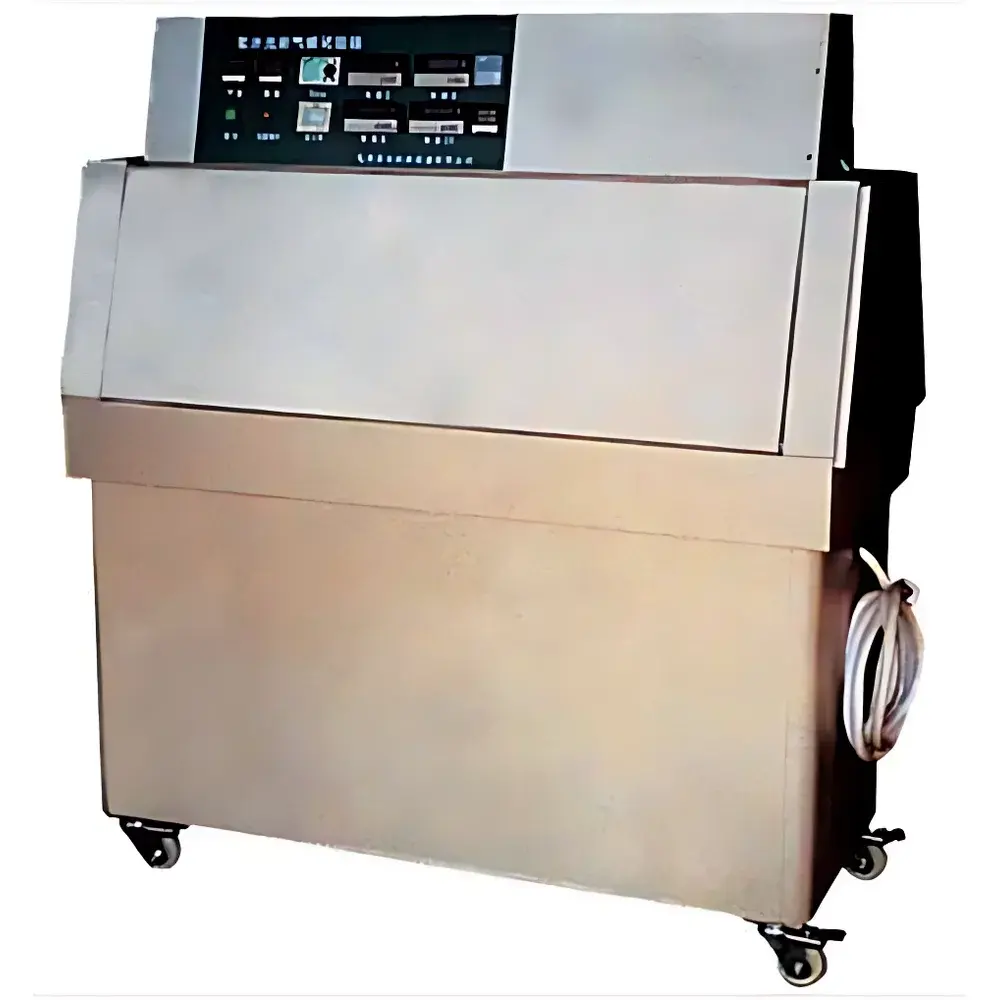
BA-ZW-A UV Aging Test Chamber
| Brand | BenAng |
|---|---|
| Origin | Shanghai, China |
| Manufacturer Type | Authorized Distributor |
| Country of Origin | China |
| Model | BA-ZW-A |
| Price | USD 4,750 (FOB Shanghai) |
| Temperature Range | Ambient +20°C to +70°C |
| Temperature Uniformity | ±0.5°C |
| Humidity Range | Up to 95% RH |
| Chamber Dimensions (W×D×H) | 1170 mm × 450 mm × 500 mm |
| UV Lamp Wavelength | 280–315 nm (UV-B) |
| Sample-to-Lamp Distance | 90–100 mm |
| Heating & Humidification | Electric Steam Generator |
| Control System | Imported Digital Touch Panel Controller |
| Compliance | GB/T 5170.9–2017 |
Overview
The BA-ZW-A UV Aging Test Chamber is an engineered environmental simulation system designed to replicate the photochemical degradation effects induced by solar ultraviolet radiation and condensation cycles—primarily UV-B irradiation (280–315 nm) combined with controlled thermal and humid conditions. Based on the fundamental principles of accelerated weathering, the chamber subjects materials to calibrated UV exposure under precisely regulated temperature (ambient +20°C to +70°C, ±0.5°C uniformity) and humidity (up to 95% RH), enabling reproducible assessment of surface chalking, gloss loss, color fading, polymer chain scission, and coating delamination. Its operational architecture conforms to the metrological verification methodology defined in GB/T 5170.9–2017, ensuring traceable performance validation for quality control laboratories, R&D centers, and third-party testing facilities engaged in material durability evaluation.
Key Features
- Stainless steel construction throughout: Interior chamber, sample rack, and outer enclosure fabricated from SUS304 stainless steel for corrosion resistance and long-term dimensional stability under cyclic UV/humidity exposure.
- Precision digital temperature control: Equipped with an imported microprocessor-based temperature controller featuring PID algorithm, high-resolution thermistor sensing, and real-time deviation compensation.
- Electric steam-generation humidification system: Enables rapid, stable, and particle-free humidity delivery up to 95% RH without water droplet carryover or localized condensation artifacts.
- CNC-machined structural integrity: Outer cabinet manufactured using computer numerical control machining, guaranteeing tight panel tolerances, seamless welds, and consistent aesthetic finish aligned with ISO 9001-compliant production practices.
- Dual-mode operation: Supports both constant-condition testing (e.g., sustained UV + 60°C + 90% RH) and programmable cycling between irradiation and dark condensation phases—mimicking diurnal moisture accumulation.
- Integrated safety architecture: Includes dual-stage overtemperature protection (mechanical and electronic), ground-fault circuit interruption, thermal fuse cutoff, and automatic lamp current monitoring with visual LED indication.
Sample Compatibility & Compliance
The BA-ZW-A accommodates flat or low-profile specimens up to 1170 mm wide, with standardized sample mounting via adjustable SUS304 racks. It supports test specimens conforming to ASTM G154 (Standard Practice for Operating Fluorescent Ultraviolet (UV) Lamp Apparatus for Exposure of Nonmetallic Materials), ISO 4892-3 (Plastics — Methods of Exposure to Laboratory Light Sources — Part 3: Fluorescent UV Lamps), and GB/T 14522 (Mechanical Testing of Non-Metallic Materials — Artificial Weathering Test Method). While not certified to IEC 60068-2-5 or UL 746C out-of-the-box, its performance parameters—including spectral output distribution, irradiance stability, and chamber uniformity—are verifiable against these standards using NIST-traceable calibration instruments. The unit meets general requirements for GLP-compliant test documentation when paired with external data logging systems supporting audit trails.
Software & Data Management
The BA-ZW-A operates via a standalone digital touch interface with non-volatile memory for storing up to 10 user-defined test profiles. All setpoints (temperature, humidity, UV duration, cycle count) are entered via tactile membrane keys with numeric keypad input. Real-time lamp current monitoring provides indirect irradiance trending; however, the system does not include built-in radiometric calibration or automated data export. For regulatory environments requiring electronic records, integration with external USB or RS485-connected data loggers is supported—enabling compliance with FDA 21 CFR Part 11 when configured with appropriate access controls, electronic signatures, and audit trail functionality at the host software level.
Applications
This chamber is routinely deployed in quality assurance workflows for automotive interior trim, architectural sealants, PVC window profiles, outdoor signage films, photovoltaic encapsulants, and printed circuit board conformal coatings. It serves as a pre-screening tool prior to outdoor exposure per ASTM G7, supports root-cause analysis of field failures attributed to UV-induced embrittlement, and contributes to material selection decisions during early-phase product development. In electronics manufacturing, it assists in validating the robustness of solder mask formulations and flexible printed circuit substrates under simulated tropical storage conditions.
FAQ
What UV spectrum does the BA-ZW-A emit, and how is it verified?
The chamber utilizes fluorescent UV-B lamps (280–315 nm peak), with spectral output validated using a calibrated spectroradiometer prior to shipment. Users should perform periodic verification using a NIST-traceable UV sensor.
Can the chamber operate without humidity control?
Yes—the humidification system can be disabled independently while maintaining full temperature and UV control, allowing dry-heat UV exposure protocols.
Is the sample-to-lamp distance adjustable?
No—the distance is fixed at 90–100 mm to ensure consistent irradiance distribution per GB/T 5170.9; adjustment would invalidate calibration and compromise test repeatability.
Does the unit support remote monitoring or Ethernet connectivity?
Not natively—the controller lacks network interfaces. Remote supervision requires external PLC integration or serial-to-Ethernet gateway hardware.
What maintenance intervals are recommended for optimal performance?
Lamp replacement every 1,600 hours of operation; quarterly inspection of steam generator scale buildup; biannual recalibration of temperature and humidity sensors using certified reference standards.



