
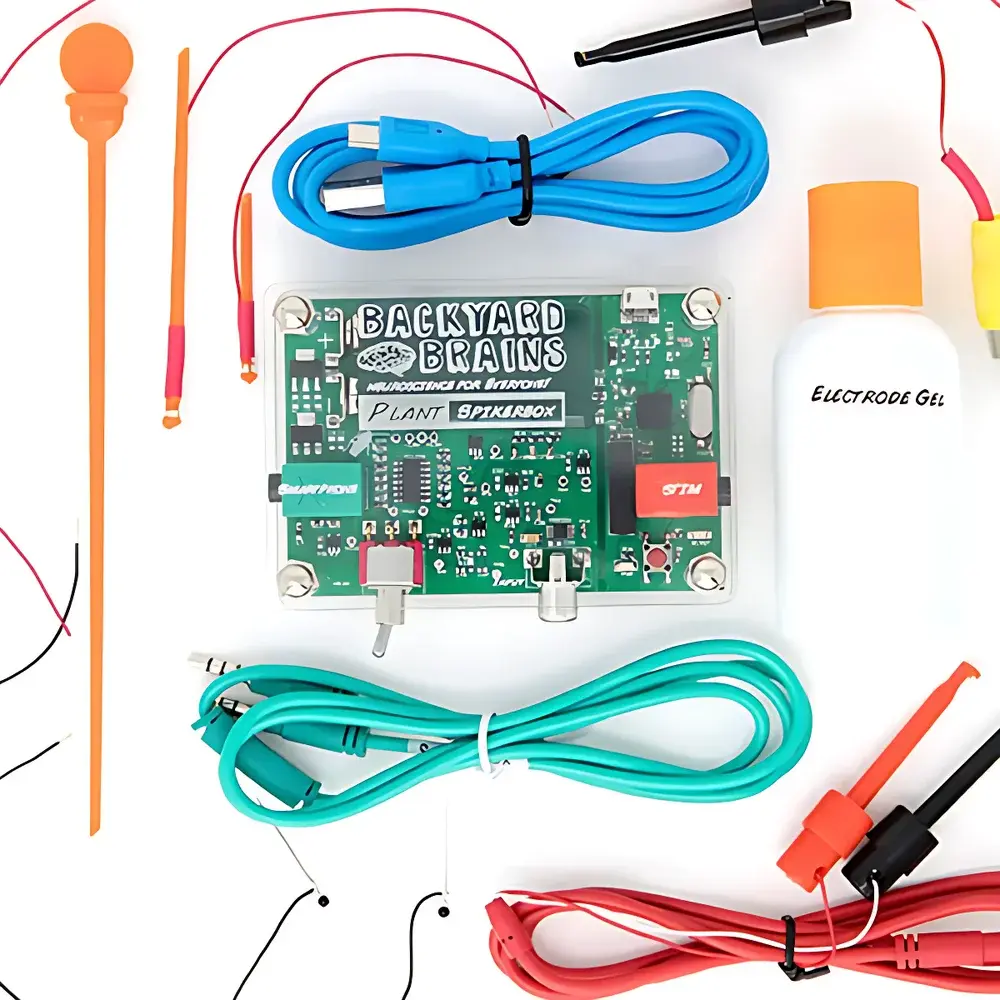
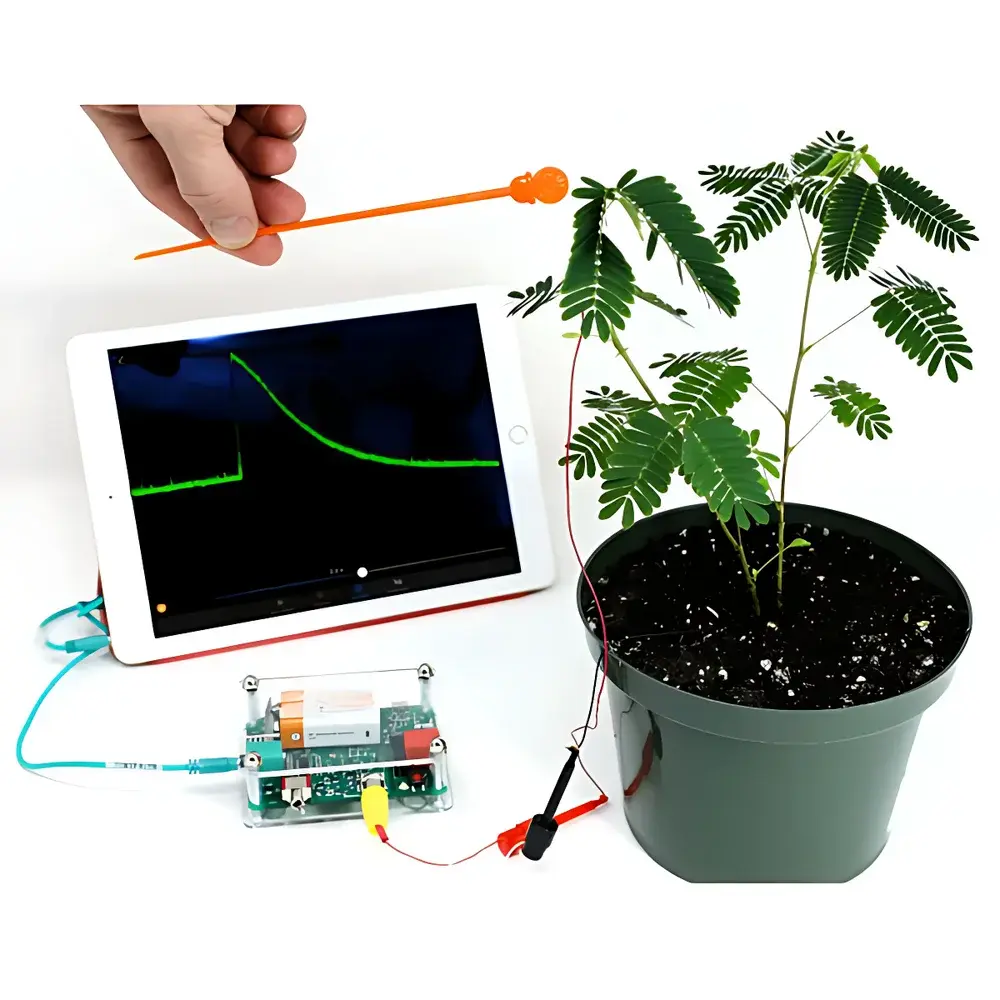
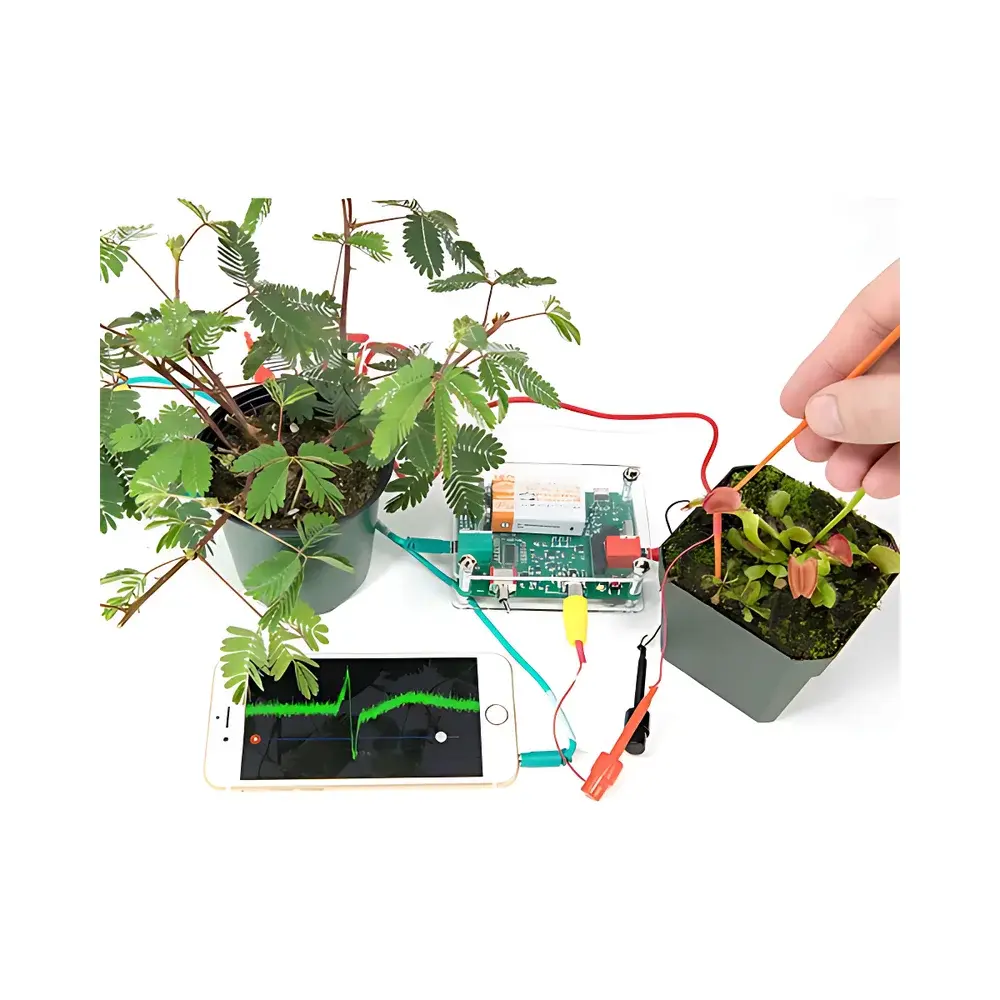
Backyard Brains Plant SpikerBox
| Brand | Backyard Brains |
|---|---|
| Origin | USA |
| Manufacturer Type | Distributor |
| Origin Category | Imported |
| Model | Plant SpikerBox |
| Price | USD 1 (Educational Kit Base Unit) |
Overview
The Backyard Brains Plant SpikerBox is an open-source, educational electrophysiology instrument engineered to detect, amplify, and visualize extracellular bioelectrical signals generated by living plant tissues in real time. Unlike traditional animal-focused neurophysiology tools, this device leverages high-gain differential amplification (gain: ×1000) and analog filtering (bandpass: 10 Hz–3 kHz) to resolve slow voltage transients—such as action potentials in Dionaea muscipula (Venus flytrap) or Mimosa pudica (sensitive plant)—without requiring invasive intracellular electrodes. Its design adheres to core principles of comparative plant electrophysiology: signal fidelity is preserved through low-noise instrumentation-grade circuitry, while galvanic isolation ensures safety during live-plant interfacing. The system operates on the premise that many vascular plants generate propagating electrical events in response to mechanical, thermal, or chemical stimuli—phenomena documented in peer-reviewed literature (e.g., Plant Physiology, Vol. 178, 2018) and aligned with ISO 14155-compliant experimental methodology for non-invasive biological signal acquisition.
Key Features
- Plug-and-Play Operation: No calibration dials, zero-adjustment knobs, or firmware flashing required—power via USB (5 V DC) and begin recording within seconds.
- Real-Time Signal Visualization: Outputs analog voltage signals compatible with standard oscilloscopes, audio interfaces, or Backyard Brains’ free SpikeRecorder software (Windows/macOS/Android/iOS).
- Stimulus Integration: Includes a calibrated manual stimulator with adjustable pulse duration (1–500 ms) and amplitude (0–10 V DC), enabling controlled elicitation of plant action potentials.
- Modular Electrode Interface: Supports Ag/AgCl or stainless-steel recording electrodes; includes conductive electrode gel and variable-length shielded leads (1.5 m recording + 1.5 m ground) optimized for high common-mode rejection ratio (CMRR > 80 dB).
- Educational Transparency: Full circuit schematics, PCB layout files, and Arduino-compatible firmware are publicly available under CC-BY-SA 4.0 license, supporting curriculum-aligned lab exercises in biophysics and systems biology.
Sample Compatibility & Compliance
The Plant SpikerBox has been validated for use with multiple model species exhibiting measurable surface potential shifts, including Dionaea muscipula, Mimosa pudica, Aloe vera, and Zea mays seedlings. Electrode placement follows non-destructive protocols: surface contact at petiole–leaf junctions or stem nodes minimizes tissue damage while maximizing signal-to-noise ratio. All hardware complies with FCC Part 15 Class B and CE EN 61326-1 (electromagnetic compatibility for laboratory equipment). While not intended for clinical or regulatory submission use, its signal chain meets GLP-relevant traceability standards when paired with timestamped digital recordings and metadata logging in SpikeRecorder v4.2+.
Software & Data Management
Data acquisition is managed via SpikeRecorder—a cross-platform application supporting WAV export (16-bit, 44.1 kHz sampling), real-time FFT analysis, and stimulus-triggered averaging. Exported files conform to IEEE 11073-10201 (medical device communication) metadata conventions, facilitating integration into MATLAB, Python (via scipy.io.wavfile), or LabVIEW environments. Audit trails include automatic session timestamps, user-defined experiment tags, and hardware ID logging—features supporting reproducibility requirements outlined in ANSI/ISO/IEC 17025:2017 Clause 7.7. Raw data files retain full bit-depth fidelity with no onboard compression or interpolation.
Applications
- Classroom demonstration of plant excitability and systemic signaling
- Undergraduate research projects on stimulus-response latency in carnivorous plants
- Comparative studies of electrical propagation velocity across monocot/dicot species
- Development of low-cost biosensors using plant-based signal transduction
- Interdisciplinary STEAM modules linking botany, electronics, and data science
FAQ
Is the Plant SpikerBox FDA-approved for human use?
No—it is strictly designed for educational and non-clinical plant electrophysiology. It does not meet FDA 21 CFR Part 820 or IEC 62304 requirements for medical devices.
Can I interface it with third-party DAQ systems?
Yes—the analog output (0–5 V, BNC connector) is compatible with National Instruments USB-6009, Digilent Analog Discovery 2, or any device accepting ±10 V single-ended input.
What is the minimum detectable signal amplitude?
Theoretical noise floor is 2.3 µV RMS (referred to input); practical detection threshold for plant APs is ~15–50 µV depending on electrode placement and species.
Does it support long-term continuous recording?
Yes—SpikeRecorder supports unlimited-duration WAV capture limited only by host storage; recommended maximum session length is 24 hours for thermal stability.
Are replacement electrodes and gels available separately?
Yes—Backyard Brains sells Ag/AgCl reusable electrodes (P/N: ELEC-AGCL) and conductive gel refills (P/N: GEL-PLANT) compliant with ASTM F2457-21 for biomedical electrode materials.
Related Products




