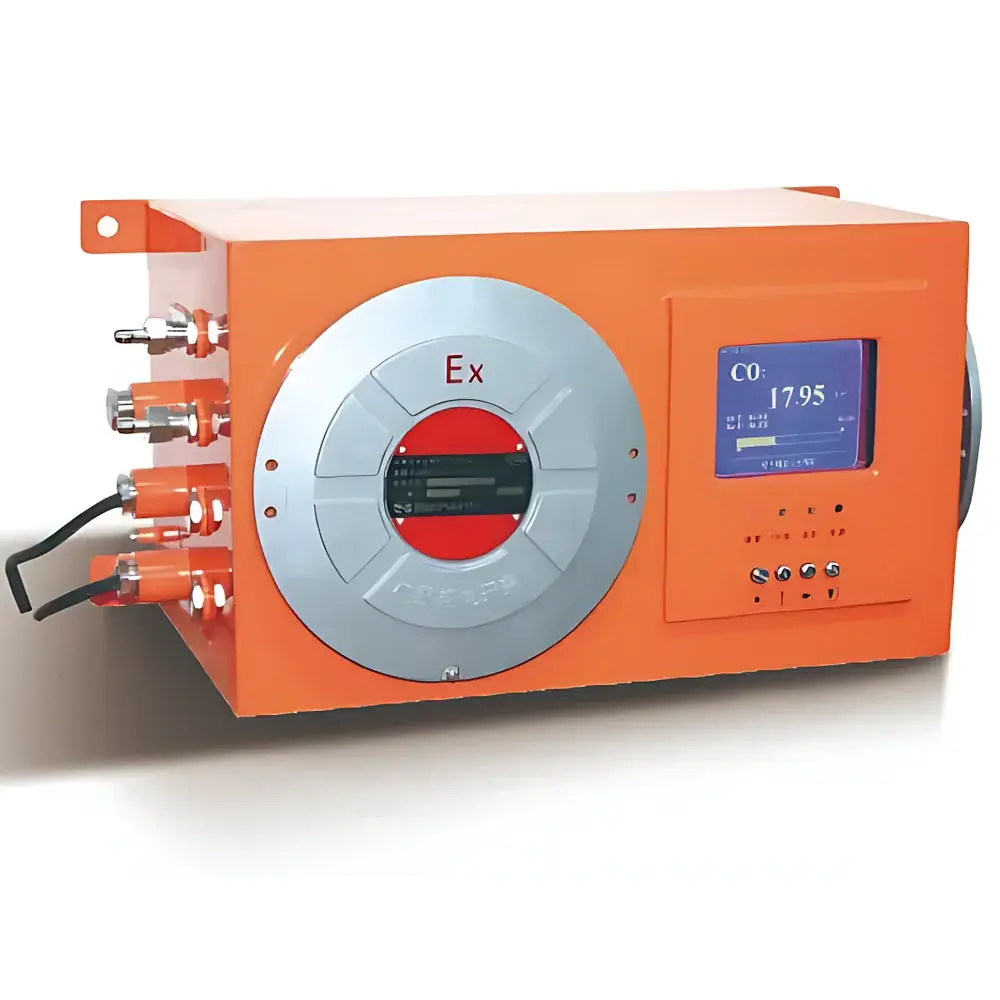
BAIF-MAIHAK QGS-08C EX Non-Dispersive Infrared (NDIR) Gas Analyzer
| Brand | BAIF-MAIHAK |
|---|---|
| Model | QGS-08C EX |
| Type | Non-Dispersive Infrared (NDIR) Gas Analyzer |
| Detection Principle | Selective Infrared Absorption |
| Light Source | High-Power Stable IR Source |
| Detector | Thin-Film Microphone Detector (Capacitive) |
| Optical Path | Single-Source, Series Dual-Absorption Chamber |
| Display | Backlit LCD with Full Chinese Menu Interface |
| Signal Processing | Fully Digital Signal Processing (DSP) |
| Output | Isolated 4–20 mA (also supports 0/2–20 mA), Load ≤ 400 Ω |
| Communication | RS-232, Modbus-RTU |
| Safety Certification | Ex d IIB T6 Gb (for QGS-08C EX variant) |
| Environmental Protection Compliance | Meets China’s HJ 75–2017 & HJ 76–2017 for CEMS applications |
| Enclosure Rating | IP65 (industrial dust/water resistance) |
| Power Supply | AC 220 V ± 10 %, 50 Hz |
| Warm-up Time | ≤ 30 min to operational stability |
| Operating Temperature | –10 °C to +50 °C |
| Storage Temperature | –20 °C to +60 °C |
Overview
The BAIF-MAIHAK QGS-08C EX is a certified intrinsically safe, non-dispersive infrared (NDIR) gas analyzer engineered for continuous, real-time measurement of specific infrared-absorbing gases—including CO, CO₂, CH₄, SO₂, NO, and hydrocarbons—in hazardous industrial environments. Its core measurement principle relies on Beer–Lambert law-based absorption spectroscopy: a broadband infrared source emits radiation through dual serial absorption cells—one reference, one sample—where target gases attenuate characteristic mid-infrared wavelengths (typically 2–14 µm). A highly sensitive thin-film capacitive microphonic detector converts differential pressure fluctuations induced by modulated IR absorption into precise electrical signals. The instrument employs full digital signal processing (DSP) architecture, eliminating analog drift and enhancing long-term baseline stability. Designed to meet stringent process safety requirements, the QGS-08C EX carries Ex d IIB T6 Gb explosion-proof certification per GB 3836.1–2010 / IEC 60079-0:2017, enabling deployment in Zone 1/2 classified areas typical of petrochemical refineries, natural gas compression stations, and solvent-handling facilities.
Key Features
- High-stability, high-output infrared source with extended lifetime (>10,000 hours), ensuring consistent radiant intensity and minimizing zero drift.
- Dual-path optical design with gold-plated measurement cell interior—resistant to corrosion from acidic or humid process streams, including SO₂-laden flue gas and wet hydrocarbon vapors.
- Full-digitized signal chain: 24-bit ADC, adaptive noise filtering, and real-time temperature-compensated calibration algorithms improve repeatability to ±1 % FS over 30 days.
- Intelligent dual-range operation: automatically switches between high-sensitivity (e.g., 0–100 ppm) and wide-range (e.g., 0–100 % vol) modes; intermediate span points are user-configurable via front-panel menu.
- Robust industrial interface: isolated 4–20 mA analog output with HART-compatible protocol support, plus RS-232 and Modbus-RTU (RTU mode, ASCII optional) for integration into DCS, SCADA, or CEMS platforms.
- Built-in system integrity safeguards: hardware watchdog timer, soft-start power sequencing, and fault-state isolation outputs (calibration, alarm, range-switch, and error status—all galvanically separated).
Sample Compatibility & Compliance
The QGS-08C EX accepts gas samples at ambient or conditioned temperatures (with optional heated sampling line), pressures up to 150 kPa (gauge), and dew points ≤ 5 °C. It accommodates particulate-laden streams when used with standard 5-µm particulate filters and coalescing moisture traps. The analyzer complies with national emission monitoring standards HJ 75–2017 (Technical Specification for Continuous Emission Monitoring Systems) and HJ 76–2017 (Verification Procedures for CEMS), and its mechanical and electrical construction adheres to GB/T 13983–2018 (Industrial Process Analyzers — General Requirements). For international deployment, it satisfies EMC directive 2014/30/EU and low-voltage directive 2014/35/EU when installed with certified barriers. While not pre-certified to ATEX or IECEx, its Ex d enclosure design enables third-party certification for global Class I, Division 1 or Zone 1 installations.
Software & Data Management
Front-panel operation utilizes an intuitive Chinese-language LCD interface with context-sensitive prompts, hierarchical navigation, and password-protected configuration levels (operator, engineer, administrator). All calibration events—including zero/span adjustment, multi-point linearity verification, and sensor response time logging—are timestamped and stored internally with audit trail capability. Optional PC-based configuration software (QGS-Tool v3.x) provides remote parameter setup, real-time waveform viewing, historical trend export (CSV), and compliance reporting templates aligned with China’s CEMS data validity criteria (HJ 353–2019). Data retention supports ≥30 days of 1-minute averaged values. Though not natively 21 CFR Part 11 compliant, the system supports external validation protocols for GLP/GMP-aligned laboratories via documented change control and electronic signature workflows.
Applications
- Continuous emissions monitoring (CEMS) of CO, CO₂, and SO₂ from coal-fired boilers, cement kilns, and waste incinerators under China’s Ministry of Ecology and Environment (MEE) regulatory framework.
- Intrinsically safe hydrocarbon leak detection and combustible gas concentration monitoring in offshore platforms, LNG terminals, and ethylene cracking units.
- Process gas analysis in syngas purification, ammonia synthesis loops, and catalytic reforming units where real-time CO/CO₂ ratio control impacts catalyst efficiency.
- Indoor air quality (IAQ) assessment in underground parking garages, tunnels, and subway stations—measuring CO buildup during peak vehicle throughput.
- Research-grade combustion diagnostics: quantifying exhaust composition across varying air–fuel ratios in engine test benches and biomass burner development labs.
FAQ
What gases can the QGS-08C EX measure simultaneously?
It measures one target gas per configured optical channel; multi-gas analysis requires multiple analyzers or custom multi-cell configurations (not standard on QGS-08C EX).
Is the instrument suitable for wet or corrosive sample streams?
Yes—the gold-coated measurement cell and optional integrated sample conditioning system (heated filter + Nafion dryer) enable stable operation with dew points up to 5 °C and trace H₂SO₄/HCl concentrations.
Does it support automatic zero calibration?
Yes—via external solenoid-valve manifold connected to zero gas (N₂ or synthetic air); automatic sequence initiation is programmable by time interval or event trigger.
Can the analog output be re-ranged in the field?
Yes—span and zero points for the 4–20 mA output are fully adjustable via menu without hardware modification.
What is the recommended maintenance interval?
Optical path cleaning and detector sensitivity verification every 6 months; IR source replacement recommended at 10,000 operating hours or if signal-to-noise ratio degrades beyond specification.