
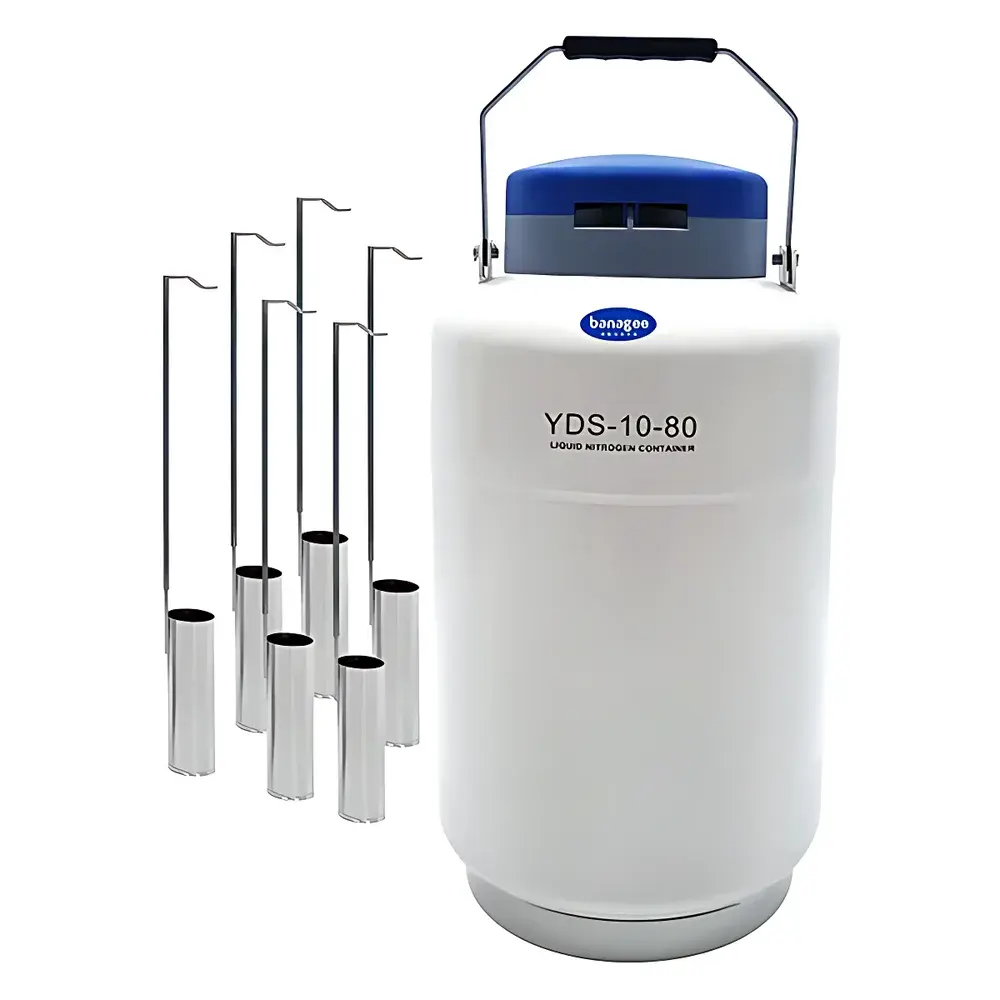
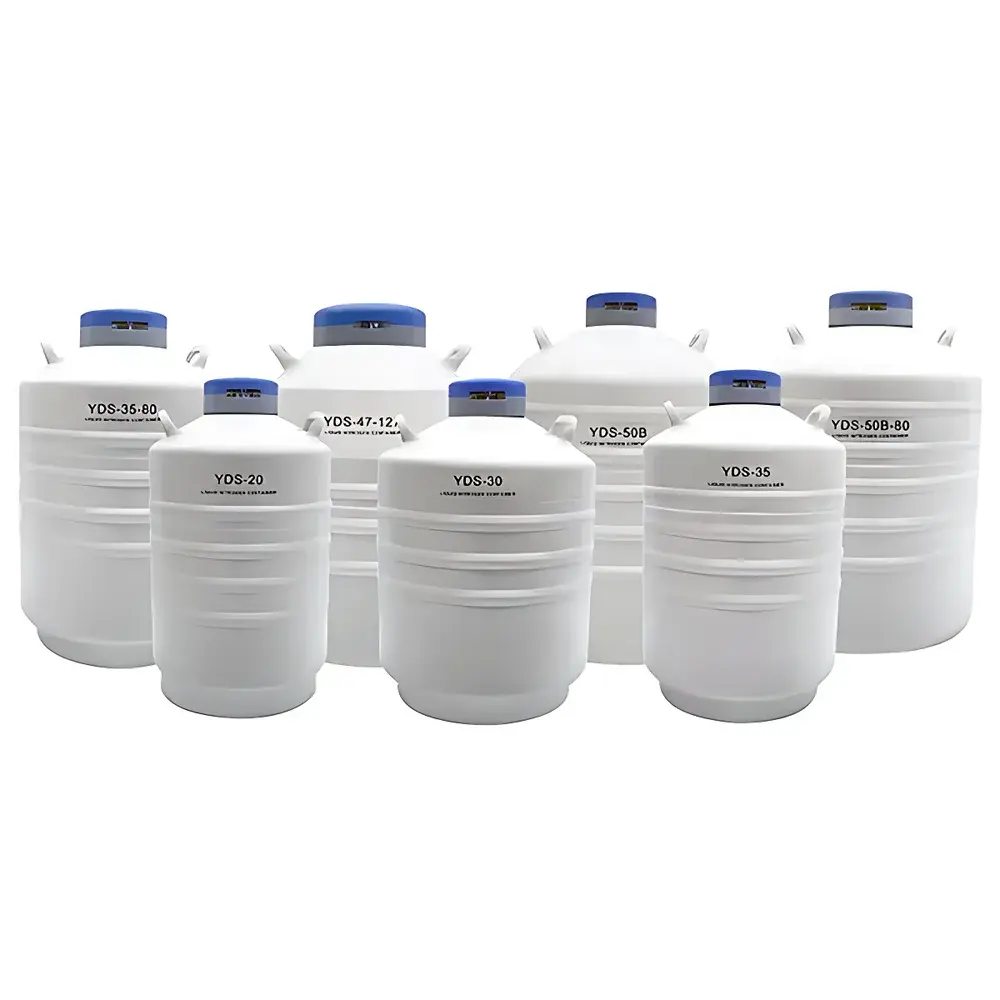
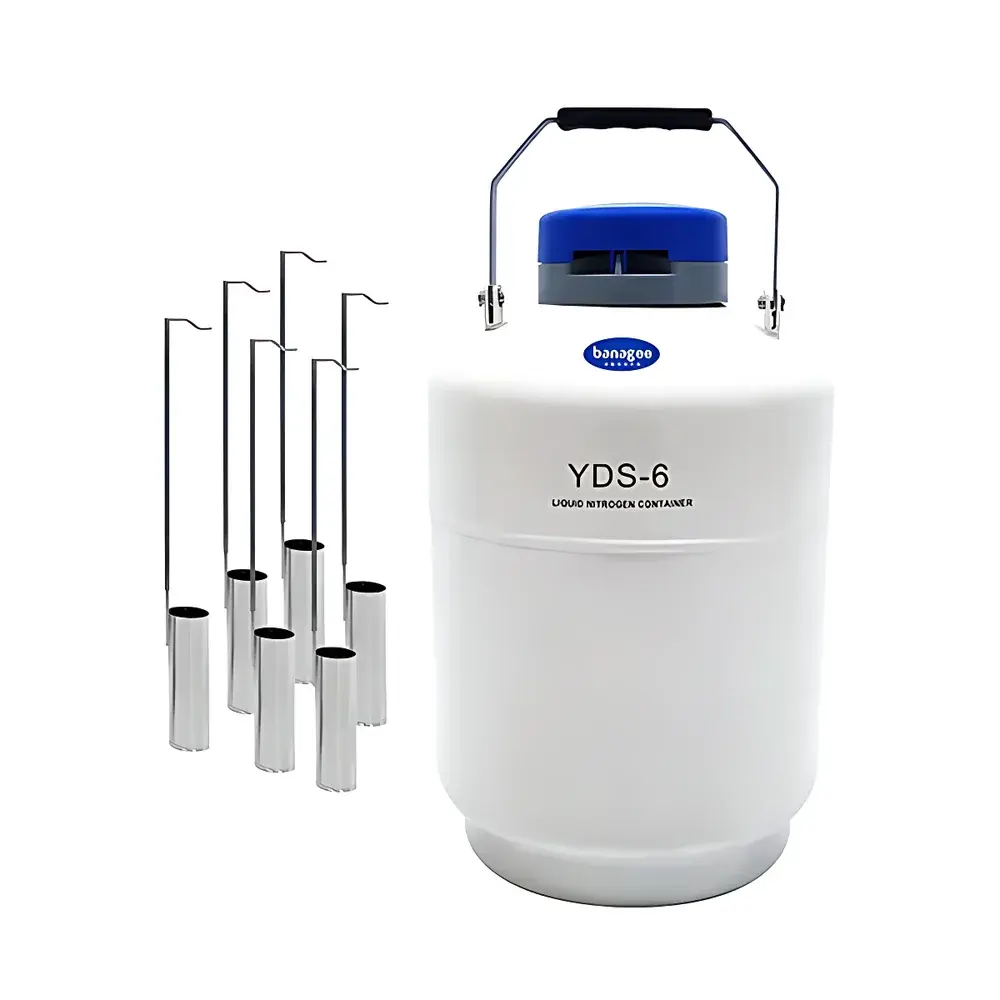
Banagee YDS-10-80 10-Liter Static Biological Liquid Nitrogen Storage Dewar
| Brand | Banagee |
|---|---|
| Origin | Beijing, China |
| Model | YDS-10-80 |
| Capacity | 10 L |
| Neck Diameter | 80 mm |
| Total Height | 550 mm |
| Outer Diameter | 300 mm |
| Empty Weight | 7.8 kg |
| Full Weight | 15.9 kg |
| Canister Quantity | 6 |
| Canister Diameter | 63 mm |
| Canister Height | 120 mm |
| Cryovial Slots per Rack | 198 (11 racks × 18 vials) |
| Static Evaporation Rate | 0.18 L/day |
| Hold Time in Static Mode | 56 days |
| Vacuum Warranty | 5 years |
| Standard Compliance | GB/T 5458–2012 |
Overview
The Banagee YDS-10-80 is a static-phase, upright liquid nitrogen (LN₂) storage dewar engineered for reliable, long-term cryopreservation of biological specimens—including human and animal cells, tissues, embryos, sperm, oocytes, and microbial strains—in academic research laboratories, biobanks, clinical IVF centers, and pharmaceutical R&D facilities. Unlike transport or auto-fill systems, the YDS-10-80 operates exclusively in passive, static storage mode: it relies on high-integrity vacuum insulation and optimized thermal geometry to minimize boil-off without mechanical refrigeration or active level monitoring. Its design adheres to the structural and performance requirements specified in GB/T 5458–2012, the Chinese national standard governing cryogenic vessels for biological sample preservation. The dewar’s 10-liter internal capacity supports up to 198 standard 2 mL cryovials (configured across six aluminum canisters, each holding 11 cryoracks at 18 vials per rack), making it suitable for mid-volume archival needs where footprint, operational simplicity, and cost-efficiency are prioritized over automated inventory tracking or remote telemetry.
Key Features
- High-strength, lightweight aerospace-grade aluminum alloy construction ensures structural integrity while minimizing handling weight (7.8 kg empty; 15.9 kg full).
- Multi-layer super-insulation system with high-vacuum interstitial space achieves a low static evaporation rate of 0.18 L/day—enabling uninterrupted 56-day hold time under ambient laboratory conditions (25°C, 60% RH).
- Electrostatically applied powder-coated outer shell eliminates flaking, chipping, and solvent-based VOC emissions associated with conventional liquid paint finishes—enhancing durability and lab safety compliance.
- Integrated locking lid assembly prevents unauthorized access and accidental lid displacement during routine retrieval operations, supporting chain-of-custody protocols in regulated environments.
- Optimized neck geometry (80 mm diameter) balances ease of sample access with thermal efficiency—compatible with standard cryotongs, barcode scanners, and manual rack handlers.
- Five-year vacuum integrity warranty and one-year comprehensive parts-and-labor coverage reflect validated long-term performance consistency under ISO 9001-aligned manufacturing controls.
Sample Compatibility & Compliance
The YDS-10-80 accommodates standardized cryogenic accessories including aluminum canisters (63 mm Ø × 120 mm H), polypropylene cryoracks (11 positions per canister), and ANSI/SLAS-format 2 mL external-thread cryovials. It is compatible with common cryoprotectants (e.g., DMSO, glycerol, ethylene glycol) and validated for storage at ≤ –196°C. While not certified to ISO 13485 or FDA 21 CFR Part 11 out-of-the-box, its mechanical design and documented hold-time performance support alignment with GLP and GCP frameworks when integrated into site-specific SOPs. Users deploying this dewar in clinical or biobanking contexts should perform annual vacuum decay verification and maintain logbook records per institutional biosafety and quality management requirements.
Software & Data Management
As a purely passive storage device, the YDS-10-80 does not incorporate embedded electronics, sensors, or connectivity hardware. It requires no firmware updates, calibration software, or network configuration. Sample tracking, temperature history logging, and inventory reconciliation must be implemented externally using laboratory information management systems (LIMS) such as LabVantage, STARLIMS, or open-source alternatives like OpenSpecimen. Manual recordkeeping remains fully compliant when supported by dual-operator verification, timestamped entry, and audit-trail documentation per ISO/IEC 17025 clause 7.10.
Applications
- Long-term archival of primary cell isolates and immortalized lines in academic cell culture cores.
- Embryo and gamete banking in assisted reproductive technology (ART) clinics operating under CAP or ESHRE guidelines.
- Storage of reference standards, QC materials, and stability test samples in pharmaceutical quality control labs.
- Field-deployable backup storage for mobile biorepositories or disaster-resilient specimen redundancy strategies.
- Educational use in undergraduate and graduate life science curricula requiring hands-on cryopreservation training.
FAQ
Is the YDS-10-80 suitable for liquid-phase or vapor-phase storage?
It is designed for vapor-phase storage only—samples are held above the LN₂ meniscus within the insulated vapor space, minimizing cross-contamination risk and thermal shock during retrieval.
Can I retrofit this dewar with a level sensor or alarm system?
No—the vessel lacks provision for sensor ports, wiring conduits, or power interfaces. Third-party add-ons may compromise vacuum integrity and void the 5-year warranty.
What maintenance is required to sustain rated hold time?
Annual visual inspection of the outer shell, lid seal compression, and neck bore cleanliness is recommended. Avoid abrasive cleaning agents or mechanical impact near the vacuum jacket seam.
Does Banagee provide CE or UL certification for this model?
This unit is manufactured and tested per GB/T 5458–2012 and carries no CE marking or UL listing; users importing into EU or North America must conduct independent conformity assessment per local regulatory pathways.
How does static evaporation rate vary with ambient temperature?
Measured evaporation increases approximately 0.02 L/day per +5°C deviation above 25°C; actual hold time should be recalculated using empirical data from site-specific environmental monitoring.




