
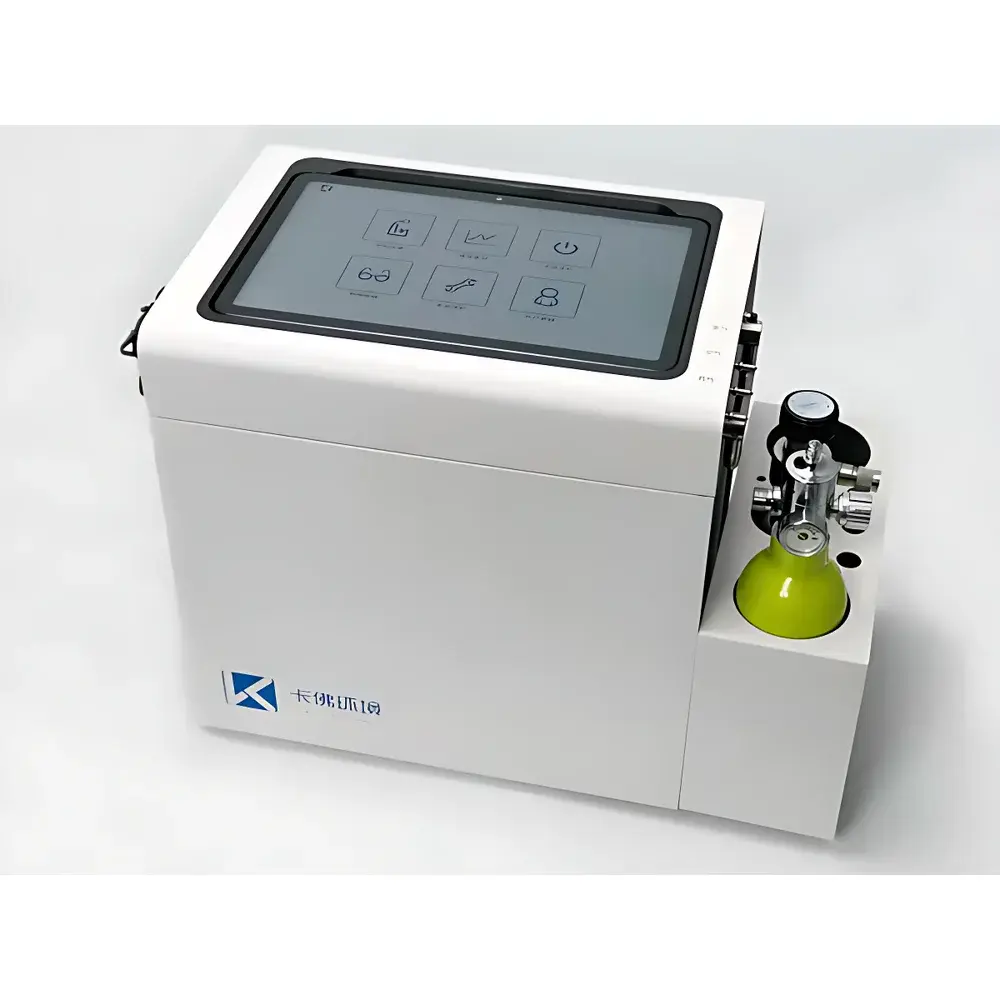
BANFF Da Vinci MINI Portable Total Hydrocarbons Analyzer
| Brand | BANFF |
|---|---|
| Origin | Zhejiang, China |
| Manufacturer Type | OEM Manufacturer |
| Product Category | Domestic |
| Model | Da Vinci MINI |
| Instrument Type | Portable Gas Chromatograph |
| Application Field | Environmental Monitoring |
| Detection Principle | Gas Chromatography with Flame Ionization Detection (GC-FID) |
| Target Analytes | Total Hydrocarbons (THC), Methane (CH₄), Non-Methane Hydrocarbons (NMHC), BTEX, Halogenated VOCs |
| Compliance Standards | HJ 1012–2018, HJ 38–2017, DB11/1367–2016, DB12/524–2020, DB51/2377–2017, JJG 700–2016, JJF (Su) 225–2019 |
Overview
The BANFF Da Vinci MINI Portable Total Hydrocarbons Analyzer is a field-deployable gas chromatograph engineered for precise, on-site quantification of total hydrocarbons (THC), methane (CH₄), non-methane hydrocarbons (NMHC), and targeted volatile organic compounds (VOCs) including BTEX and halogenated species. Built upon a dual-column GC-FID architecture, the instrument employs flame ionization detection—recognized for its universal carbon-response sensitivity, linear dynamic range (>10⁶), and robustness in variable environmental conditions. Unlike laboratory-bound systems, the Da Vinci MINI integrates all critical GC subsystems—including carrier gas regulation, column oven, FID detector, and sampling interface—into a single, ruggedized chassis designed for operation in ambient temperatures from −10 °C to 45 °C and relative humidity up to 90% RH (non-condensing). Its measurement principle conforms to established regulatory frameworks for NMHC monitoring, particularly those requiring direct separation of methane from total hydrocarbons via backflush or dual-detection strategies.
Key Features
- High-integration modular design: Compact footprint (≤380 × 300 × 180 mm) and lightweight construction (<12 kg) enable single-operator transport via integrated handle or wheeled case.
- High-vacuum sampling pump: Capable of stable flow control under low-pressure or high-resistance sampling conditions (e.g., stack ducts, sorbent tubes, or diffusion samplers).
- Optimized FID system: Features ultra-low detection limit (<0.05 ppm C₁ as propane, signal-to-noise ≥3), wide linear range (0.1–10,000 ppm C₁), and auto-ignition with real-time flame status monitoring and automatic gas shutoff upon flameout.
- Intelligent gas management: Fully automated pressure control for carrier gas (N₂ or He), hydrogen, and air (or ambient air); pressure stability ±0.01 psi; eliminates manual regulator tuning.
- Electrically actuated multi-port valves: Replace pneumatic switching to eliminate baseline drift caused by pressure transients and reduce compressed gas consumption by >40%.
- Column backflush capability: Activated post-run to purge residual heavy VOCs and prevent carryover, ensuring inter-sample integrity without manual intervention.
- Silanized internal flow paths: All metal and fused-silica surfaces undergo deactivation treatment to minimize adsorption of reactive VOCs (e.g., aldehydes, ketones, chlorinated compounds).
- Oxygen interference compensation: Onboard algorithm subtracts O₂-derived background signal during FID measurement—critical for ambient air analysis where O₂ concentration varies.
- Preloaded calibration libraries: Includes factory-validated multi-point calibration curves for THC, CH₄, NMHC, benzene, toluene, ethylbenzene, xylenes, and common chlorocarbons; supports user-defined curve generation and storage.
- Remote operation architecture: Embedded Linux OS enables full instrument control—including method setup, sequence execution, and real-time chromatogram review—via Wi-Fi or Ethernet from tablet or laptop, with no physical console required.
Sample Compatibility & Compliance
The Da Vinci MINI accepts gaseous samples directly from stainless-steel canisters (SUMMA-type), Tedlar® bags, or active sampling via built-in pump and inert-coated tubing. It complies with Chinese national and provincial environmental standards governing NMHC and VOC emissions, including HJ 1012–2018 (ambient and stack NMHC field measurement), HJ 38–2017 (fixed source GC-FID methodology), DB11/1367–2016 (Beijing local standard), DB12/524–2020 (Tianjin VOC emission limits), and DB51/2377–2017 (Sichuan VOC regulations). Instrument performance validation follows JJG 700–2016 (GC verification protocol) and JJF (Su) 225–2019 (NMHC analyzer calibration specifications). While not certified to ISO/IEC 17025 or EPA Method 25A, its operational parameters and data handling workflows support GLP-aligned field reporting and audit-ready record retention.
Software & Data Management
The Da Vinci Control Suite (v3.2+) provides intuitive method configuration, real-time chromatographic visualization, peak integration using tangent skim and valley-to-valley algorithms, and automated NMHC calculation (NMHC = THC − CH₄). All raw chromatograms, integration logs, calibration reports, and system diagnostic timestamps are stored internally (32 GB eMMC) with optional cloud sync via encrypted HTTPS. Audit trails capture operator ID, method version, calibration history, and hardware status changes—supporting traceability requirements under China’s Environmental Monitoring Quality Supervision Regulations. Export formats include CSV, PDF (with embedded spectra), and CDF (NetCDF-compliant) for third-party data platforms. Software supports 21 CFR Part 11–style electronic signature logging when deployed with external authentication servers.
Applications
This analyzer serves as a primary tool for regulatory enforcement teams conducting unannounced inspections at industrial facilities, municipal wastewater plants, petrochemical terminals, and coating application sites. It supports routine self-monitoring by facility environmental officers under China’s “Pollutant Discharge Permit System,” enabling rapid verification of compliance with hourly or daily NMHC thresholds. In ambient air quality assessment, it performs fence-line monitoring, mobile surveying (vehicle-mounted or backpack-configured), fugitive emission screening (LDAR follow-up), and comparative evaluation of continuous emission monitoring systems (CEMS). Its portability and rapid turnaround (<5 min per sample) make it especially suitable for time-sensitive scenarios such as incident response, odor complaint investigations, and pre-commissioning emission verification.
FAQ
What gases can be used as carrier gas?
Nitrogen (≥99.999%) or helium (≥99.999%) are recommended; hydrogen is not supported as carrier due to FID safety constraints.
Does the instrument require external power?
It operates on internal Li-ion battery (≥4 h runtime) or 100–240 VAC input; battery charging is conducted externally via included smart charger.
Can it quantify individual VOCs beyond NMHC?
Yes—method templates for BTEX, chloromethanes, and C₂–C₆ alkanes are preinstalled; additional compound libraries may be added via software update.
Is calibration traceable to national standards?
Calibration gases are certified to GB/T 5274–2018 (equivalent to ISO 6143) and supplied with NIM-traceable certificates; instrument calibration verification follows JJF (Su) 225–2019 procedures.
How is data integrity ensured during field use?
All chromatograms and metadata are digitally signed at acquisition; file tampering triggers hash mismatch alerts in the control software, and no post-acquisition editing of raw data is permitted.





