
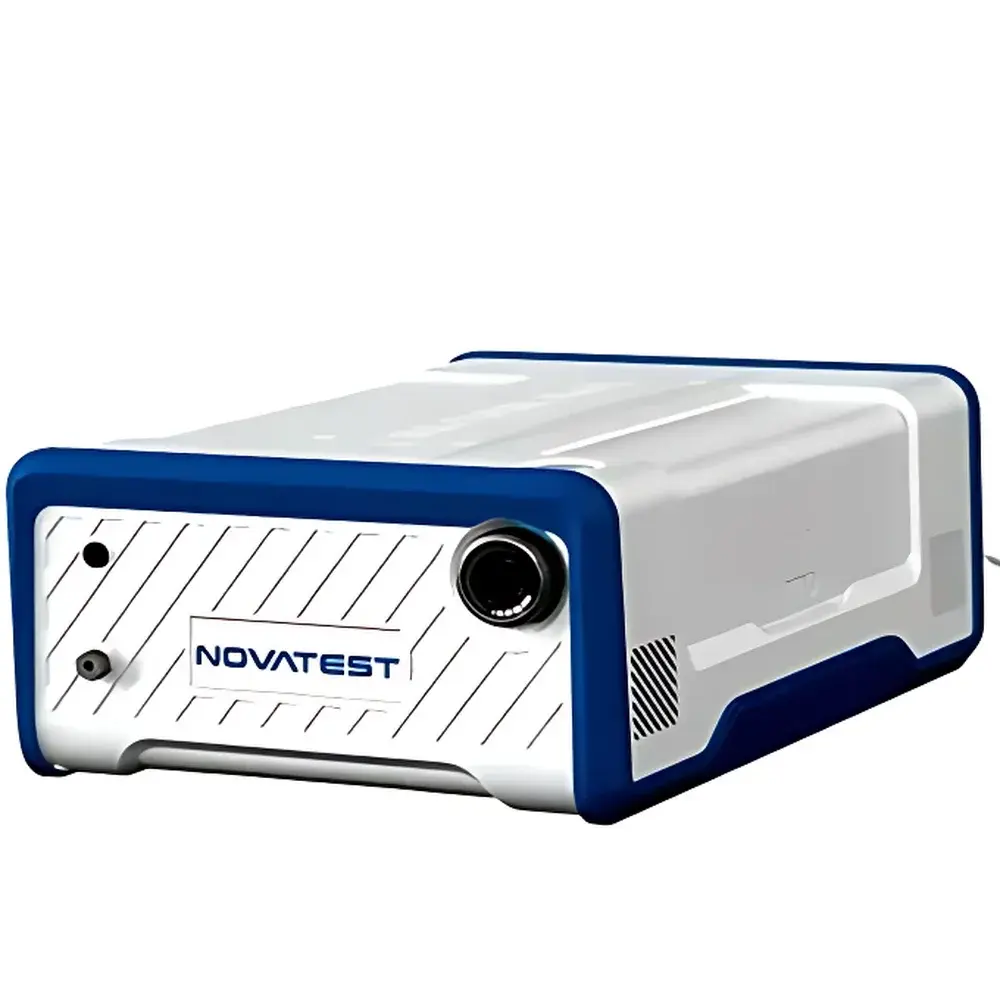
Banff P100 Portable Gas Chromatograph
| Brand | Banff |
|---|---|
| Model | P100 |
| Type | Portable Gas Chromatograph |
| Detection Principle | Microfluidic GC with PID Detection |
| Detection Limit | Sub-ppb (VOCs) |
| Sample Introduction | Ambient Air / Headspace / Canister via Integrated Microtrap |
| Compliance | Aligned with GB/T 18883–2022 (Indoor Air Quality Standard) |
| Software | Embedded Real-Time Analysis Engine with Auto-Report Generation |
| Calibration | Onboard Method Calibration & Multi-Point Standard Gas Support |
| Maintenance | Automated Post-Run Trap & Flow Path Purge |
| Power | Rechargeable Li-ion Battery (≥4 h continuous operation) |
| Dimensions | 295 × 220 × 145 mm |
| Weight | 3.2 kg |
| Operating Temperature | 5–40 °C |
| Humidity Range | 10–90% RH (non-condensing) |
Overview
The Banff P100 Portable Gas Chromatograph is an engineered field-deployable analytical system designed for on-site, real-time quantification of volatile organic compounds (VOCs) in ambient air, headspace, and canister-collected samples. It integrates a patented microfluidic gas chromatography separation module (WO2016179291A1) with a high-sensitivity photoionization detector (PID), enabling selective compound resolution and sub-parts-per-trillion (ppt) to low-parts-per-trillion (ppb) detection limits across C2–C12 hydrocarbons, oxygenates, halocarbons, and aromatics. Unlike benchtop GC systems requiring cryogenic focusing or complex carrier gas infrastructure, the P100 employs ambient-temperature activated carbon microtrapping followed by resistive heating desorption—eliminating cold traps, reducing power demand, and ensuring minimal analyte loss during transfer. Its compact architecture supports direct sampling-to-report workflows without laboratory preprocessing, making it suitable for regulatory-compliant field screening where rapid turnaround and measurement traceability are critical.
Key Features
- Microfluidic GC column technology with integrated thermal desorption microtrap—no liquid nitrogen or compressed gas required
- Dual-mode operation: pre-configured Quick Test mode and customizable Advanced Test mode with adjustable oven ramp rates, injection timing, and PID voltage settings
- Real-time chromatogram display with automatic peak identification against embedded spectral library (NIST-compatible compound list)
- Automated post-analysis purge cycle: thermally cleans trap and flow path within 90 seconds to prevent carryover between samples
- Embedded reporting engine that calculates TVOC (Total Volatile Organic Compounds) per ISO 16000-29 and GB/T 18883–2022 protocols, including retention time, peak width at half-height, peak area, and calibrated concentration (µg/m³ or ppb)
- On-device calibration management supporting multi-point standard gas verification and drift correction logs
- IP54-rated enclosure with shock-absorbing housing and internal inertized flow path for field durability
Sample Compatibility & Compliance
The P100 accepts gaseous samples directly from ambient air (via built-in pump), Tedlar bags, stainless steel canisters (with optional interface), and headspace vials (using optional heated syringe module). It complies with method requirements specified in GB/T 18883–2022 for indoor air VOC monitoring and aligns with ISO 16000-29 (Indoor air — Determination of volatile organic compounds — Microfluidic GC-PID method). While not a GLP-certified instrument, its audit-ready data structure—including timestamped raw chromatograms, operator ID tagging, calibration history, and version-controlled method files—supports 21 CFR Part 11–aligned data integrity practices when deployed under documented SOPs. All firmware and method updates are digitally signed and logged for traceability.
Software & Data Management
The P100 runs Banff’s proprietary ChromaEdge™ embedded OS, which manages acquisition, processing, and reporting without external PC dependency. Data is stored locally on encrypted internal flash memory (32 GB) and exportable via USB-C or Wi-Fi to secure enterprise networks. The system maintains full audit trails: every test record includes instrument serial number, firmware version, environmental sensor readings (T/RH), user login session ID, and checksum-verified raw signal files (.cdf format). Optional cloud sync enables centralized fleet monitoring, remote method deployment, and automated report aggregation across distributed environmental health teams.
Applications
- Regulatory indoor air quality assessments per GB/T 18883–2022 and ISO 16000 series standards
- Rapid source identification during industrial leak surveys, spill response, or fire debris analysis
- Occupational hygiene monitoring in manufacturing, pharmaceutical cleanrooms, and coating facilities
- Soil vapor intrusion screening using passive/active soil gas probes
- Water treatment plant off-gas profiling and wastewater headspace analysis
- Food packaging migration studies and flavor compound release kinetics
- Academic research in atmospheric chemistry, material emission testing, and sensor validation
- First-responder chemical threat screening in civil security and military reconnaissance scenarios
FAQ
Does the P100 require external calibration gases for routine operation?
Yes—quantitative analysis requires periodic verification with certified VOC standard mixtures (e.g., EPA TO-14/15 blends). The instrument supports single- or multi-point calibration routines with full uncertainty propagation logging.
Can the P100 quantify individual isomers such as xylene or butanol variants?
Yes—its microfluidic column achieves baseline separation of ortho-, meta-, and para-xylene, as well as n-/iso-butanol, under optimized temperature programming (typical resolution Rs ≥ 1.5).
Is method transfer possible from lab-based GC-MS to the P100?
Method translation is supported via Banff’s Method Migration Toolkit, which maps retention indices, detector response factors, and integration parameters while accounting for column geometry and thermal mass differences.
What maintenance intervals are recommended for field use?
Trap cartridges are rated for ≥500 injections; PID lamp life exceeds 10,000 hours. Firmware auto-diagnostic checks run at startup and report consumable status, flow integrity, and detector stability metrics.
How is data integrity ensured during battery-powered operation?
All acquisitions are written to non-volatile memory with journaling file system protection; unexpected power loss triggers graceful shutdown and recovery of last complete chromatogram without corruption.






