
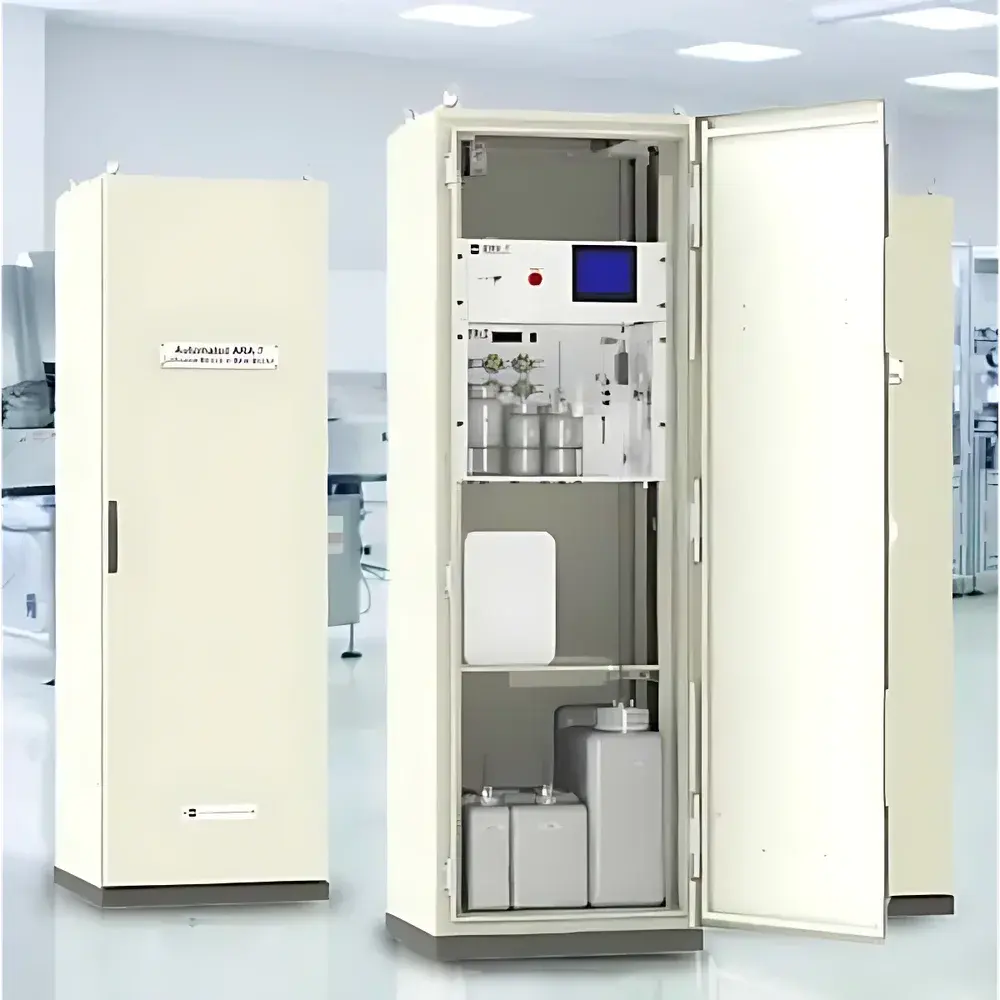
Baode Instruments ARA-7 Fully Automated Online Mercury Analyzer with Wet Digestion and Cold Vapor Atomic Absorption Spectrometry
| Brand | Baode Instruments |
|---|---|
| Origin | Beijing, China |
| Manufacturer Type | Manufacturer |
| Product Type | Online Mercury Analyzer |
| Model | ARA-7 |
| Measurement Principle | Cold Vapor Atomic Absorption Spectrometry (CVAAS) |
| Detection Wavelength | 253.7 nm |
| Sample Matrix | Aqueous environmental and industrial wastewater |
| Compliance | HJ 597–2011 (China), ASTM D3559, ISO 12846 |
| Key Components | Integrated DRA-7 wet digestion module + DRD-7 CVAAS detector |
| Automation Level | Fully automated digestion, reduction, amalgamation, desorption, detection, and cleaning |
Overview
The Baode Instruments ARA-7 is a fully automated online mercury analyzer engineered for continuous, unattended measurement of total mercury (HgT) in aqueous matrices—including industrial effluents (e.g., chlor-alkali plant discharges, municipal solid waste incineration leachates, coal-fired power plant wastewater) and natural water bodies (rivers, lakes, reservoirs). It implements a validated, two-stage analytical workflow: first, complete oxidative wet digestion to liberate mercury from organic complexes (e.g., methylmercury) and insoluble inorganic species (e.g., HgS); second, quantitative reduction to elemental mercury vapor (Hg⁰), followed by gold amalgamation, thermal desorption, and highly selective detection via Cold Vapor Atomic Absorption Spectrometry (CVAAS) at 253.7 nm. This principle ensures trace-level sensitivity (sub-ng/L detection capability), high specificity, and robustness against matrix interferences—critical for regulatory compliance monitoring under stringent environmental discharge limits.
Key Features
- Integrated wet digestion and CVAAS detection in a single rack-mounted system (DRA-7 + DRD-7 modules), eliminating manual transfer and cross-contamination risks.
- Ceramic heating elements provide uniform, controllable thermal profiles during digestion—avoiding localized overheating, reagent decomposition, or vessel degradation.
- Discrete Direct Purge (DDP) technology replaces flow-injection approaches: post-digestion, elemental Hg⁰ vapor is purged from the acidic reaction mixture using mercury-free air; only gaseous Hg⁰ enters the inert, dry transport line to the detector—effectively eliminating mercury memory effect.
- Automated calibration verification: user-definable calibration frequency, standard concentration levels, blank replicate count, and action thresholds (continue/abort on drift exceedance).
- Intelligent reagent management: level sensors for deionized water and NaOH solution; refrigerated storage compartment (4–8 °C) for SnCl₂ and Hg standard solutions; optimized consumption algorithms enabling monthly refills.
- Self-diagnostic firmware with categorized error codes, automatic power-fail recovery, and programmable multi-step cleaning cycles (NaOH wash → DI water rinse).
Sample Compatibility & Compliance
The ARA-7 is validated for use with turbid, high-salinity, and organically rich water samples typical of industrial wastewater and surface waters. Its digestion protocol—using H₂SO₄, HNO₃, KMnO₄, and K₂S₂O₈—ensures complete oxidation of methylmercury and conversion of Hg²⁺ and HgS into measurable Hg⁰. The system complies with Chinese national standard HJ 597–2011 (“Determination of Total Mercury in Water by Cold Vapor Atomic Absorption Spectrophotometry”), and its methodology aligns with internationally recognized protocols including ASTM D3559 (“Standard Test Methods for Determination of Lead, Cadmium, and Mercury in Water”) and ISO 12846:2012 (“Water quality — Determination of mercury — Method using cold vapour atomic absorption spectrometry”). For regulated environments, data integrity is supported via time-stamped audit trails, user-access logs, and optional 21 CFR Part 11–compliant software extensions.
Software & Data Management
Operation is managed via a built-in 5.7-inch color touchscreen interface supporting intuitive configuration of digestion parameters (temperature ramp, hold time), reagent volumes, purge duration, and measurement mode. All raw absorbance values, calibration curves, diagnostic logs, and maintenance timestamps are stored on an internal SD card with FAT32 formatting. Real-time analog output (4–20 mA) enables direct integration into SCADA or DCS systems. RS-232C serial communication allows bidirectional data exchange with external PCs running Baode’s proprietary MercuryView™ software—supporting automated report generation (PDF/CSV), trend analysis, alarm thresholding, and GLP-compliant electronic record retention.
Applications
- Continuous compliance monitoring at EPA- or MEE-mandated discharge points for chlor-alkali facilities, coal combustion plants, and hazardous waste treatment sites.
- Early-warning surveillance of drinking water source protection zones and ecologically sensitive aquatic ecosystems.
- Process optimization support in mercury recovery units and activated carbon adsorption systems.
- Long-term trend analysis for environmental impact assessments and remediation verification studies.
FAQ
What sample types can the ARA-7 analyze?
It is designed for liquid aqueous samples only—industrial wastewater, surface water, groundwater, and treated effluents—with suspended solids content ≤ 50 mg/L. Slurries or viscous media require pre-filtration.
Does the ARA-7 require daily operator intervention?
No. Once configured, it operates unattended for ≥30 days with scheduled reagent replenishment and periodic waste container replacement.
How does the system prevent carryover between samples?
Through Discrete Direct Purge (DDP), combined with automated NaOH/DI water cleaning cycles and gold amalgam trap regeneration—validated to achieve <0.1% carryover at 10 ng/L Hg levels.
Can the digestion method be modified for specific matrices?
Yes. Three programmable methods are available: full digestion (heated), ambient digestion (no heating), or direct reduction (H₂SO₄ + SnCl₂ only), each with adjustable reagent dosing and timing.
Is remote monitoring supported?
Yes—via RS-232C, Modbus RTU over RS-485, or optional Ethernet/WiFi gateway modules enabling secure cloud-based telemetry and alarm notifications.
Related Products





