
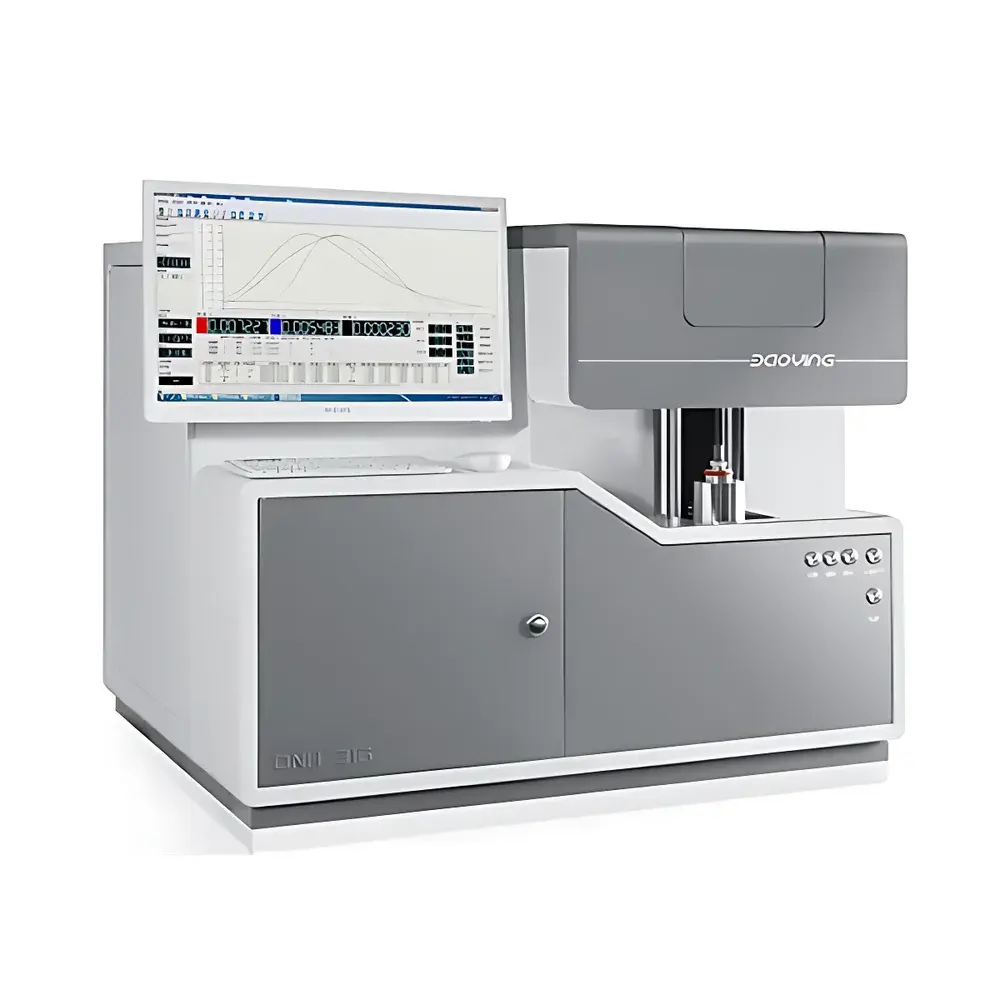
Baoying ONH-316 Inert Gas Fusion Oxygen/Nitrogen/Hydrogen Analyzer
| Brand | Baoying Technology |
|---|---|
| Origin | Shanghai, China |
| Manufacturer Type | Direct Manufacturer |
| Regional Classification | Domestic (China) |
| Model | ONH-316 |
| Instrument Type | Oxygen/Nitrogen/Hydrogen Elemental Analyzer |
| Oxygen Range | Low-O: 0.1–5000 ppm |
| High-O | 0.5–20 wt% |
| Nitrogen Range | Low-N: 0.1–5000 ppm |
| High-N | 0.5–50 wt% |
| Hydrogen Range | 0.1–5000 ppm |
| Accuracy | O/N: ±1 ppm or RSD ≤ 1% |
| H | ±0.2 ppm or RSD ≤ 2% (relative to certified reference material uncertainty) |
| Sensitivity | 0.01 ppm |
| Analysis Time (O) | 120–180 s |
| Pulse Furnace Power | 8.0 kW |
Overview
The Baoying ONH-316 is a high-performance inert gas fusion (IGF) elemental analyzer engineered for the precise quantification of oxygen (O), nitrogen (N), and hydrogen (H) in solid metallic and non-metallic materials. It operates on the principle of high-temperature thermal decomposition under ultra-pure helium or argon atmosphere—typically at temperatures exceeding 3000 °C—where sample matrices are fully dissociated, releasing interstitial and combined O, N, and H as gaseous species (e.g., CO, N₂, H₂). These evolved gases are then swept through a conditioned gas stream into dual detection modules: a solid-state non-dispersive infrared (NDIR) cell for CO-based oxygen determination and a high-stability thermal conductivity detector (TCD) for simultaneous N₂ and H₂ measurement. The system’s core architecture integrates proprietary solid-state optical components, digitally regulated gas dynamics, and thermally isolated detection chambers—ensuring metrological integrity across the full dynamic range from sub-ppm to multi-percent concentrations.
Key Features
- Inert Gas Fusion Platform: 8.0 kW graphite electrode pulse furnace with alloyed electrodes exhibiting exceptional red hardness and electrical conductivity; optimized heat transfer via proprietary thermal exchange design ensures uniform crucible heating and complete sample melt homogeneity.
- Multi-Range Detection Architecture: Dual independent detection paths—solid-state NDIR for oxygen (via CO) and TCD for nitrogen/hydrogen—each equipped with individual temperature-controlled enclosures (±0.1 °C stability) and microcrystalline pulsed IR sources eliminating mechanical choppers and gas turbulence.
- Digital Gas Flow & Pressure Control: Electronic pressure control (EPC) modules on all gas lines compensate for ambient barometric fluctuations; each flow path features dedicated EPC units, ensuring stoichiometric carrier gas delivery and minimizing cross-sensitivity between analytes.
- Automated System Integrity Monitoring: Built-in leak-tightness verification sequence prior to analysis; integrated DTU module enables remote diagnostics, firmware updates, and real-time performance logging compliant with preventive maintenance schedules.
- Low-Background Gas Handling: On-board gas purification train removes residual O₂, H₂O, CO₂, and hydrocarbons from carrier gas; critical for achieving validated sub-0.01 ppm detection limits and long-term baseline stability during ultra-trace analysis.
- Modular Industrial Integration: All subsystems—including furnace, gas handling, detectors, and industrial-grade embedded PC—are housed within a single robust chassis; stainless-steel passivated gas pathways enhance corrosion resistance and extend service intervals beyond 10,000 analyses.
Sample Compatibility & Compliance
The ONH-316 accommodates diverse solid specimens including ferrous and non-ferrous alloys (steels, titanium, nickel superalloys), ceramics, carbides, and refractory metals. Sample mass ranges from 0.1 g to 1.0 g depending on matrix and target element concentration. Method development aligns with ASTM E1019, ISO 14284, and GB/T 11261 standards for inert gas fusion analysis. Full audit trail functionality—including user login, method versioning, raw signal archives, and calibration history—is implemented to support GLP and GMP environments. Data export formats (CSV, XML) and optional SQL database connectivity facilitate integration into LIMS platforms compliant with FDA 21 CFR Part 11 requirements.
Software & Data Management
Baoying Analytical Suite v4.2 provides intuitive workflow-driven operation—from sample registration and method selection to real-time spectral visualization and post-run quantitation. Calibration supports single-point, multi-point, and bracketing modes with automatic drift correction based on reference material consensus values. Peak integration uses adaptive baseline algorithms resistant to thermal noise and transient gas-phase interference. All analytical results include uncertainty estimates derived from CRM-certified standard deviations. Raw data files retain unprocessed detector voltages, furnace power profiles, and gas flow logs—enabling full traceability and reprocessing without instrument reanalysis. Remote access via secure TLS-encrypted connection permits off-site troubleshooting and method validation oversight.
Applications
- Quality control of high-purity specialty steels where oxygen content governs inclusion morphology and fatigue life.
- Hydrogen embrittlement assessment in aerospace titanium alloys per AMS 2750 and ASTM F2795.
- Process validation of powder metallurgy feedstocks for additive manufacturing (AM) powders (e.g., Ti-6Al-4V, Inconel 718).
- Research-grade quantification of interstitial elements in advanced ceramics (SiC, Al₂O₃) and nuclear-grade zirconium cladding.
- Failure analysis laboratories requiring ISO/IEC 17025-compliant reporting for litigation or regulatory submission.
FAQ
What carrier gases are compatible with the ONH-316?
Helium and argon are both supported; helium offers superior thermal conductivity for TCD sensitivity, while argon provides better CO detection linearity in high-oxygen matrices. Gas purity must meet ISO 8573-1 Class 1 requirements (≤0.1 ppm H₂O/O₂).
Can the system analyze coated or surface-treated samples?
Yes—provided the coating thickness is ≤5 µm and does not contain volatile organic binders. Surface oxide layers are fully included in total oxygen measurement unless pre-abraded per ASTM E1122.
Is routine maintenance documented and traceable?
All maintenance events—including crucible replacement, filter changes, and detector zero calibrations—are timestamped, user-logged, and exported with analytical reports to satisfy ISO 17025 clause 7.7.
How is hydrogen quantification validated at sub-1 ppm levels?
Using certified low-H reference materials (e.g., NIST SRM 1263a) with gravimetrically assigned uncertainties; system repeatability is verified daily via duplicate analysis with RSD ≤1.5% at 0.5 ppm H.
Does the instrument support automated sample changers?
The ONH-316 platform is mechanically and software-ready for integration with third-party autosamplers (e.g., CETAC ASX-520); API-level command protocol documentation is provided under NDA.





