
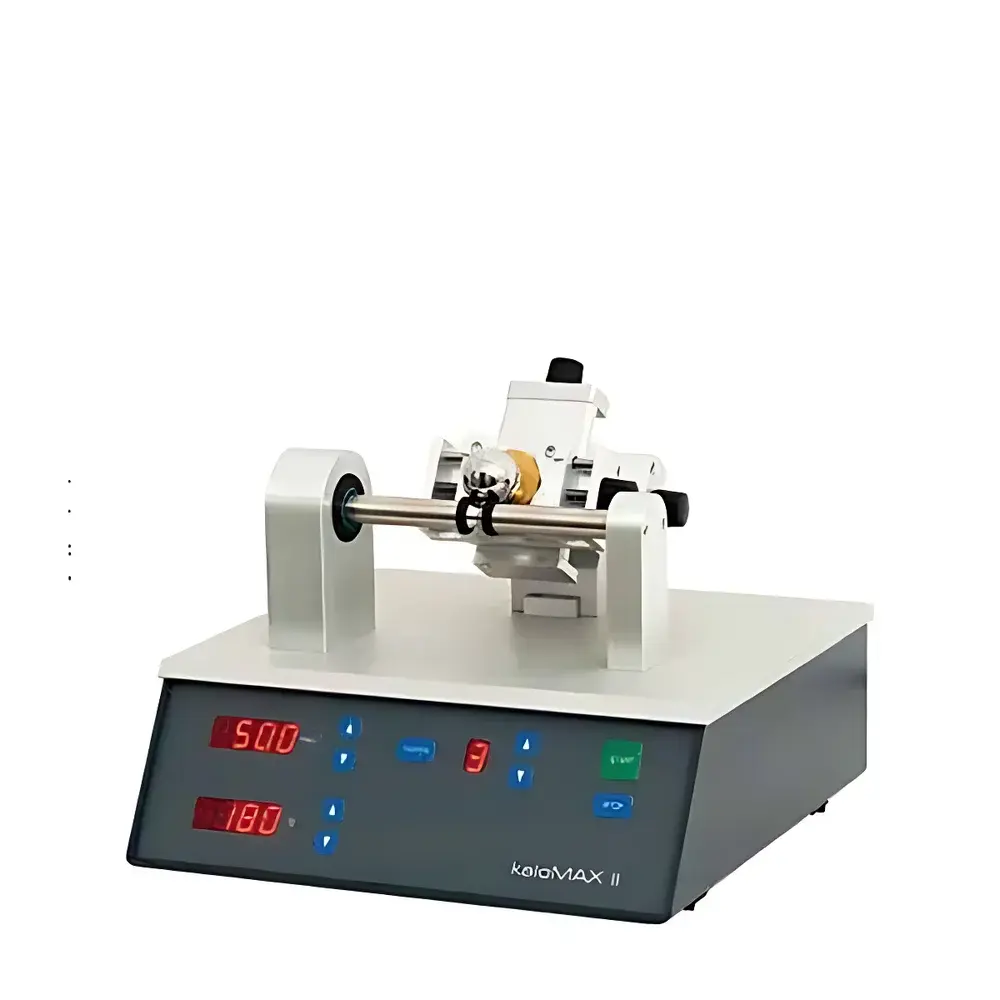
BAQ kaloMAX II Ball Cratering Thickness Measurement System
| Brand | BAQ |
|---|---|
| Origin | Germany |
| Model | kaloMAX II |
| Measuring Principle | Ball cratering (geometric depth determination via spherical indentation) |
| Thickness Range | 0.3 – 30 µm |
| Ball Diameter | 15 – 30 mm |
| Planar Sample Clamp Range | 50 mm |
| Circular Sample Clamp Range | 3 – 30 mm (customizable) |
| Cross-Stage Travel | 25 × 25 mm |
| Tilt Angle | 60° |
| Drive Shaft Speed | 100–1200 rpm (12 preset values) |
| Cycle Time | 5–180 s (20 preset values) |
| Display | 4-digit speed, 4-digit timer, 1-digit program ID |
| Input Voltage | 85–264 VAC |
| Input Frequency | 47–63 Hz |
| Dimensions (W×D×H) | 300 × 295 × 235 mm |
| Weight | ~8 kg |
| Accuracy | ±1–5% (surface roughness dependent) |
| Optional | Removable clamp base, graded abrasive slurries, high-resolution microscope camera system, kaloSOFT evaluation software, integrated automation-ready configuration |
Overview
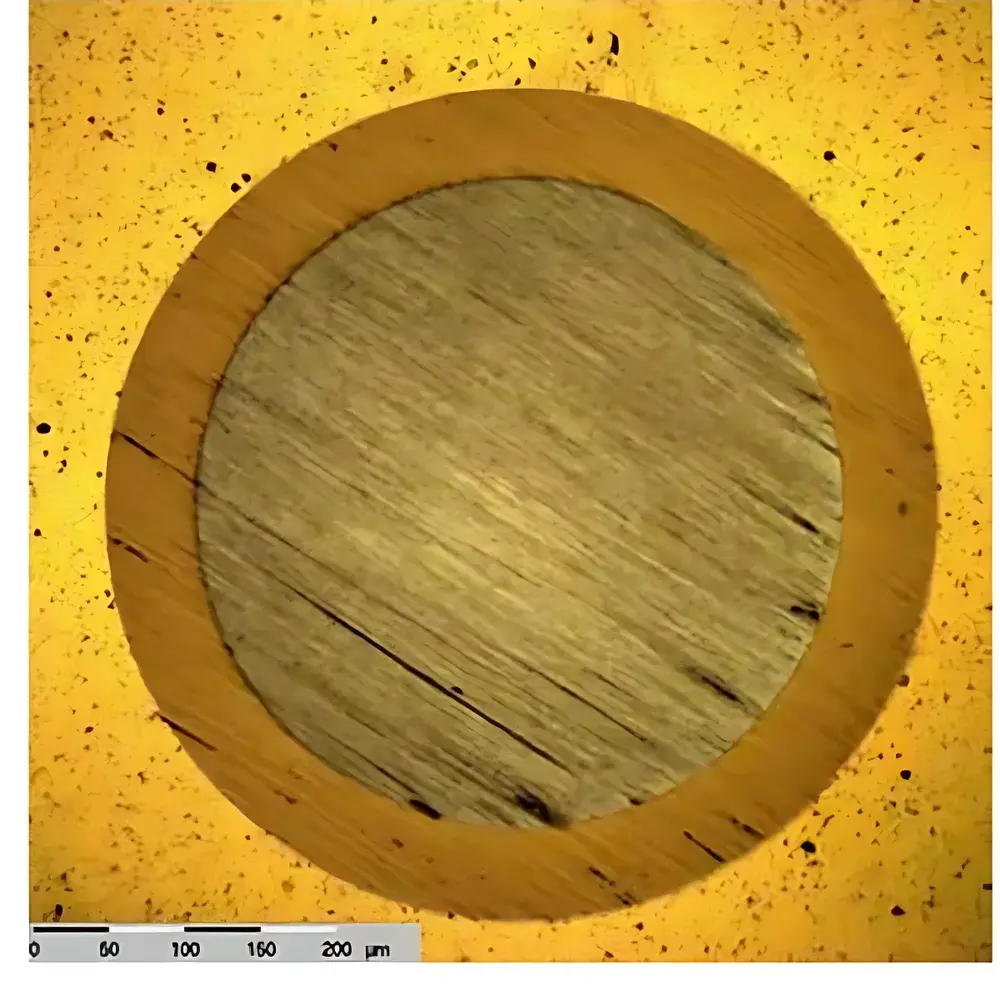
The BAQ kaloMAX II is a precision-engineered ball cratering thickness measurement system designed for non-destructive, geometric quantification of thin metallic, ceramic, and composite coatings in the sub-micrometer to low-micrometer range. It operates on the standardized ball cratering principle—defined in ASTM B662 and ISO 20502—where a rotating hardened steel sphere, under controlled load and rotational speed, abrades a spherical depression through the coating into the substrate. The resulting crater geometry exposes the coating/substrate interface as a distinct circular ring (or concentric rings for multilayer systems) under optical magnification. Thickness is calculated using the known ball radius and measured crater diameters, eliminating reliance on optical contrast, density assumptions, or calibration standards. This method delivers traceable, operator-independent results with high reproducibility across diverse conductive and non-conductive substrates—including Ni-P, Cr, TiN, DLC, electroplated Cu/Ni/Au stacks, and PVD-coated aerospace alloys.
Key Features
- Robust electromechanical architecture with precision-ground spindle and backlash-free drive train, ensuring consistent torque transmission and rotational stability across the full 100–1200 rpm range.
- Modular sample stage featuring 60° tilt adjustment and dual-clamping capability—supporting both planar specimens (up to 50 mm width) and cylindrical or irregularly shaped parts (3–30 mm diameter, with custom fixtures available).
- Dedicated 4-digit LED interface with independent displays for real-time spindle speed, elapsed cycle time, and active program number—enabling rapid setup verification and process repeatability without external PC dependency.
- Wide operational voltage and frequency tolerance (85–264 VAC, 47–63 Hz) ensures stable performance in global laboratory environments, including sites with fluctuating mains supply.
- Compact footprint (300 × 295 × 235 mm) and lightweight design (~8 kg) facilitate integration into QC labs, metrology cleanrooms, or R&D workbenches with space constraints.
Sample Compatibility & Compliance
The kaloMAX II accommodates rigid, flat, or curved samples with minimal surface preparation—no conductive coating or vacuum required. It is validated for use on electroplated, electroless, PVD, CVD, and thermal-sprayed coatings on metals (steel, aluminum, titanium), silicon wafers, and ceramic substrates. Measurement compliance aligns with ASTM B662-22 “Standard Test Method for Coating Thickness by Ball Cratering” and ISO 20502:2017 “Metallic and other inorganic coatings — Measurement of coating thickness — Ball cratering method.” The system supports GLP/GMP documentation workflows when paired with kaloSOFT, including audit-trail-enabled user logins, timestamped measurement records, and exportable CSV/PDF reports compliant with FDA 21 CFR Part 11 requirements.
Software & Data Management
kaloSOFT—the dedicated evaluation software—integrates seamlessly with standard USB microscope cameras (e.g., 5 MP CMOS sensors). It automates crater diameter detection using edge-enhanced threshold segmentation, calculates layer thicknesses from up to four concentric rings (for tri- or quad-layer stacks), and applies correction factors for ball wear and surface topography. All raw images, measurement parameters, and calculation logs are stored in a structured SQLite database with version-controlled backups. Export options include ISO/IEC 17025-compliant certificates, batch summary dashboards, and SPC-ready data files compatible with Minitab, JMP, and LabWare LIMS.
Applications
- Quality control of functional coatings in automotive fuel injectors, semiconductor packaging leads, and medical device stents.
- Process validation for electroless nickel-phosphorus (ENP) deposition in aerospace hydraulic components.
- Failure analysis of interfacial delamination in multi-layer PCB surface finishes (e.g., OSP/ENIG/ENEPIG).
- Research-grade thickness profiling of nanoscale ALD-grown HfO₂ gate dielectrics on patterned Si wafers.
- Calibration transfer between production-line eddy current gauges and reference metrology labs.
FAQ
Is the ball cratering method destructive to the sample?
Yes—ball cratering is a micro-destructive technique; it creates a localized spherical indentation (~50–200 µm diameter) that penetrates the coating. However, the damage is confined and does not compromise structural integrity for most functional components.
Can kaloMAX II measure coatings thinner than 0.3 µm?
No—below 0.3 µm, crater geometry becomes indistinct due to surface diffusion, plastic flow, and limited optical resolution. For ultrathin films (<100 nm), XRR or ellipsometry is recommended.
What abrasives are compatible with the system?
BAQ-certified alumina and diamond-based slurries (0.1–3.0 µm particle size) are supplied with defined viscosity and pH stability to ensure repeatable material removal rates.
Does the system require annual recalibration?
No routine recalibration is mandated; however, periodic verification using NIST-traceable step-height standards (e.g., Veeco TG series) is recommended every 12 months per ISO/IEC 17025 Clause 6.5.
Is automation integration supported?
Yes—RS-232 and TTL I/O ports enable synchronization with robotic sample handlers, PLC-controlled environmental chambers, and MES-triggered measurement sequences in Industry 4.0 environments.



