
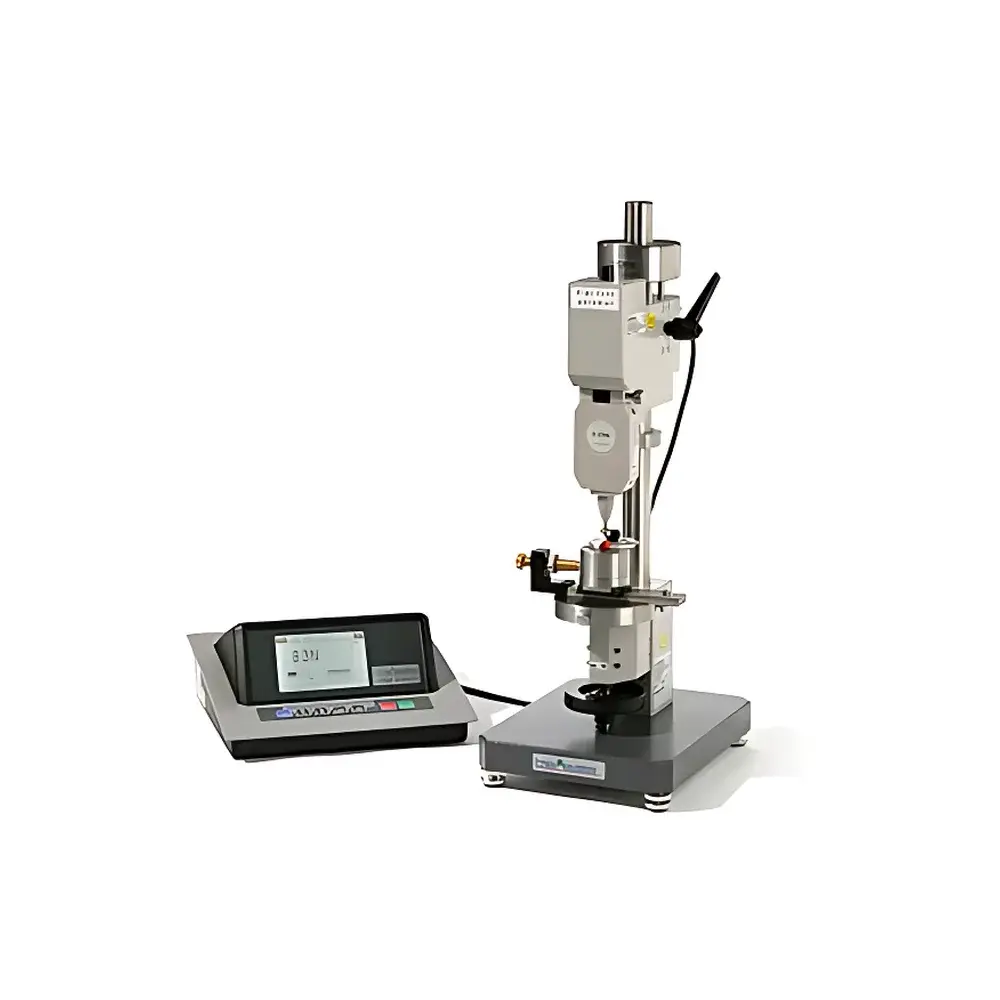
Bareiss digi test II Gelomat Capsule Hardness Tester
| Brand | Bareiss |
|---|---|
| Origin | Germany |
| Model | digi test II |
| Force Range Options | 0–2 N or 0–20 N (user-swappable load modules) |
| Test Principle | Axial compression with controlled displacement rate |
| Display | LCD (240 × 128 pixels) |
| Dimensions (Base Unit) | 200 × 250 × 570 mm |
| Weight (Base Unit) | 9 kg |
| Housing Material | Anodized aluminum alloy |
| Power Supply | 100–240 VAC, 50/60 Hz |
| Communication Interfaces | RS-232, USB |
| Compliance | Designed for GLP-compliant capsule quality control in pharmaceutical R&D and manufacturing |
Overview
The Bareiss digi test II Gelomat is a dedicated, modular axial compression tester engineered specifically for the quantitative mechanical characterization of soft gelatin and HPMC-based capsules. Unlike general-purpose hardness testers or durometers, the Gelomat implements a controlled-force, displacement-monitored compression protocol aligned with pharmacopeial expectations for capsule shell integrity assessment. It operates on the principle of quasi-static uniaxial compression—applying a precisely regulated normal force perpendicular to the capsule’s equatorial plane while recording deformation response and peak rupture force. This methodology enables objective evaluation of both elastic recovery behavior (at low loads, 0–2 N) and structural collapse resistance (at higher loads, 0–20 N), directly correlating to critical quality attributes such as fill protection, handling robustness, and dissolution performance.
Key Features
- Modular architecture with tool-free disassembly of load application unit, test head, and electronics—enabling rapid recalibration, sensor replacement, or preventive maintenance without specialized technician support.
- Dual-range force transducer system: Interchangeable 0–2 N and 0–20 N load modules allow method-specific configuration without hardware modification; each module is factory-calibrated and traceable to national standards (DAkkS-accredited calibration certificates available upon request).
- Customizable capsule positioning fixtures: Bareiss offers application-specific fixture plates—including single-capsule holders, multi-position trays (4-, 6-, or 12-place), and geometry-adapted mounts for oblong, oval, or enteric-coated variants—to ensure consistent loading axis alignment and minimize lateral buckling artifacts.
- Integrated real-time display with 240 × 128-pixel LCD interface supports on-device parameter review, pass/fail threshold setting, and immediate result visualization—including force vs. displacement curves, peak load, and deformation at 10% strain (configurable).
- Anodized aluminum construction ensures dimensional stability across ambient temperature fluctuations (15–30 °C operating range) and long-term resistance to solvent exposure during routine cleaning in cGMP environments.
Sample Compatibility & Compliance
The digi test II Gelomat accommodates standard capsule sizes from #000 to #5 (including mini- and micro-capsules with optional adapters) and supports both dry-state and conditioned (e.g., 40% RH / 25 °C stabilized) testing per ICH Q5C guidelines. Its mechanical design complies with ISO 17025 requirements for measurement uncertainty estimation in hardness testing, and data acquisition meets ALCOA+ principles (Attributable, Legible, Contemporaneous, Original, Accurate) when used with validated software. While not a standalone 21 CFR Part 11-compliant system, the instrument’s RS-232 and USB outputs enable seamless integration into validated LIMS or ELN platforms supporting electronic signature and audit trail functionality.
Software & Data Management
Raw force-displacement data is exported in ASCII CSV format via USB or RS-232, preserving full resolution (0.001 N force, 0.01 mm displacement). Optional Bareiss TestControl software (v4.2+) provides statistical analysis (mean, SD, CV%, histogram distribution), batch reporting, and automated pass/fail flagging against user-defined specification limits (e.g., USP capsule shell strength thresholds). All data files include embedded metadata: timestamp, operator ID, fixture ID, load module serial number, and environmental conditions (if logged externally). Exported reports conform to ISO/IEC 17025 documentation requirements for accredited testing laboratories.
Applications
- Quantitative comparison of capsule shell formulation variants (e.g., plasticizer type/concentration, bloom strength, moisture content).
- Stability-indicating testing across accelerated and real-time storage conditions (per ICH Q1A–Q1E).
- In-process verification of capsule drying kinetics and final moisture equilibrium impact on mechanical resilience.
- Supplier qualification of empty capsule lots against internal specifications or pharmacopeial benchmarks (e.g., Ph. Eur. 2.9.40, JP 6.07).
- Root cause analysis of capsule deformation during blister packaging, bottling, or transit simulation studies.
FAQ
Is the digi test II Gelomat compliant with USP or Ph. Eur. monographs?
It is not explicitly referenced in current USP or Ph. Eur. 2.9.40, but its measurement principle, force resolution, and repeatability meet the technical requirements outlined in those chapters for capsule shell mechanical testing.
Can the instrument be integrated into an automated production line?
No—it is designed for laboratory-based QC/QA and R&D use; however, its digital interfaces support semi-automated batch testing workflows when paired with external PLC-controlled sample handlers.
What calibration frequency is recommended?
Annual calibration is advised per ISO/IEC 17025; interim verification using certified reference weights (traceable to PTB) should be performed before each daily test session.
Does Bareiss provide IQ/OQ documentation?
Yes—validated installation and operational qualification protocols are available as part of the GxP Support Package, including risk assessments, test scripts, and acceptance criteria aligned with ASTM E2500 and EU Annex 15.
How is positional accuracy maintained across different capsule sizes?
Fixture plates incorporate precision-machined centering bores and adjustable height stops; all fixtures undergo metrological validation using coordinate measuring machine (CMM) traceable to ISO 10360 standards.



