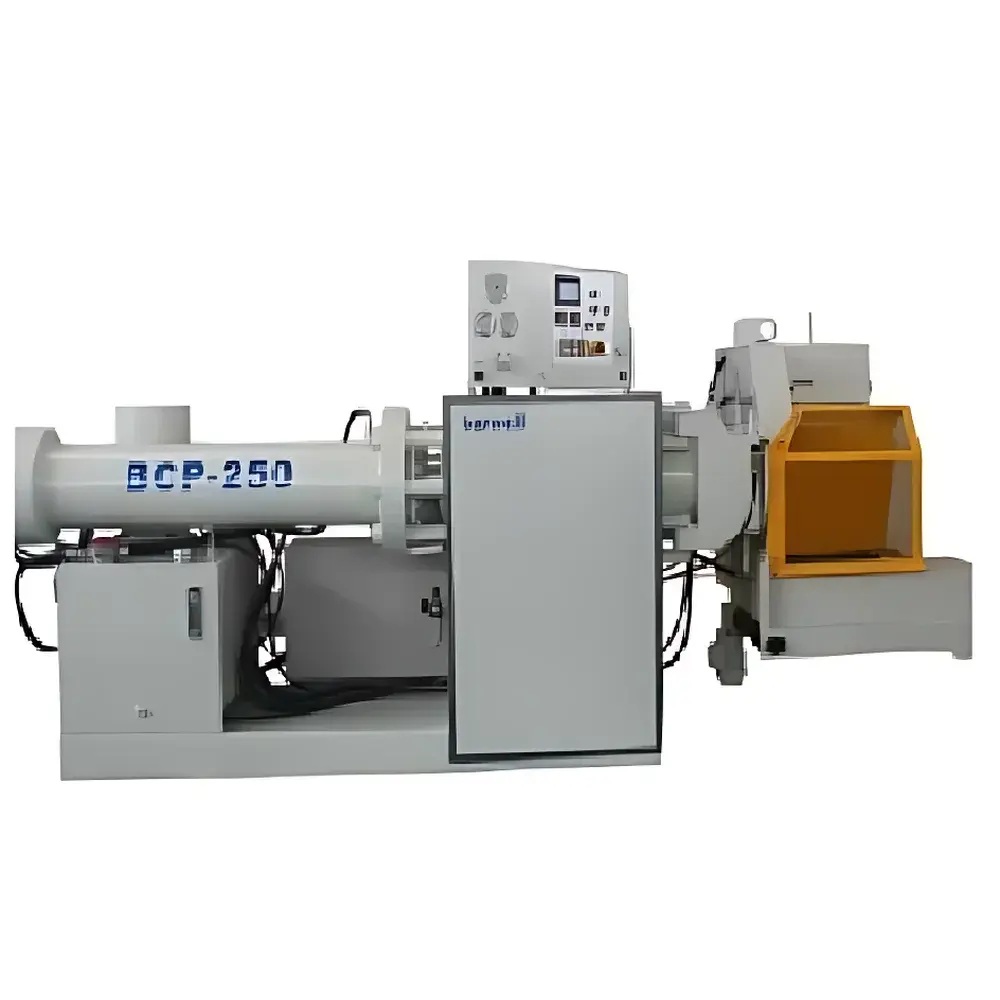
Barwell BCP-250 Rubber Preforming Extruder
| Brand | Barwell |
|---|---|
| Origin | United Kingdom |
| Model | BCP-250 |
| Feed Capacity | 40 L |
| Max Output | 450 kg/h |
| Plunger Diameter | 250 mm |
| Max Mold Diameter | 190 mm |
| Max Preform Weight | 2000 g |
| Operating Pressure | 210 bar (3000 psi) |
| Machine Dimensions (L×W×H) | 4340 × 1100 × 1730 mm |
| Weight | 3800 kg |
| Total Power | 22 kW |
| Hydraulic Oil Tank | 200 L |
| Air Supply | 6–10 bar |
| Cooling Water Flow | 35 L/min at 25 °C |
| Control Interface | 5.6″ TFT Color Touchscreen (Bilingual: English/Chinese) |
| Cutting Speed | Up to 400 RPM (Infinitely Variable via Inverter) |
Overview
The Barwell BCP-250 Rubber Preforming Extruder is a precision-engineered, vacuum-assisted plunger-type extrusion system designed for the high-integrity preformation of uncured rubber compounds prior to final vulcanization. Unlike conventional screw extruders, the BCP-250 employs a hydraulically driven axial plunger mechanism that delivers consistent, pulse-free material displacement—critical for minimizing entrapped air, eliminating voids, and ensuring dimensional repeatability in complex geometries such as O-rings, oil seals, valve stems, grommets, and automotive NVH components. Its operation is grounded in controlled volumetric displacement under elevated backpressure (up to 210 bar), enabling stable extrusion of medium-to-high-durometer compounds (Shore A 30–90) without thermal degradation or shear-induced scorch. The integrated vacuum chamber upstream of the die head removes volatiles and micro-bubbles, while multi-stage filtration ensures particulate-free output—directly supporting ISO 9001-compliant rubber compounding workflows and IATF 16949-aligned production traceability.
Key Features
- Plunger-driven extrusion architecture with zero-screw-slip design—eliminates melt homogeneity variability inherent in rotary systems
- Vacuum-assisted deaeration chamber (≤10 mbar residual pressure) integrated into feed zone, reducing air entrapment to <0.3% vol. per ASTM D2240 Annex A
- Hydraulically actuated, servo-controlled cutting unit with inverter-driven motor (0–400 RPM, infinitely variable)—enabling precise length control within ±0.3 mm tolerance
- Real-time gravimetric feedback loop: High-resolution load cell (±0.1 g resolution) interfaces with PLC to auto-adjust stroke depth and dwell time per preform
- Modular die head configuration supporting GP (General Purpose) and SH (Special Hardness) tooling—compatible with custom manifold designs for multi-cavity ring, toroidal, and 3D-profile extrusion
- 5.6″ industrial-grade TFT touchscreen HMI with dual-language UI (English/Chinese), password-protected parameter tiers (Operator/Engineer/Admin), and audit-trail-enabled event logging
- Robust cast-iron frame with vibration-damped mounting and ISO 2372-compliant hydraulic power unit (22 kW, 200 L reservoir)
Sample Compatibility & Compliance
The BCP-250 accommodates a broad spectrum of uncured elastomers including natural rubber (NR), SBR, NBR, EPDM, FKM, CR, and thermoplastic elastomers (TPEs) with Mooney viscosity ranging from ML(1+4)@100°C 20–120. It meets mechanical safety requirements per EN 692 and EN 693, incorporates CE-marked hydraulic and electrical subsystems, and supports integration into FDA-regulated environments when configured with 316 stainless steel wetted parts and validated cleaning protocols. Process data—including weight, cut count, vacuum level, pressure trace, and cycle time—is timestamped and exportable in CSV/Excel format for GLP/GMP documentation. Optional 21 CFR Part 11-compliant electronic signature and audit trail modules are available for pharmaceutical-grade elastomer component manufacturing.
Software & Data Management
The embedded control firmware records all critical process parameters per cycle: plunger position vs. time, real-time pressure profile (0–250 bar range), vacuum decay curve, cut synchronization trigger, and final preform mass. Data is stored locally on industrial-grade SD card (16 GB) with automatic rollover and can be exported via USB or Ethernet (Modbus TCP). The system supports OPC UA server integration for MES/SCADA connectivity (e.g., Siemens SIMATIC IT, Rockwell FactoryTalk). Batch reports include statistical process control (SPC) metrics—X̄/R charts for weight consistency, Cpk ≥1.33 validation—and support automated non-conformance flagging based on user-defined upper/lower limits.
Applications
- Precision preforming of static and dynamic sealing elements: AS568-standard O-rings, quad rings, X-rings, and custom lip seals
- Automotive fluid system components: brake hose grommets, fuel pump diaphragms, turbocharger boots
- Consumer goods: golf ball cores, shoe sole blanks, bicycle tire tubes, appliance gaskets
- Aerospace elastomeric bushings and vibration isolators requiring strict void content specifications (per AMS-2772)
- Medical device prototypes: silicone-based implantable component preforms compliant with ISO 10993 biocompatibility screening pathways
FAQ
What rubber compound viscosities are compatible with the BCP-250?
Compounds with Mooney viscosity ML(1+4)@100°C between 20 and 120 are routinely processed; low-viscosity fluids require optional pre-compaction stage.
Can the machine handle filled compounds containing >40% carbon black or silica?
Yes—its hardened alloy plunger sleeve and tungsten-carbide-lined die inserts resist abrasive wear; filtration mesh options down to 80 µm are available.
Is offline mold change supported without recalibration?
Yes—modular die carriers feature kinematic locating pins and zero-point clamping; full tool changeover takes <8 minutes with repeatable alignment verified via laser interferometry.
Does the system support recipe management across multiple SKUs?
Up to 999 stored recipes with version control, user access restrictions, and change history logging—all synchronized with plant-level ERP via REST API.
What maintenance intervals are recommended for hydraulic and vacuum subsystems?
Hydraulic oil analysis every 2000 operating hours; vacuum pump oil replacement every 500 hours; die seal inspection per 10,000 cycles per ISO 15243 bearing life modeling.