
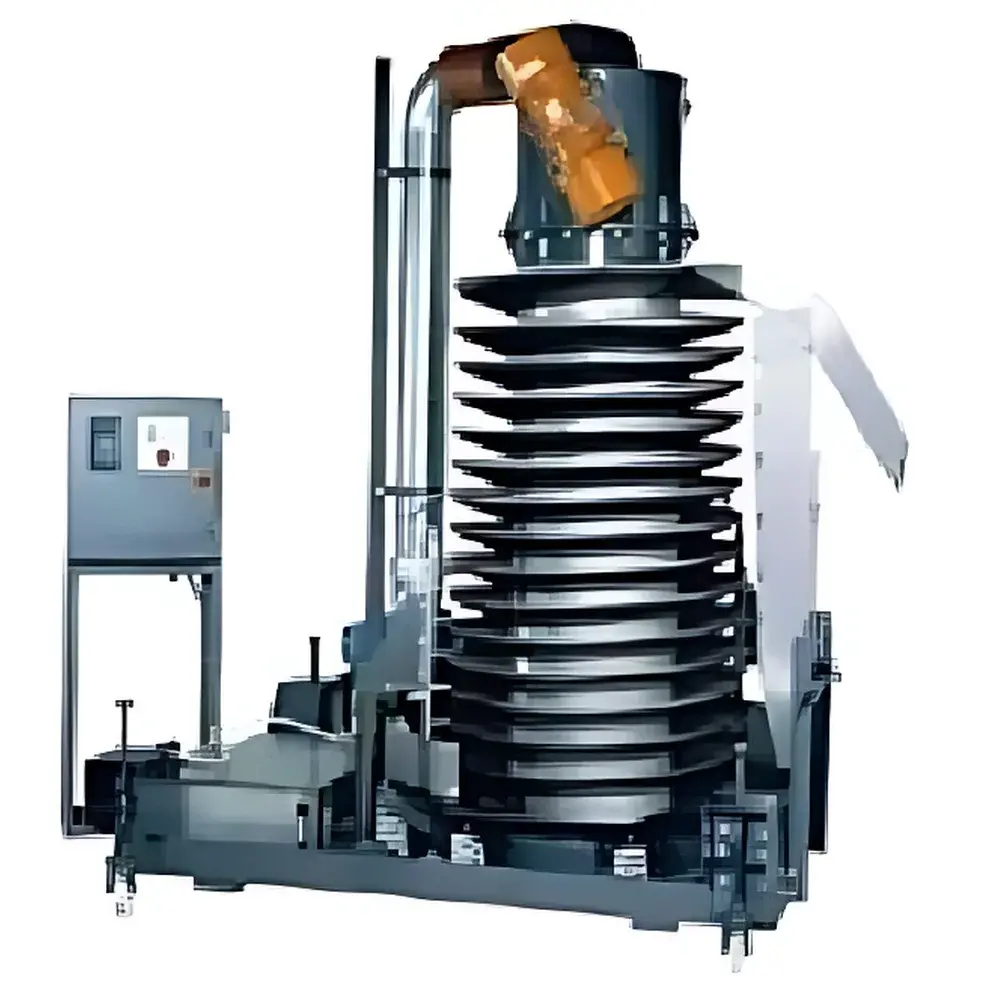
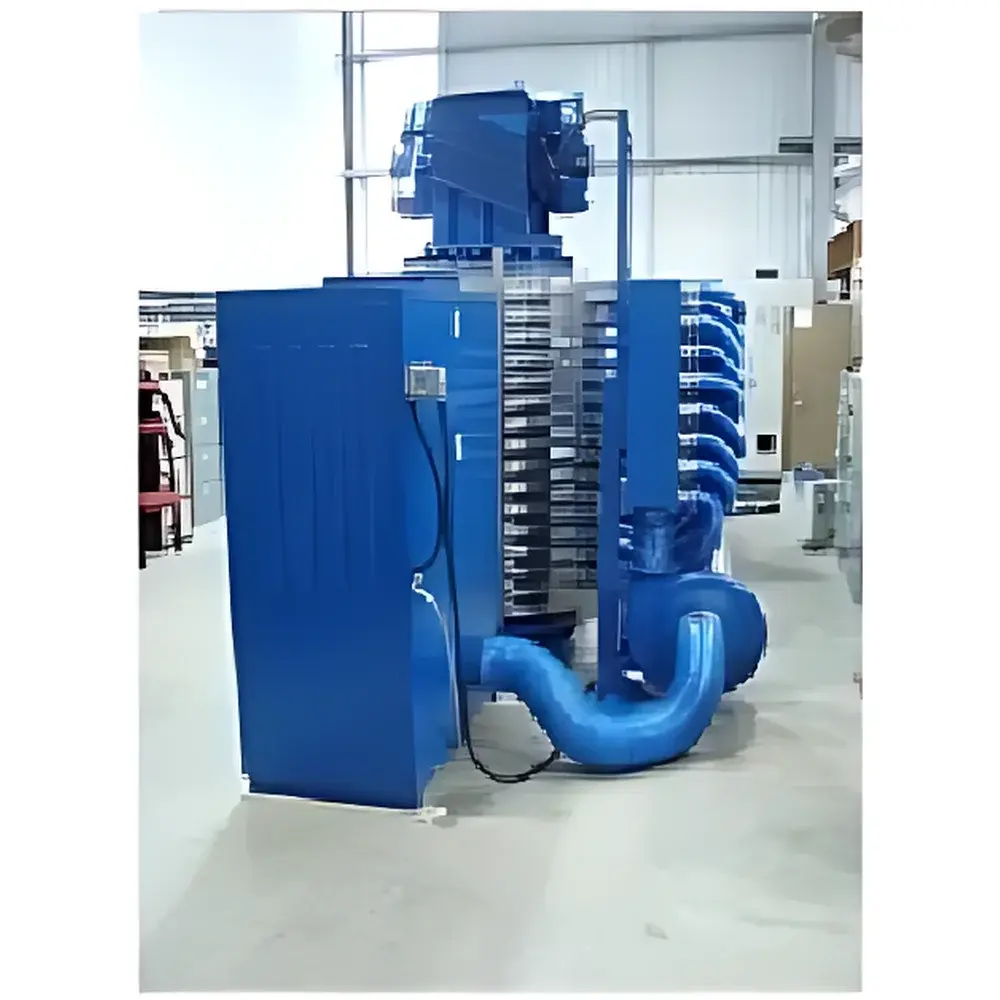
Barwell Curve Rubber Cooling Vibratory Sieve
| Brand | Barwell |
|---|---|
| Origin | United Kingdom |
| Model | Curve / Flat / Bowl |
| Dimensions (L×W×H) | 1000×1900×2580 mm (Curve), 1000×870×2800 mm (Flat), 1960×2250×2930 mm (Bowl) |
| Inlet Height | 320 mm |
| Stroke Length | 36.6 mm (Curve), 41 mm (Flat), 40 mm (Bowl) |
| Stroke Width | 233 mm (Curve), 205 mm (Flat), 265 mm (Bowl) |
| Stroke Pitch | 110 mm (Curve), 100 mm (Flat), 120 mm (Bowl) |
| Motor Power | 2 × 750 W |
| Vibration Frequency | 30–50 Hz |
| Air-Cooling Nozzles | Yes |
| Polycarbonate Cover | No (Curve), Yes (Flat), No (Bowl) |
Overview
The Barwell Curve Rubber Cooling Vibratory Sieve is an engineered component of the Barwell precision preforming system, designed specifically for post-extrusion thermal management and physical separation of hot rubber preforms in high-volume elastomer manufacturing environments. Operating synchronously with Barwell preformers, the unit applies controlled vibratory motion combined with directed ambient or forced-air cooling to rapidly reduce surface temperature, prevent premature agglomeration, and facilitate clean separation of individual preforms prior to downstream handling or curing. Its mechanical design adheres to the principles of linear-motion vibratory conveyance—utilizing dual eccentric-mass drive systems to generate consistent, low-amplitude, high-frequency oscillation across a rigid stainless-steel deck. This ensures uniform material residence time, minimal mechanical stress on thermally sensitive compounds, and repeatable thermal profiles critical for maintaining compound integrity and dimensional stability during the critical transition from molten to solid state.
Key Features
- Three configurable platform variants—Curve, Flat, and Bowl—engineered for distinct preform geometries and thermal mass requirements: Curve for general-purpose cylindrical or tapered preforms; Flat for gas-cooled, low-profile extrudates; Bowl for high-volume, large-section preforms such as shoe soles or industrial gaskets.
- Dual 750 W three-phase vibration motors delivering stable 30–50 Hz frequency range with adjustable amplitude control, enabling optimization for compound viscosity, green strength, and cooling rate.
- Stainless-steel sieve deck with precisely calibrated stroke geometry: stroke length (36.6–41 mm), stroke width (205–265 mm), and pitch (100–120 mm) are dimensionally matched to each model’s throughput and cooling envelope.
- Integrated forced-air cooling nozzles positioned along the vibratory path to maximize convective heat transfer without direct contact or moisture introduction—compatible with ambient air or externally regulated compressed air supply.
- Modular structural frame fabricated from powder-coated mild steel, rated for continuous industrial operation under ISO 14001-compliant manufacturing conditions and designed for integration into existing production lines via standardized mounting interfaces.
Sample Compatibility & Compliance
The Barwell Cooling Vibratory Sieve accommodates uncured natural rubber (NR), synthetic elastomers including SBR, EPDM, NBR, and thermoplastic vulcanizates (TPVs) in preform weights ranging from 5 g to 1.2 kg per piece. Deck aperture configurations can be customized to match preform diameter and aspect ratio, minimizing bounce-induced surface marking while ensuring full separation. All models comply with CE Machinery Directive 2006/42/EC, meet IP54 ingress protection rating for dust and splash resistance, and are constructed using materials compliant with REACH Annex XVII restrictions on hazardous substances. Electrical components conform to IEC 60204-1 safety standards, and vibration emission levels are documented per ISO 5349-1 for hand-arm exposure assessment where operator proximity is required during maintenance.
Software & Data Management
As a standalone mechanical process unit, the Barwell Cooling Vibratory Sieve operates without embedded firmware or digital control interface. Vibration frequency and airflow are manually adjusted via external variable-frequency drives (VFDs) and pneumatic regulators, permitting seamless integration into PLC-controlled production cells. For traceability in regulated environments (e.g., automotive Tier-1 suppliers operating under IATF 16949), auxiliary sensors—including inline air temperature probes, vibration amplitude transducers, and cycle-count relays—can be retrofitted and logged via third-party SCADA systems. Audit trails for maintenance intervals, motor current draw, and airflow pressure differentials support GLP-aligned equipment qualification protocols when deployed in R&D or pilot-scale validation labs.
Applications
- Cooling and de-tacking of extruded rubber preforms prior to automatic pick-and-place loading onto curing presses or conveyors.
- Separation of co-extruded multi-layer preforms (e.g., tread/base compounds) without interfacial shear damage.
- Surface drying of water-quenched preforms in tire component manufacturing to eliminate residual moisture before stacking or packaging.
- Pre-conditioning of preforms for subsequent robotic vision inspection—reducing thermal blur and improving edge contrast detection accuracy.
- Integration into automated rubber compounding lines compliant with Industry 4.0 architecture via OPC UA-compatible I/O modules.
FAQ
What distinguishes the Curve model from the Flat and Bowl variants?
The Curve model features a gently arced deck profile optimized for gravity-assisted flow and uniform cooling of standard cylindrical preforms; the Flat model uses a horizontal deck with integrated air nozzles suited for thin-section, gas-cooled extrudates; the Bowl model employs a deep, radial-concave geometry to retain and evenly distribute high-mass preforms such as molded shoe soles.
Can the vibration frequency be synchronized with upstream preformer cycle time?
Yes—via external VFD input signals (0–10 V or 4–20 mA), the dual motors can be phase-locked to preformer indexing signals, ensuring one-to-one correspondence between preform ejection and deck oscillation onset.
Is the unit suitable for use in cleanroom-class rubber processing environments?
While not ISO Class 5 certified, the sealed motor housings, absence of lubrication points on the deck, and optional polycarbonate guard (Flat model only) support deployment in ISO 8 (Class 100,000) environments typical of medical-grade elastomer manufacturing.
What maintenance intervals are recommended for continuous 24/7 operation?
Motor bearing inspection every 2,000 operating hours; vibration isolator bushing replacement every 12 months; air nozzle clearance verification weekly; structural bolt torque recheck quarterly per ISO 10816-3 vibration severity guidelines.






