
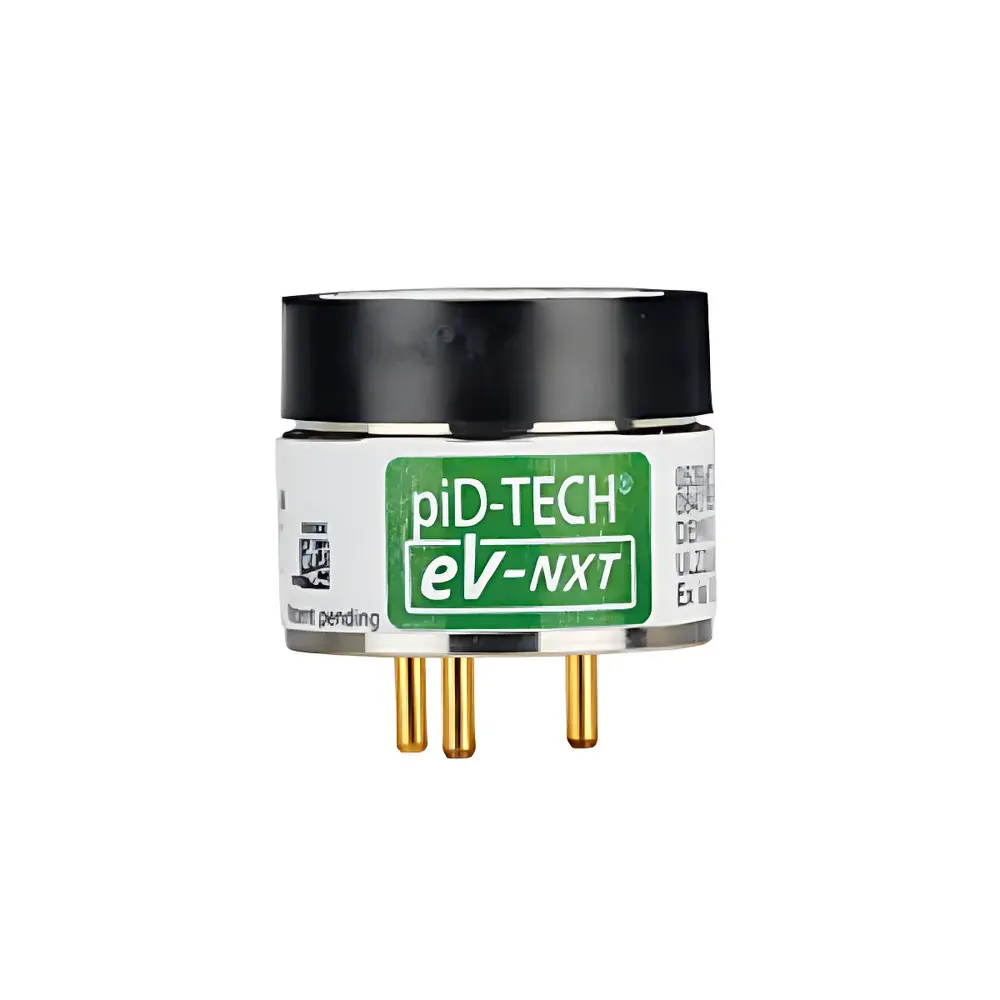
Baseline eV-NXT 045-110 PID Photionization Detector Sensor (Green Variant)
| Brand | Baseline |
|---|---|
| Origin | USA |
| Manufacturer Type | Authorized Distributor |
| Origin Category | Imported |
| Model | eV-NXT 045-110 |
| Price | Upon Request |
| Detection Range | 0–10,000 ppm |
| LOD | 500 ppb |
| T90 Response Time | < 3.5 s |
| Typical Sensitivity | 0.6 mV/ppm |
| Calibration Gas | 2000 ppm Isobutylene (standard) |
| Operating Temperature | –20 °C to +50 °C |
| Operating Humidity | 0–95% RH (non-condensing) |
| Power Supply | 3.3 V DC nominal |
| Power Consumption | < 80 mW (active mode) |
Overview
The Baseline eV-NXT 045-110 is a high-performance, green-variant photoionization detector (PID) sensor engineered for continuous, reliable volatile organic compound (VOC) monitoring in demanding environmental and industrial applications. Unlike conventional PIDs relying on fixed-lamp UV energy output and analog signal conditioning, the eV-NXT platform integrates a temperature-stabilized 10.6 eV krypton lamp, low-noise transimpedance amplifier architecture, and real-time baseline compensation algorithms. Its measurement principle is based on photoionization: VOC molecules entering the detection chamber absorb photons from the UV lamp, generating ion-electron pairs proportional to concentration. The resulting current is converted to a calibrated voltage output (mV/ppm), traceable to NIST-traceable isobutylene standards. Designed specifically for outdoor air quality networks, leak detection surveys, and confined-space entry pre-screening, this sensor delivers stable operation across wide ambient thermal and hygroscopic gradients—critical for unattended field deployments where condensation, diurnal temperature swings, and solar loading are routine.
Key Features
- Enhanced inter-sensor repeatability (±5% full-scale deviation at 2000 ppm isobutylene), enabling true plug-and-play replacement without site-specific recalibration
- Active baseline stabilization across –20 °C to +50 °C and 0–95% RH (non-condensing), minimizing humidity-induced drift and thermal hysteresis
- Ultra-low power consumption (< 80 mW at 3.3 V DC), supporting multi-year battery life in wireless sensor nodes and portable monitors
- Integrated self-diagnostics including lamp intensity monitoring, electrode contamination flagging, and open-circuit/short-circuit fault detection per UL 913 Class I, Division 1 requirements
- Fast T90 response time of < 3.5 seconds ensures timely detection of transient VOC plumes during fence-line monitoring or emergency response
- Green variant designation (045-110) denotes optimized spectral filtering and low-outgassing housing materials compliant with RoHS 3 and REACH SVHC screening protocols
Sample Compatibility & Compliance
The eV-NXT 045-110 detects >95% of common VOCs with ionization potentials below 10.6 eV—including benzene, toluene, xylene (BTX), styrene, acetone, ethanol, formaldehyde (with catalytic pre-converter), and chlorinated solvents such as trichloroethylene. It does not respond to methane, ethane, CO, CO₂, or H₂O vapor. The sensor meets intrinsic safety requirements per UL 913 (Class I, Division 1, Groups A–D) and carries ATEX/IECEx certification (II 1G Ex ia IIC T4 Ga). Its mechanical design conforms to IP67 ingress protection when integrated into certified housings. All calibration and verification procedures align with EPA Method TO-15 and ASTM D5466–22 for ambient air VOC sampling instrumentation. Data integrity supports GLP-compliant audit trails when paired with compliant data loggers.
Software & Data Management
The sensor outputs a ratiometric analog voltage (0–3 V) proportional to VOC concentration, compatible with standard 24-bit ADC interfaces used in OEM gas analyzers and IoT edge gateways. Baseline provides optional digital interface modules (I²C and UART) featuring onboard temperature-compensated linearization and non-volatile memory for factory calibration coefficients. Firmware supports configurable alarm thresholds, moving-average smoothing (1–60 s window), and diagnostic register polling. When deployed in networked air quality platforms, raw sensor outputs integrate natively with EPA AirNow-compatible APIs and comply with ISO/IEC 17025 data handling requirements for accredited laboratories. Audit logs include timestamped lamp-on duration, zero-check cycles, and fault-event counters—fully traceable under FDA 21 CFR Part 11 if used in pharmaceutical facility environmental monitoring.
Applications
- Urban and regional ambient air quality monitoring networks (AQMS) targeting BTEX, aldehydes, and oxygenated VOCs
- Industrial fenceline monitoring per EPA OTM-40 and EU Industrial Emissions Directive (IED) Annex VI compliance
- Soil vapor intrusion assessment and remediation verification at brownfield sites
- Real-time fugitive emission detection during LDAR (Leak Detection and Repair) programs
- Portable personal exposure monitors for HSE officers in petrochemical, paint, and coating facilities
- Indoor air quality (IAQ) dashboards in smart buildings and cleanrooms requiring sub-ppm VOC resolution
FAQ
What VOCs does the eV-NXT 045-110 detect?
It responds to VOCs with ionization potentials ≤10.6 eV, including aromatics, ketones, esters, amines, and many halogenated compounds. It does not detect permanent gases (e.g., CH₄, CO₂) or highly saturated hydrocarbons.
Is field calibration required?
No routine field calibration is needed due to inter-unit repeatability and embedded baseline correction; however, quarterly bump testing with 2000 ppm isobutylene is recommended per OSHA 1910.120 and IEC 60079-29-1.
Can it operate in high-humidity outdoor environments?
Yes—the sensor’s proprietary electrode passivation and sealed optical path maintain stable baseline performance up to 95% RH non-condensing, validated per ISO 9001 environmental stress testing protocols.
Does it support hazardous area installation?
Yes—when installed in an approved IS-rated enclosure, it complies with UL 913 Class I, Div 1 and ATEX Zone 0/1 requirements for continuous operation in explosive atmospheres.
How is long-term stability verified?
Baseline provides a 24-month stability warranty backed by accelerated life testing (8,000 lamp-hours @ 25 °C, 60% RH), with drift < ±2% FS/year typical under continuous operation.







