
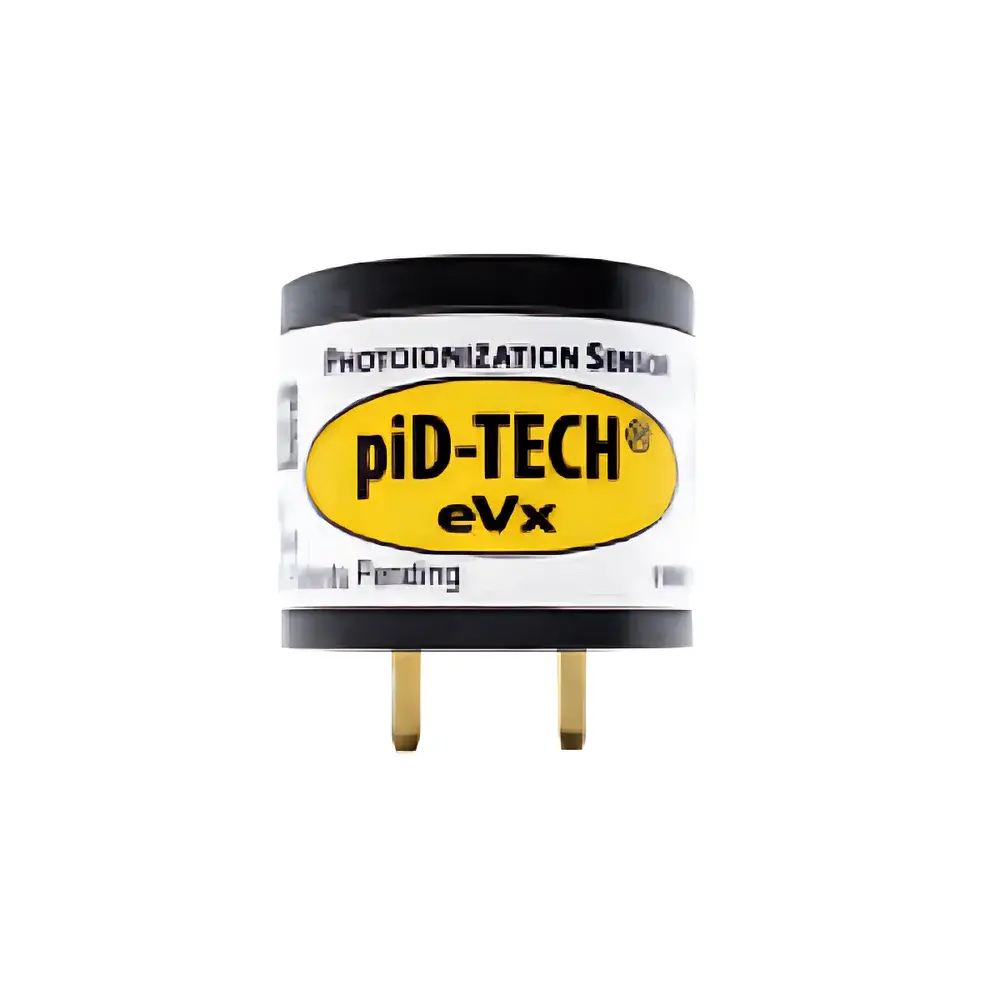
Baseline piD-TECH® eVx™ 045-013 Intrinsically Safe Photoionization Detector (PID) Sensor – Yellow Housing
| Brand | Baseline |
|---|---|
| Origin | USA |
| Manufacturer Type | Authorized Distributor |
| Origin Category | Imported |
| Model | piD-TECH® eVx™ 045-013 |
| Price | Upon Request |
| Detection Range | 20 ppm |
| Minimum Detectable Quantity (MDQ) | 1.5 ppb |
| T90 Response Time | < 4 s (typical) |
| Housing Color | Yellow |
| Certification | UL, CAN/CSA, ATEX, IECEx |
| Sensor Architecture | 4-Series Compatible |
| Lamp Type | Long-Life UV Lamp (10.6 eV) |
| Internal Regulation | Dual Linear Voltage Regulators |
| Filtration | Dual-Stage Particle Filter |
| Humidity Compensation | Electrode-Based Suppression |
| Thermal Drift | Negligible |
| Maintenance | Field-Serviceable & Cleanable |
Overview
The Baseline piD-TECH® eVx™ 045-013 is an intrinsically safe, yellow-housed photoionization detector (PID) sensor engineered for high-fidelity detection of volatile organic compounds (VOCs) in ambient air and industrial process streams. Operating on the principle of ultraviolet (UV) photon-induced ionization—typically at 10.6 eV—the sensor generates a current proportional to the concentration of ionizable VOCs (e.g., benzene, toluene, xylene, styrene, acetone, isopropanol, and many halogenated hydrocarbons). Unlike catalytic bead or metal oxide semiconductor sensors, PIDs provide non-destructive, real-time, and compound-class-selective measurement without cross-sensitivity to CO₂, methane, or common inorganic gases. This model is specifically optimized for OEM integration into portable, transportable, and fixed-mount gas monitoring systems requiring regulatory-grade reliability, low-power operation, and compatibility with legacy 4-series sensor footprints.
Key Features
- Intrinsically safe design certified to UL 913, CAN/CSA C22.2 No. 157, ATEX II 1G Ex ia IIC T4 Ga, and IECEx Ex ia IIC T4 Ga standards—enabling deployment in Class I, Division 1 hazardous locations.
- Yellow housing variant (model 045-013) facilitates rapid visual identification in multi-sensor arrays and complies with ANSI Z535.4 color-coding conventions for warning-level instrumentation.
- Dual-stage particulate filtration minimizes fouling from dust, mist, and aerosols—extending calibration interval stability and reducing maintenance frequency in field-deployed applications.
- Integrated lamp restart circuit ensures consistent, repeatable lamp ignition across temperature and voltage fluctuations—critical for unattended operation in remote or battery-powered instruments.
- Electrode-based humidity suppression mitigates signal drift caused by condensation or high-RH environments (up to 95% RH non-condensing), preserving baseline integrity without active heating or desiccant cartridges.
- Onboard dual linear voltage regulators stabilize lamp bias and amplifier supply rails—delivering < ±0.5% full-scale signal variation over operating temperature (–20 °C to +50 °C).
- Field-serviceable optical chamber and replaceable UV lamp (rated for >12,000 hours) support lifecycle maintenance beyond standard warranty periods—reducing total cost of ownership for OEM integrators.
Sample Compatibility & Compliance
The eVx™ 045-013 detects VOCs with ionization energies below 10.6 eV, including aromatic, aliphatic, unsaturated, and chlorinated compounds. It is not responsive to methane, ethane, formaldehyde, or compounds with IE > 10.6 eV (e.g., methanol, acetonitrile). The sensor meets performance criteria outlined in ASTM D5403 (standard test method for VOC content by PID), ISO 16000-18 (indoor air—determination of VOCs), and EPA Method TO-17 (for screening-level assessment in ambient monitoring). Its intrinsic safety certifications align with global hazardous area directives, enabling seamless integration into systems subject to FDA 21 CFR Part 11 (for electronic records in pharmaceutical cleanrooms) and EU Machinery Directive 2006/42/EC.
Software & Data Management
While the eVx™ 045-013 is an analog-output sensor (0–5 V or 4–20 mA configurable), Baseline provides OEM integration kits including digital interface modules supporting Modbus RTU, RS-485, and I²C protocols. Firmware libraries include automatic zero-tracking algorithms, temperature-compensated span correction, and diagnostic registers for lamp health, filter saturation, and signal-to-noise ratio (SNR) monitoring. All firmware updates comply with IEC 62443-4-2 security requirements. Audit trails generated during calibration or configuration events meet GLP/GMP data integrity expectations when paired with compliant host systems.
Applications
- Portable personal exposure monitors for industrial hygiene professionals conducting OSHA-permissible exposure limit (PEL) assessments.
- Fixed-site perimeter monitoring at petrochemical facilities, landfills, and wastewater treatment plants per EPA 40 CFR Part 60 Subpart OOOOa.
- OEM integration into HVAC IAQ controllers for real-time TVOC feedback in LEED-certified commercial buildings.
- Environmental emergency response units requiring rapid VOC screening during hazmat incidents (NFPA 472-compliant).
- Research-grade atmospheric chemistry instrumentation where low MDQ (1.5 ppb) and sub-4-second T90 enable time-resolved plume mapping.
FAQ
What VOCs can the eVx™ 045-013 detect?
It responds to VOCs with ionization energies ≤10.6 eV—including BTEX, styrene, chloroform, and many ketones and esters—but not methane, CO, H₂S, or highly polar compounds like ethanol or formaldehyde.
Is calibration required before first use?
Yes. Baseline recommends initial 3-point calibration using certified isobutylene gas standards traceable to NIST, followed by quarterly verification under typical field conditions.
Can this sensor operate in high-humidity environments?
Yes. Its electrode-based humidity compensation enables stable operation up to 95% RH non-condensing without external drying systems.
What is the expected lamp lifetime?
The UV lamp is rated for ≥12,000 hours of continuous operation; lamp status is monitored via integrated diagnostics and reported through the host system’s register map.
Does the yellow housing affect optical performance?
No. The housing material is UV-transparent polycarbonate with IR-blocking additives; spectral transmission above 100 nm remains unaffected, and color coding serves only for mechanical and operational identification.
Related Products







